
A rejected Access to Work application can leave you unsure what comes next, particularly if the decision does not clearly explain its reasoning. If you are looking for what to do if Access to Work application is rejected, start with the letter: it can help you understand the outcome, but it does not establish that support is impossible.
It is understandable to feel uncertain about what information may help or how to manage support at work while the decision remains unresolved. This guide explains how to read the correspondence, organise relevant information about your work-related needs and identify a practical next step. IntegraSense’s Access to Work consultancy can help you structure a clear account of those needs. Specialist communication support can also help you express or discuss your requirements.
Key Takeaways
- Separate the decision outcome from the reasons given, and note any questions the letter leaves unanswered.
- Organise relevant information around your work tasks, the barriers you encounter and the support requested.
- Use the instructions in your current correspondence to identify an appropriate next step, without assuming what the response will be.
- Consider Access to Work consultancy or communication support to help explain your work-related needs clearly.
Access to Work decision rejected: understand what the letter says
A rejection can leave you uncertain about whether the support you need is still possible. The decision letter is the starting point for understanding the outcome, not proof that support can never be considered. Before preparing a response, separate what the decision confirms from the reasons it gives and any questions it leaves open.
In brief: the outcome tells you what was decided; the reasons explain the decision; anything the letter does not address is a point to clarify. This distinction helps you avoid treating an unclear explanation as a complete account of your work-related needs.
Read the correspondence carefully and note its exact wording. Avoid relying on assumptions about why support was declined. A decision may address one part of a request without explaining how other tasks, barriers or communication needs were considered.
Which details in the decision letter should you identify?
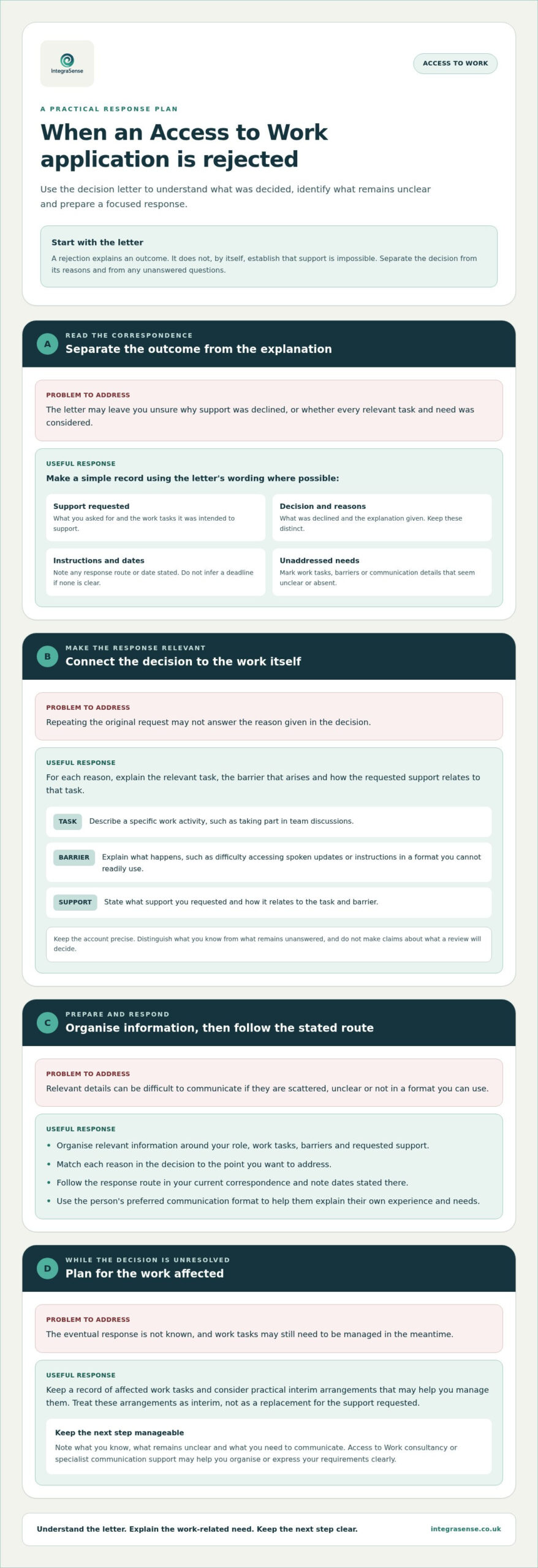
Make a simple record of the request and response. Use the letter’s wording where possible, then mark any details that seem absent or unclear:
- Support requested: note what you asked for and which work tasks it was intended to support.
- Decision and reasons: record what was declined and the explanation given, keeping the outcome distinct from its rationale.
- Instructions and dates: note any response route or date stated in the correspondence. Do not infer a deadline if none is clear.
- Unaddressed needs: identify relevant work tasks, barriers or communication details that the letter does not appear to discuss.
For example, if your request described communication support for meetings, check whether the response addresses those meetings and the specific communication barriers involved. Note the point that is missing or unclear rather than assuming the decision is incorrect. This helps you see what has been considered and what may need a clearer explanation, giving you a more useful foundation for your next step.
How to respond to a rejected Access to Work application
A clear response starts with the decision, not a fresh version of the original application. First identify the reason given. Then gather information that addresses it. Finally, follow the response route in your current correspondence and note any dates stated there rather than assuming a deadline.
Information is most useful when it answers the decision’s stated reasons, rather than simply repeating the original request. This keeps your response focused and makes the link between your work and the support you need easier to follow.
How can you make your case clear and relevant?
Describe what happens during specific work tasks, what barrier arises and how the requested support relates to that task. For instance, explain how you access spoken updates during team discussions, or what happens when instructions are shared in a format you cannot readily use. Include only relevant details, and distinguish what you know from what remains unanswered.
- Clarify: match each reason in the decision to the point you want to address.
- Gather: organise relevant information around tasks, barriers and the support requested.
- Respond: follow the route in your correspondence and present information in a format you can use to communicate accurately.
Use the person’s preferred communication format when preparing or discussing the response. This can help them explain their own experience and needs clearly. Keep the account precise: describe the effect on work tasks, but do not make claims about what a review will decide.
IntegraSense’s Access to Work consultancy can help organise a clear account of work-related support needs and communication requirements.
Plan your next steps and get support with Access to Work
While you wait for a response or consider what the correspondence asks you to do, plan for more than one possibility. The decision may change, remain the same or leave points that need clarification. None of these outcomes can be assumed in advance. Keep a record of the work tasks affected and consider practical arrangements that may help you manage them in the meantime. Treat these as interim arrangements, not as a replacement for the support requested.
When can specialist consultancy or communication support help?
Access to Work consultancy can help you organise information about your role, the barriers you encounter and the support you are seeking into a clear account. That structure can also help you prepare to discuss your needs, without suggesting that a particular decision will follow. IntegraSense provides Access to Work consultancy and specialist communication services for people who need support to express or discuss their requirements.
Communication support may be useful if you need to explain your experience in a format that works for you. For example, you may want support to communicate your needs during a discussion about work-related support. The focus is on helping you convey your requirements clearly, not speaking over you or predicting how your application will be decided.
Keep the next step manageable: note what you know, what remains unclear and what you need to communicate. IntegraSense can help you organise your work-related support needs or consider how to express them clearly.
Take the next step with a clear plan
A decision about work-related support can affect how you approach your role, but you do not need to resolve every question at once. Focus on the point that needs attention now: understanding the correspondence, preparing a response or communicating the support you need. Ground your next action in the information available, and adjust your plan as further details emerge.
If you are considering what to do if Access to Work application is rejected, a clear conversation can help you organise your thoughts and identify a practical way forward. IntegraSense can discuss your situation and the support you need to communicate your requirements. Contact IntegraSense to discuss Access to Work support.
Frequently Asked Questions
Can I reapply after an Access to Work application is rejected?
A new application may not be the only route, and whether it is appropriate depends on your circumstances and the current process. Check the decision correspondence for instructions before starting another application. If your role, working arrangements or support needs have changed, note what is different and when it changed so you can explain the current situation accurately.
How long does it take to hear back after responding to a rejection?
No response timeframe can be promised here. The time taken may depend on your circumstances and the process being followed. Keep a record of when you sent your response and any subsequent contact. If the correspondence does not explain what to expect next, use its stated contact route to ask for clarification.
Can I provide more information after an Access to Work decision?
Whether you can provide more information depends on the decision and the current process. Check the correspondence for instructions about submitting information or requesting a review. If you can add material, make each item relevant and explain what it clarifies, such as how a particular work task is affected. Further information does not guarantee a different decision.
Does a rejected application mean I cannot have workplace support?
A rejection concerns the Access to Work request considered through that process. It does not, by itself, settle every possible workplace arrangement. You could discuss practical options with the relevant people at work, such as how meeting information is shared or tasks are organised. Consider what information is appropriate to share, and check current guidance before making assumptions about funding.