
Planning deafblind interpreting services starts with the person, not the meeting. In a professional setting, it can be difficult to know what Deafblind interpreting involves or what information will help shape an assignment. Communication preferences matter, so planning should make space for them from the beginning.
This guide explains the interpreter’s role, distinguishes interpreting from assessment and shows how to prepare by considering the purpose, setting and participants. It also outlines how IntegraSense provides specialist support for complex professional contexts. Use the practical points below to plan communication support around the interaction and the person taking part.
Key Takeaways
- Deafblind interpreting is planned around the person’s communication preferences and the interaction, rather than a single standard method.
- Before arranging support, clarify the assignment’s purpose, setting and participants, alongside the person’s preferred ways to communicate.
- Share relevant context, such as the agenda, likely speakers and how information will be presented, to help shape support to the interaction.
- IntegraSense provides specialist communication support for complex professional settings across health, education and the public sector.
What Deafblind interpreting services provide in professional settings
Deafblind interpreting is specialist communication support shaped around the person, the interaction and its purpose. In a professional meeting, an interpreter may convey what participants say and relevant information that is not spoken, such as who has entered the room or how someone is responding. The support helps the person access the communication taking place while keeping their established preferences central.
There is no single method that suits every Deafblind person. Communication may involve speech, sign, written formats or other approaches, depending on the individual and context. IntegraSense’s specialist communication support is tailored to the assignment. Deafblind interpreting, British Sign Language (BSL) interpreting and International Sign interpreting are distinct specialisms with different purposes.
How communication preferences shape the interpreting assignment
Start with what the person already uses and finds effective. Their established communication methods, preferences for turn-taking and requirements for receiving information should guide preparation. If the person communicates through hands-on signing, for example, that preference should inform the arrangement. In this method, the person places their hands over the interpreter’s hands to feel the signs. It is one possible approach, not a default for every assignment.
Interpreting is distinct from assessment. The interpreter supports communication during an interaction. A Deafblind Assessment can help establish or understand a person’s communication profile and support needs. Keeping these purposes separate makes it easier to identify the right service. A meeting may need an interpreter to convey contributions and relevant visual information, while an assessment focuses on understanding how communication support should be shaped.
How to prepare for a Deafblind interpreting assignment
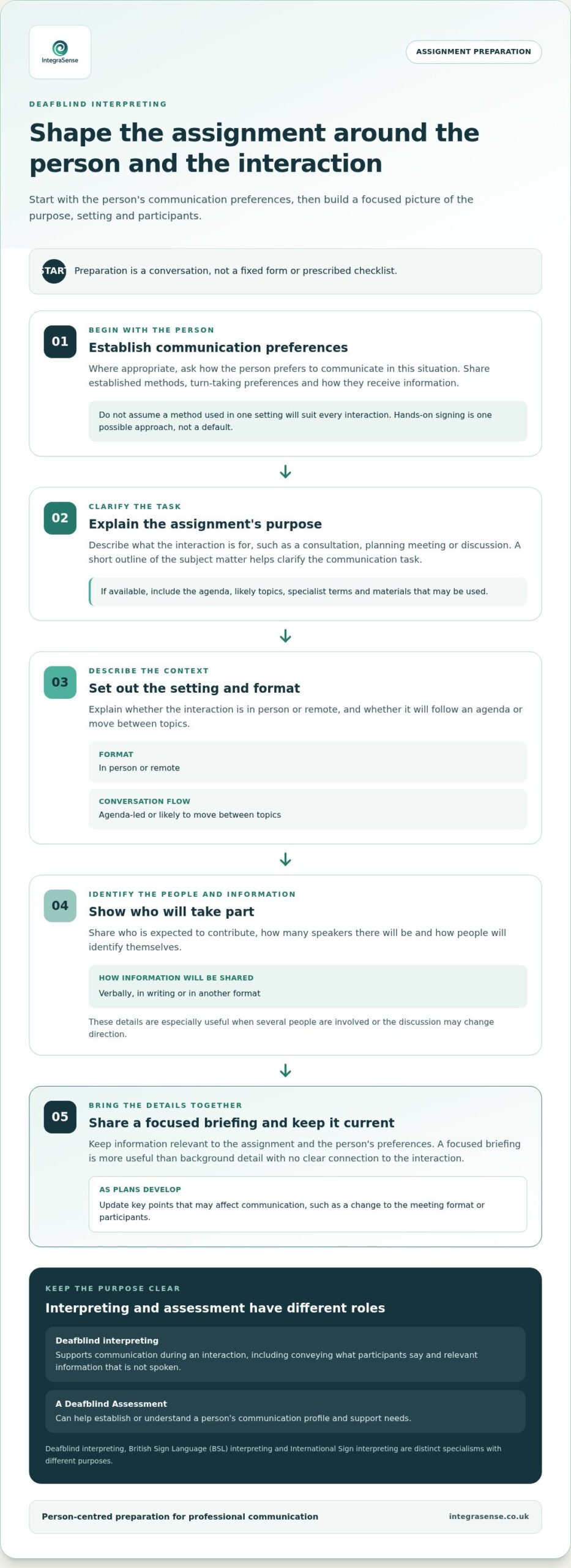
Good preparation connects the person’s communication preferences with the purpose and practical context of the interaction. Establish the person’s preferences, clarify the assignment purpose, describe the setting and identify who will take part. These details help build a useful picture of the interaction and shape support around its demands.
What to share when arranging communication support
Begin with the person’s established communication preferences. Where appropriate, ask the person directly how they prefer to communicate in this situation. Share the methods they use, any preferences for turn-taking and relevant ways they receive information. Do not assume that a method used in one setting will suit every interaction.
Next, explain what the assignment is for, such as a consultation, planning meeting or discussion. A short description of the subject matter can help clarify the communication task. If there is an agenda, share the topics likely to be covered and flag any specialist terms or materials that may be used.
Describe the setting and participants. Explain whether the interaction is in person or remote, who is expected to contribute and whether the conversation will follow an agenda or move between topics. Practical details can include the number of speakers, how people will identify themselves, and whether information will be shared verbally, in writing or in another format. These points are particularly useful when several people are involved or the discussion is likely to change direction.
Keep the information relevant to the assignment and the person’s preferences. A focused briefing is more useful than a large volume of background detail with no clear connection to the interaction. As plans develop, update the key points that may affect communication, such as a change to the meeting format or participants.
For Deafblind interpreting, this context helps align support with the interaction rather than relying on assumptions. Preparation is a conversation, not a fixed form or prescribed checklist. Where an assignment is complex, discussing its purpose, setting and communication requirements with IntegraSense’s specialist communication support team can help shape the arrangement to its professional context.
Working with IntegraSense for specialist Deafblind interpreting
Professional assignments can involve several people, specialist subject matter and information shared in different ways. IntegraSense provides Deafblind interpreting and specialist communication support shaped to the person’s communication preferences and the context of the interaction. This support is relevant across health, education and public-sector settings, as well as other complex professional environments where the purpose and format of communication vary.
The support needed depends on the person and the assignment, not a fixed arrangement. A professional discussion, appointment and group meeting can each have different communication demands. IntegraSense’s multidisciplinary consultancy works with individuals and professionals across these contexts, with attention to the communication requirements of the specific assignment.
From assignment context to a clear next step
Planning brings together the person’s preferences and the practical shape of the interaction. Sharing relevant information about the purpose, setting and participants gives IntegraSense a clear starting point for tailoring support. Consider what the interpreter needs to understand before the interaction, what information the person needs access to during it, and how participants can make the conversation easier to follow.
Explore IntegraSense’s specialist communication and interpreting services to learn more about support for professional contexts. If you are arranging interpreting, share the assignment’s purpose and communication requirements with IntegraSense.
Plan the next conversation with the person at its centre
Every assignment is an opportunity to make communication support responsive to the person and the purpose of the interaction. Keep the person’s preferences visible as plans develop. Consider how the discussion will work, who needs to be involved and what context the interpreter should understand. This gives the arrangement a clear starting point without assuming one format will suit every conversation.
If you are organising interpreting, bring together the person’s preferences and the key details of the assignment. Contact IntegraSense to discuss Deafblind interpreting support and the communication needs of your professional setting.
Frequently Asked Questions
Does every Deafblind person use the same communication method?
No. Communication preferences differ from person to person, and someone may use different methods for conversation and written information. Avoid making assumptions based on a person’s sight or hearing alone. Find out how the person prefers to communicate in the specific interaction and use that information to guide planning.
Can Deafblind interpreting support a group meeting?
Yes. Deafblind interpreting can support communication in a group meeting. Organisers can help make the discussion easier to follow by introducing speakers by name and role, managing turn-taking and signalling topic changes verbally. Sharing an agenda and participant list can also provide useful context for the interpreter and the person taking part.
Is a Deafblind assessment the same as interpreting?
No. A Deafblind Assessment focuses on understanding a person’s communication and support needs, while interpreting conveys communication during a particular interaction. An assessment can inform wider support planning; interpreting enables participation in a meeting or appointment. These services have different purposes, so it is useful to be clear about the need when arranging support.