
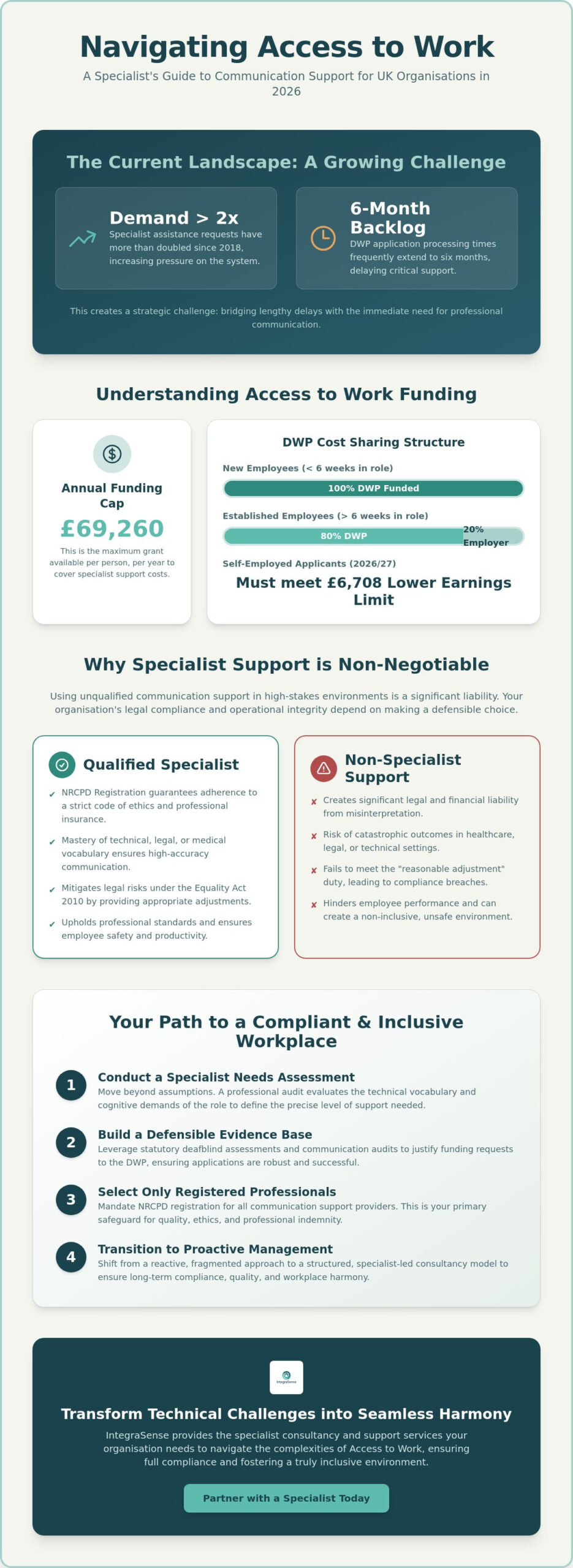
This guide provides the specialist insight necessary to navigate the 2026 regulatory landscape, ensuring your organisation secures qualified BSL or Deafblind interpreters while maintaining rigorous compliance with the Equality Act 2010. We will examine the current £69,260 annual funding cap, clarify the 80/20 cost-sharing structures for established employees, and outline the precise steps required to integrate expert communication support into your operational framework. By moving away from fragmented support systems toward a structured, specialist-led approach, you can transform technical challenges into seamless workplace harmony.
Key Takeaways
- Understand the specific scope of DWP-funded grants to ensure that Deaf, hard of hearing, and deafblind employees receive the precise specialist assistance required for their professional roles.
- Navigate the application process for Access to Work communication support UK by identifying the professional credentials necessary to handle high-stakes technical and legal vocabulary.
- Evaluate the critical necessity of NRCPD registration to mitigate the legal and operational risks associated with using unqualified or non-specialist communication providers.
- Learn how to leverage statutory deafblind assessments to establish a defensible evidence base for securing appropriate funding levels and tailored workplace adjustments.
- Transition from reactive support management to a proactive consultancy model with IntegraSense to ensure long-term system harmony and regulatory compliance.
What is Access to Work Communication Support in the UK?
Access to Work (AtW) is a publicly funded employment support programme managed by the Department for Work and Pensions (DWP). It serves as a financial bridge, providing grants that enable individuals with disabilities or health conditions to enter and remain in the workforce. Within this framework, the “Communication Support” element is a critical pillar for Deaf, hard of hearing, and deafblind professionals. It ensures that environmental barriers to information exchange are dismantled through high-level human intervention, allowing for seamless integration into professional settings.
This support aligns with the broader legal framework surrounding Disability in the United Kingdom, specifically the Equality Act 2010. While employers have a statutory duty to provide “reasonable adjustments,” AtW provides the funding for specialist services that go beyond what’s considered reasonable for a business to absorb. The scope is comprehensive, covering everything from British Sign Language (BSL) interpreting and specialist note-taking to deafblind manual interpreters and lip-speakers.
Eligibility for Communication Support Grants
Securing Access to Work communication support UK is possible for employees, self-employed individuals, and those about to start a new role. The grant isn’t a benefit; it’s a productivity tool. For individuals who’ve been in their job for less than six weeks, the DWP typically pays 100% of the approved costs. For existing employees, a cost-sharing arrangement usually applies, where the DWP pays 80% and the employer contributes the remaining 20%. Self-employed applicants must meet a Lower Earnings Limit of £6,708 per year for the 2026/2027 period to qualify.
Types of Specialist Communication Funded
The DWP distinguishes between various methods of interaction based on the specific sensory needs of the applicant. While BSL is a primary focus, more complex needs require specialist deafblind communication methods, such as tactile signing or the manual alphabet. To ensure the grant covers the necessary level of expertise, a communication audit is often required. These audits evaluate the technical vocabulary and cognitive demands of the role. IntegraSense provides these specialist consultancy services to help organisations identify the exact level of support required to maintain both operational efficiency and regulatory compliance.
Selecting the Right Specialist: BSL, Deafblind, and Complex Needs
Selecting a specialist for Access to Work communication support UK is a decision that impacts both professional safety and legal compliance. Many organisations mistakenly believe that any individual with basic signing skills can facilitate a high-level meeting. This assumption is dangerous. Technical, medical, and legal environments require an interpreter with a deep mastery of industry-specific vocabulary and the cognitive stamina to maintain accuracy over long periods. National Registers of Communication Professionals working with Deaf and Deafblind People (NRCPD) registration isn’t just a badge; it’s a guarantee that the practitioner adheres to a strict code of ethics and maintains professional indemnity insurance.
For deafblind employees, the requirements become even more nuanced. Support often involves tactile signing or close-proximity interpreting, requiring a specialist who understands the physical and sensory dynamics of the interaction. While the official Access to Work guidance provides the framework for funding, the responsibility for selecting a competent professional rests with the employer and the individual. It’s about finding a partner who understands the intricate balance between human perception and technical precision.
The Risks of Non-Specialist Support
Inaccurate communication in high-stakes environments like healthcare or education can lead to catastrophic outcomes. Misinterpreting a clinical instruction or a legal nuance doesn’t just hinder productivity; it creates significant liability. To mitigate this, organisations must adopt a “defensible decision-making” approach. This means choosing providers based on verified competencies rather than cost alone. It’s about ensuring that every interaction is robust, accurate, and legally sound.
Professional Supervision and Quality Assurance
High-quality interpreting is emotionally and cognitively demanding. To maintain these standards, BSL interpreter professional supervision is essential. This practice allows interpreters to reflect on their work, manage vicarious trauma, and ensure ethical boundaries remain intact. At IntegraSense, we provide professional supervision for interpreters as part of our commitment to External Quality Assurance (EQA). This structured oversight ensures that the support provided remains at the highest professional standard, protecting both the employee and the organisation. If you’re unsure about the level of expertise your team requires, our consultants can help you audit your communication needs to ensure total alignment with your operational goals.
Implementing Robust Support with IntegraSense
Effective implementation of Access to Work communication support UK requires more than just a successful application; it demands a systematic integration into your organisation’s governance. Reactive adjustments often lead to friction and missed deadlines. Instead, a proactive approach ensures that communication specialists are woven into the fabric of professional practice. IntegraSense acts as a visionary partner in this process, moving beyond simple vendor status to provide a complete, holistic journey from initial conceptualization to final execution. This ensures that technical depth never overwhelms the user, but rather empowers them to manage their space effectively.
For those with dual sensory loss, the path to equity begins with a statutory deafblind assessment. These assessments are vital for building a defensible evidence base when approaching the DWP. According to the Access to Work official guidance, the grant aims to cover costs beyond reasonable adjustments, but without a specialist assessment, the true depth of a person’s needs may be underestimated. Our consultants bridge this gap, ensuring that funding applications reflect the real-world complexities of the role and the high-level expertise required for success.
Consultancy and Accessibility Audits
Proactive organisations utilise accessibility audits to identify environmental and systemic barriers before they impact performance. A multidisciplinary approach to workplace inclusion doesn’t just solve problems; it prevents them. By auditing your current communication infrastructure, we help you create a resilient environment where every employee can contribute at their highest level. This strategic foresight transforms workplace equity from a compliance checkbox into a tangible operational advantage.
Securing Specialist Support Today
Partnering with IntegraSense for AtW support is a methodical process designed for precision and long-term viability. We assist in the initial application, specialist provider selection, and ongoing quality assurance. If communication barriers arise or disputes occur, our expertise in conflict resolution and mediation provides a logical path toward resolution. This ensures that system harmony is maintained, allowing your team to focus on their core mission while we handle the technical complexities of communication equity. To begin your journey toward an optimised workplace, you can contact our specialist team for a confidential consultation.
Architecting a Future of Communication Equity
Securing effective Access to Work communication support UK is a strategic investment in organisational resilience. We’ve explored how the intersection of DWP funding and specialist expertise creates a robust framework for genuine workplace inclusion. By prioritising NRCPD registered BSL interpreters and utilizing statutory deafblind assessments, you move beyond mere compliance toward an environment of total system harmony. This proactive approach effectively mitigates the operational risks of miscommunication while ensuring every professional interaction remains precise, authoritative, and legally sound.
In addition to human expertise, the future of workplace accessibility is increasingly being shaped by sophisticated AI tools that enhance semantic understanding and voice recognition. To see how these technologies are advancing communication equity globally, visit Ubestream Inc.
IntegraSense stands ready to guide you through this complex landscape as a dependable partner. Our team of Specialist Deafblind Assessors and NRCPD Registered BSL Interpreters provides the expertise in defensible decision-making required to navigate the intricacies of modern workplace adjustments. We don’t just facilitate communication; we provide the strategic insight needed to empower your workforce and manage your professional spaces with absolute clarity. It’s time to transition from reactive problem-solving to a future of optimized accessibility.
Contact IntegraSense today to discuss your specialist communication requirements and take the first step toward a more accessible, high-performing workplace. Building an inclusive environment is an achievable goal when you have the right specialists by your side.
Frequently Asked Questions
How much communication support can I get through Access to Work?
The maximum annual award for Access to Work communication support UK is currently capped at £69,260. This funding is designed to cover the cost of specialists that exceed an employer’s standard duty for reasonable adjustments. For new employees or self-employed individuals, the DWP typically funds 100% of the approved costs. For those in a role for more than six weeks, a cost-sharing arrangement usually requires the employer to contribute 20% of the costs.
Does Access to Work pay for BSL interpreters in every meeting?
Yes, the grant generally covers BSL interpreters for all work-related activities, including meetings, training sessions, and internal briefings. The goal is to ensure that communication barriers don’t hinder an employee’s ability to perform their duties or progress in their career. If your role involves frequent high-stakes interactions, the DWP can approve a budget that facilitates regular, consistent support. It’s vital to outline these requirements clearly during your application to ensure the funding matches your professional reality.
What is the difference between a BSL interpreter and a Deafblind communicator?
A BSL interpreter translates spoken language into visual signs, whereas a Deafblind communicator uses tactile methods to facilitate information exchange. Individuals with dual sensory loss often require specialized support such as tactile signing or the manual alphabet, which involves physical contact. Selecting the correct specialist depends on the individual’s specific sensory profile. IntegraSense provides expert assessments to identify the most effective communication strategy, ensuring that the support provided aligns with the professional’s unique perceptual needs.
Can an employer be forced to pay if Access to Work doesn’t cover the full cost?
Employers have a statutory duty under the Equality Act 2010 to provide reasonable adjustments, which remains in effect regardless of grant limitations. If the cost of specialist communication support exceeds the annual cap or the DWP’s contribution, the employer must assess if the remaining balance constitutes a reasonable adjustment. Failing to provide necessary support can lead to significant legal and operational liabilities. Our consultancy services help organisations navigate these responsibilities to ensure both regulatory compliance and a harmonious workplace environment.