
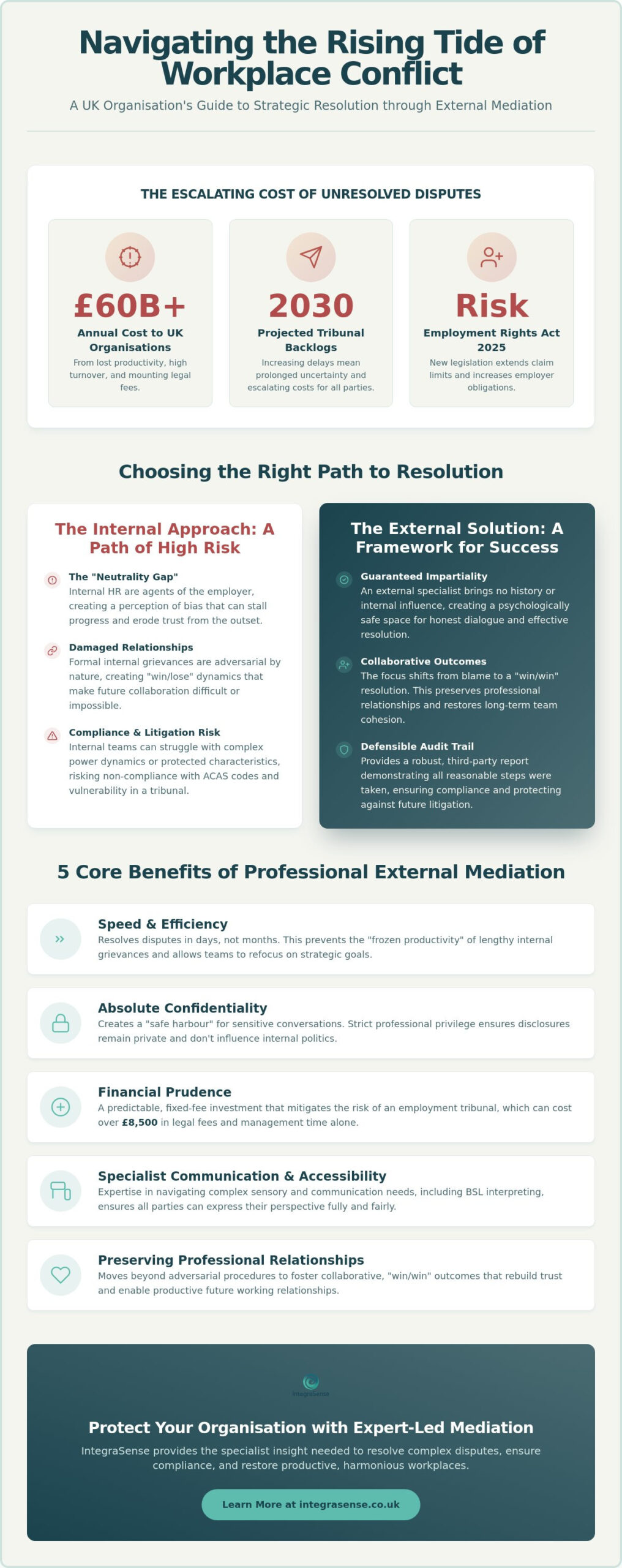
Workplace conflict now costs UK organisations over £60 billion annually. This staggering figure reflects a combination of diminished productivity, high staff turnover, and the mounting legal costs associated with a tribunal system where backlogs now stretch toward 2030. With the Employment Rights Act 2025 extending claim limits and increasing employer obligations, the benefits of external mediation for workplace disputes have become central to strategic risk management. Relying on internal investigations often triggers concerns regarding perceived bias, yet the alternative of a formal grievance can be equally damaging to long-term team cohesion.
It’s natural to worry that unresolved friction will eventually lead to a costly employment tribunal or a permanent erosion of your professional culture. This article demonstrates how external mediation provides a neutral, defensible, and cost-effective framework for resolving complex conflicts while protecting the integrity of your workforce. We’ll explore the shift toward early intervention and explain how specialist partners like IntegraSense restore professional relationships through structured, expert-led dialogue. You’ll discover a logical sequence for moving away from systemic chaos and toward an optimized, compliant environment.
Key Takeaways
- Understand why internal HR departments often face a “neutrality gap” and how external specialists provide the defensible decision-making framework required in high-risk sectors.
- Explore the core benefits of external mediation for workplace disputes, focusing on how a fixed-fee approach mitigates the rising financial risks of the UK tribunal system.
- Learn to create a “safe harbour” for sensitive conversations using absolute confidentiality to prevent internal leaks and maintain long-term team productivity.
- Identify the precise “mediation moment” to transition from informal management to professional intervention using qualified experts with External Quality Assurance credentials.
Beyond Internal HR: Why External Mediation is a Strategic Necessity
Internal HR departments face an inherent structural challenge when managing conflict. They’re agents of the employer. This creates a “neutrality gap” that employees often perceive as an unavoidable bias toward management. This perception can stall progress before a single word is spoken. One of the primary benefits of external mediation for workplace disputes is the immediate dissolution of this tension. When a specialist from IntegraSense enters the environment, they bring no history with the organisation and no influence over future career progression. This independence allows for a psychological shift where participants feel safe to disclose the root causes of friction without fear of professional reprisal. Mediation as a formal process relies on this impartiality to remain effective.
The Limitations of In-House Conflict Resolution
Failed internal attempts carry hidden costs. They lead to lost productivity and the eventual departure of skilled staff. Internal mediators often struggle to navigate complex power dynamics or sensitivities involving protected characteristics. Without sufficient distance, an organisation risks non-compliance with ACAS codes. This leaves them vulnerable if a case reaches a tribunal. By leveraging the benefits of external mediation for workplace disputes, organisations can effectively disrupt the “grievance-to-tribunal” pipeline through early, expert involvement.
Mediation as a Tool for Risk Management
In high-risk sectors such as healthcare and education, external intervention is a governance requirement. It supports conflict resolution and risk management by providing a robust, third-party audit trail. These external reports demonstrate that the organisation took all reasonable steps to resolve issues. This ensures safeguarding compliance and protects the brand’s reputation against future litigation.
5 Key Benefits of External Mediation for UK Organisations
UK organisations often face a choice between long-winded internal grievances and the streamlined efficiency of external intervention. The benefits of external mediation for workplace disputes extend beyond simple conflict resolution; they offer a structural advantage in organisational agility. While a formal grievance can paralyse a department for months, external mediation typically concludes within a matter of days. This speed prevents the “frozen” productivity that occurs when teams await a formal verdict. It allows leadership to focus on strategic growth rather than administrative friction.
Confidentiality acts as a “safe harbour” for all participants. In an internal setting, there’s often a persistent fear of gossip or accidental leaks from HR files. External mediators operate under strict professional privilege, ensuring that sensitive disclosures never influence future performance reviews or internal politics. From a financial perspective, the case is clear. The average cost of an employment tribunal now exceeds £8,500 in legal fees and management time alone. A fixed-fee mediator provides a predictable investment that mitigates these risks. These advantages align with the 10 Reasons to Mediate, which highlight how early intervention preserves capital and protects institutional reputation.
Navigating Specialist Communication and Sensory Needs
Generic mediation providers often overlook the complex requirements of employees with sensory impairments. For a BSL user or a deafblind employee, a standard meeting room setup is a barrier, not a solution. True accessibility requires mediators who understand BSL interpreting and specialist communication support. We ensure that every participant has the linguistic tools to express their perspective fully. A person-centred approach ensures that communication profiles are respected, preventing the frustration that often fuels further conflict. If you’re managing a diverse workforce, IntegraSense provides the specialist insight needed to bridge these gaps effectively.
Preserving the Professional Relationship
Formal procedures are adversarial by nature. They create a “win/lose” dynamic that often makes future collaboration impossible. External mediation shifts this focus toward a collaborative “win/win” outcome. It functions similarly to professional supervision and mentoring, helping parties build the resilience needed to manage future disagreements independently. This restoration of trust is vital for maintaining a healthy, sustainable organisational culture.
To support the restoration of professional trust, many organisations choose to host team-building meals at neutral venues like Venezia Exeter, which helps to rebuild social bonds in a relaxed, Mediterranean-inspired setting.
Implementing External Mediation: From Risk to Resolution
Transitioning from workplace friction to a sustainable resolution requires a structured, intentional approach. It begins by identifying the “mediation moment”—that specific point where informal management no longer suffices and the risk of a formal grievance looms. When internal dialogue stalls, the benefits of external mediation for workplace disputes become evident through a logical, four-step implementation framework.
- Identify the Pivot: Recognise when internal power dynamics or perceived biases prevent honest disclosure. Professional intervention is necessary when “informal chats” fail to change behaviour.
- Select with Precision: Engage a mediator who holds external quality assurance (EQA) credentials. This ensures the process is held to rigorous standards and remains legally defensible.
- Ensure Accessibility: Prepare an environment that guarantees both psychological safety and physical accessibility. This is especially critical in UK settings where Access to Work requirements or sensory support needs must be met to ensure a fair process.
- Maintain Momentum: Establish a post-mediation phase. Agreements must be documented and monitored to ensure they translate into lasting professional harmony.
Choosing the Right Mediator for Your Organisation
Don’t settle for a generalist when your sector has specific technical or communication complexities. You need a facilitator, not a judge. The right mediator ensures the final agreement belongs entirely to the parties involved, as this ownership is what makes a resolution durable. Understanding the broader benefits of mediation, including improved communication and significant cost savings, helps leadership position this specialist investment as a core business function. IntegraSense provides this level of specialist insight, combining professional authority with a deep understanding of complex workforce needs.
Integrating Mediation into Governance
Effective organisations don’t just use mediation as a reactive tool; they weave it into their governance. Start by updating your staff handbook to list external mediation as a preferred first step in any dispute. This signals a commitment to a “resolution-first” culture. You can also use anonymised data from these sessions to identify systemic friction points. These insights are invaluable when conducting accessibility audits or reviewing internal policies. It moves the organisation away from a chaotic, reactive state and toward an optimised, compliant environment.
Securing Organisational Harmony Through Specialist Intervention
External mediation is more than a resolution tool; it’s a strategic pillar for modern governance. By removing the perceived bias of internal HR, organisations create a space where genuine professional restoration can occur. This process ensures that every employee, regardless of their sensory or communication profile, has an equal voice in the outcome. Embracing the benefits of external mediation for workplace disputes allows leadership to pivot away from the high-risk grievance-to-tribunal cycle and toward a model of continuous, proactive improvement.
IntegraSense stands as a specialist partner in this transition. We offer deep expertise in complex sensory and communication environments, ensuring that your conflict resolution processes are both accessible and inclusive. As registered providers of professional supervision and External Quality Assurance, we deliver specialists in defensible decision-making and risk management. Contact IntegraSense today for specialist mediation and conflict resolution services. Building a resilient, compliant workplace starts with a commitment to expert-led dialogue.
Frequently Asked Questions
Is external mediation legally binding in the UK?
The mediation process itself is voluntary, but the resulting signed settlement is a legally binding contract. Once parties reach an agreement and document it in writing, it holds the same legal weight as any other employment or commercial contract. Following the Churchill v Merthyr Tydfil CBC decision, UK courts now have the authority to order parties to mediate, making it a critical and effectively compulsory step in modern dispute resolution.
How much does external workplace mediation cost compared to a tribunal?
External mediation is significantly more cost-effective than the alternative of an employment tribunal. While a full tribunal hearing can easily exceed £8,500 in legal fees and management time, mediation operates on a predictable, fixed-rate basis. This financial clarity is one of the primary benefits of external mediation for workplace disputes. It allows organisations to resolve friction early, avoiding the financial volatility and productivity losses associated with the current tribunal backlog.
Can mediation be used for cases of workplace bullying or harassment?
Yes, mediation is an effective tool for addressing bullying or harassment when managed by qualified specialists who understand power dynamics. Under the new duties introduced in October 2026, employers must take all reasonable steps to prevent harassment in the workplace. Utilising a specialist from IntegraSense provides a structured, neutral environment that demonstrates a proactive approach to risk management, which is often more effective than formal, adversarial investigations.
What happens if one party refuses to take part in mediation?
While mediation remains a voluntary choice, a refusal to participate without a valid reason can lead to significant financial penalties in subsequent court proceedings. Courts now closely scrutinise whether parties acted reasonably in attempting to resolve the dispute. If an organisation or individual refuses to mediate, they may face adverse costs orders even if they win the case. Encouraging participation ensures that disputes stay within a defensible, professional framework.