
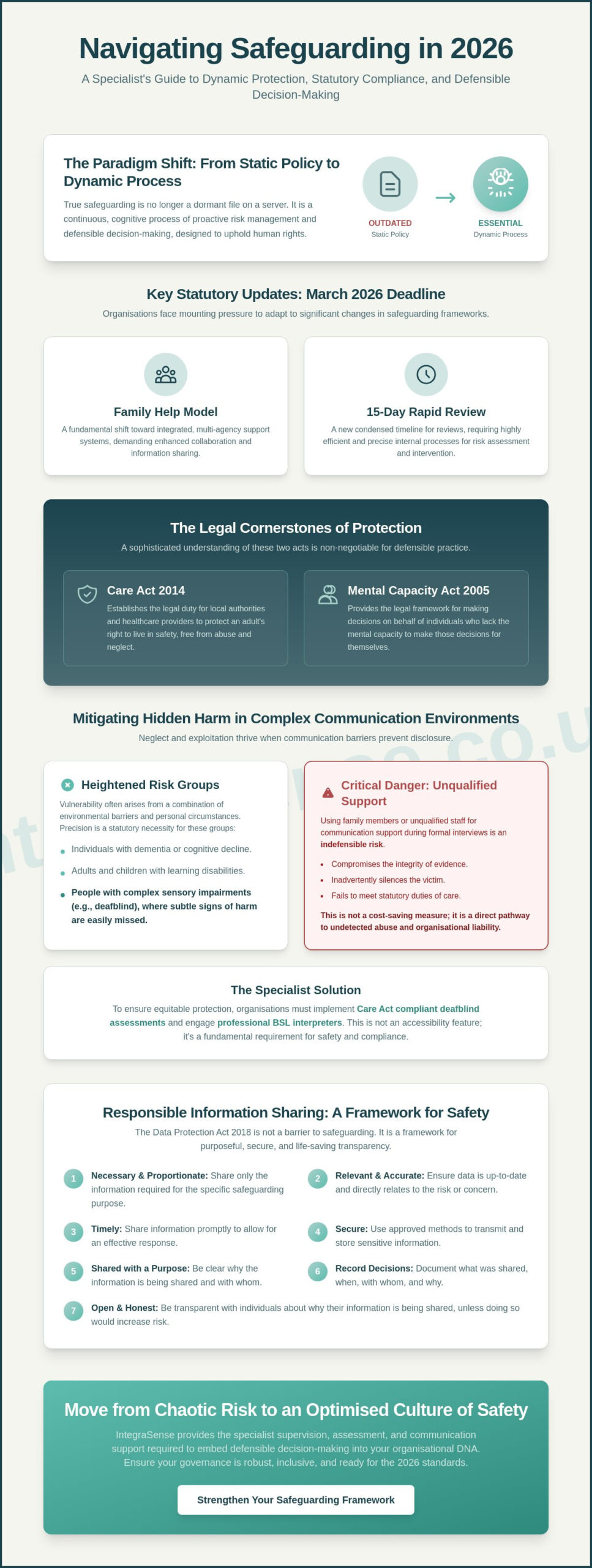
The most dangerous assumption in modern governance is that a static policy document constitutes protection. True safeguarding is a dynamic, cognitive process of defensible decision-making, not a dormant file on a server. You’re likely feeling the mounting pressure of the March 2026 statutory updates, particularly the shift toward the Family Help model and the condensed 15-day rapid review timeline. It’s natural to feel anxious when the Care Act and Mental Capacity Act demand such high levels of precision, especially when identifying subtle abuse in individuals with complex sensory needs.
This guide empowers you to master these complexities through expert-led insights into statutory compliance and professional protection. You’ll gain a clear understanding of the 2026 standards and learn how to integrate accessible communication into your existing frameworks. We’ll examine how specialist services, such as those provided by IntegraSense, ensure your governance is both robust and inclusive. From anti-discriminatory practice to multi-agency collaboration, this overview prepares your organisation to move away from chaotic risk and toward an optimised, specialist-led culture of safety.
Key Takeaways
- Define safeguarding as a proactive framework for human rights, distinguishing between the specific requirements for protecting children and adults in a modern UK context.
- Recognize the heightened risks of neglect in individuals with sensory impairments and the critical danger of utilizing unqualified communication support during formal interviews.
- Establish a defensible decision-making process that prioritizes structured, evidence-based risk management over static, outdated policies.
- Discover how professional supervision strengthens practitioner resilience and ensures your organisation meets the rigorous 2026 statutory expectations.
What is Safeguarding? Defining Professional Protection in 2026
Safeguarding is a proactive framework designed to uphold human rights and enable individuals to live lives free from harm. In the current professional climate, it’s moved beyond a simple reactive duty to become an essential component of organisational governance and professional practice. Leaders who view this as a static policy risk missing the nuanced shifts in statutory expectations that define 2026.
To truly grasp What is Safeguarding?, specialists must distinguish between two distinct but related pathways. Safeguarding children is primarily concerned with preventing maltreatment and ensuring children grow up in circumstances consistent with the provision of safe and effective care. Safeguarding adults, however, follows a rights-based protection model that prioritizes empowerment and person-centered outcomes. Both pathways require a sophisticated understanding of the legal landscape to ensure every decision is defensible and ethically sound.
The Legal Landscape: Care Act and Mental Capacity Act
Local authorities and healthcare providers carry a significant duty of care under the Care Act 2014, which establishes the legal requirement to protect an adult’s right to live in safety. This duty is inextricably linked to the Mental Capacity Act 2005, which provides the legal framework for making decisions on behalf of people who lack the ability to make those decisions for themselves.
Vulnerability is rarely a single-factor condition. It often emerges from a combination of environmental barriers and personal circumstances. Specific groups require heightened focus, including:
- Individuals living with dementia or cognitive decline.
- Adults and children with learning disabilities.
- People with complex sensory impairments, such as those who are deafblind.
For these individuals, the risk of “hidden harm” increases when communication support is inadequate. Precision in these cases isn’t just a goal; it’s a statutory necessity. By aligning your internal systems with these legal pillars, you create a culture where protection is optimized and risks are systematically mitigated. IntegraSense provides the specialist expertise required to bridge these communication gaps, ensuring that compliance is never compromised by a lack of clarity.
Mitigating Risks in Complex Communication Environments
Communication is the conduit for protection. When sight and hearing are both compromised, the traditional mechanisms of safeguarding can fail. Neglect and exploitation often thrive in the silence created by dual sensory impairment. Without specialist intervention, subtle indicators of harm are frequently misinterpreted as symptoms of a person’s condition rather than red flags for intervention. This oversight creates an environment where abuse remains undetected because the victim lacks the specific tools to signal for help.
Relying on family members or unqualified staff during interviews creates an indefensible risk. It compromises the integrity of evidence and can inadvertently silence the victim. To prevent this, organisations must implement Care Act compliant deafblind assessments to accurately map an individual’s unique communication needs. This precision aligns with the UK Government statutory guidance, which mandates multi-agency accuracy in identifying and managing risk across all vulnerable groups.
In our digital-first environment, information sharing must be purposeful and secure. The seven golden rules for effective information sharing include being open and honest, seeking advice when in doubt, and ensuring that any data shared is necessary, proportionate, and secure. Professionals must remember that the Data Protection Act 2018 isn’t a barrier to safety; it’s a framework for responsible, life-saving transparency.
Sensory Impairment and the Barrier to Disclosure
Standard reporting channels, such as telephone helplines or generic online forms, are often inaccessible to those with dual sensory loss. This creates a high-risk disclosure gap where the individual’s voice is structurally excluded. Specialist BSL interpreting is not merely an accessibility feature; it’s a fundamental requirement for equitable protection. To ensure your facility is prepared, consider this communication audit checklist:
- Verification of tactile or visual signaling systems in all private areas.
- Ensuring that electronic security and fire systems are regularly serviced to maintain a safe environment; check out Scaitec Security Solutions Ltd for professional maintenance tips.
- Staff competency in deafblind awareness and basic manual communication.
- Immediate access to qualified, registered BSL interpreters for all formal assessments.
- Documented evidence of individual communication plans within care records.
If your current frameworks lack these specialist safeguards, partnering with a specialist consultancy can help you identify and close these critical gaps in your protection strategy.
Implementing a Robust Framework: Defensible Decision-Making
Expertise is the foundation of safety. Defensible decision-making isn’t a guarantee of a perfect outcome; it’s a structured, evidence-based approach to managing risk that withstands professional scrutiny. This process requires practitioners to document not just what they decided, but exactly why they decided it, based on the information available at the time. It moves safeguarding from a reactive “best guess” to a rigorous, transparent methodology that protects both the individual and the practitioner.
Conducting a regular safeguarding audit is the first step in identifying structural gaps in your organisational governance. These audits should evaluate everything from staff training records to the efficacy of your whistleblowing policies. To validate these internal findings, integrating External Quality Assurance (EQA) provides an objective lens, ensuring your protocols aren’t just present, but performant under pressure. IntegraSense offers these specialist services to help organisations transition from compliance-heavy checklists to truly resilient, specialist-led protection systems.
The Role of Professional Supervision and Mentoring
Resilient practitioners make better decisions. Engaging in professional supervision for practitioners allows for reflective practice, which is essential for preventing vicarious trauma and professional burnout in safeguarding leads. It’s the bridge that allows a team to move from understanding what is safeguarding to mastering the execution of defensible decision-making in social care.
When an allegation arises, your organisation’s “first response” protocol must be immediate and methodical. Consider these three actionable steps to ensure your framework holds up under the 2026 statutory timelines:
- Immediate Safety: Secure the environment and ensure the individual is out of immediate danger without compromising potential evidence or the integrity of the investigation.
- Preserve and Record: Use a standardised template to record the disclosure or concern exactly as it was presented, ensuring that sensory-specific communication needs are documented.
- Internal Notification: Trigger your internal reporting line to the Designated Safeguarding Lead (DSL) to determine if a multi-agency referral is required under the 15-day rapid review window.
Advancing Your Governance Toward 2026 Standards
Mastering the complexities of safeguarding requires a commitment to both legal precision and human-centric communication. We’ve established that protection is most effective when it’s treated as a dynamic, evidence-based process rather than a static administrative burden. By prioritising specialist communication support and statutory Deafblind Assessments, you ensure that no individual’s voice is lost within the system. These measures don’t just meet compliance; they build a culture of genuine accountability and professional resilience.
Founded in 2019, IntegraSense provides the technical expertise and specialist BSL support necessary to navigate these high-stakes environments. Whether you’re conducting a governance audit or implementing professional supervision, our consultants help you bridge the gap between policy and practice. Taking these proactive steps today will reduce organisational risk and provide the clarity needed to handle even the most complex cases with confidence.
Contact IntegraSense for specialist safeguarding consultancy and defensible decision-making support to begin optimising your protection frameworks for the future.
Frequently Asked Questions
What is the difference between safeguarding and child protection?
Safeguarding is the broad preventative strategy used to promote the welfare of all people, while child protection is the specific activity undertaken to protect children suffering significant harm. Think of safeguarding as the universal umbrella of care and child protection as the reactive process triggered by a specific risk. While the former involves early intervention and environmental safety, the latter requires formal investigation and statutory intervention to prevent further maltreatment.
Who is responsible for safeguarding in a UK workplace or organisation?
Every person within a UK organisation shares a collective responsibility for safeguarding, though the ultimate legal accountability rests with the board and the Designated Safeguarding Lead. Under the Care Act 2014, employers must ensure all staff are equipped to recognise and report concerns. Organisations often find that regular professional supervision and clear internal reporting lines are the most effective ways to manage this shared responsibility and mitigate institutional risk.
What is a defensible decision in a safeguarding context?
A defensible decision is a choice that is professionally recorded, evidence-based, and made using a structured risk assessment process that can withstand legal scrutiny. It’s not defined by the eventual outcome, but by the quality of the reasoning used at the time the decision was made. By documenting the rationale and considering all available data, practitioners ensure their actions remain transparent and justifiable during any future professional or legal review.