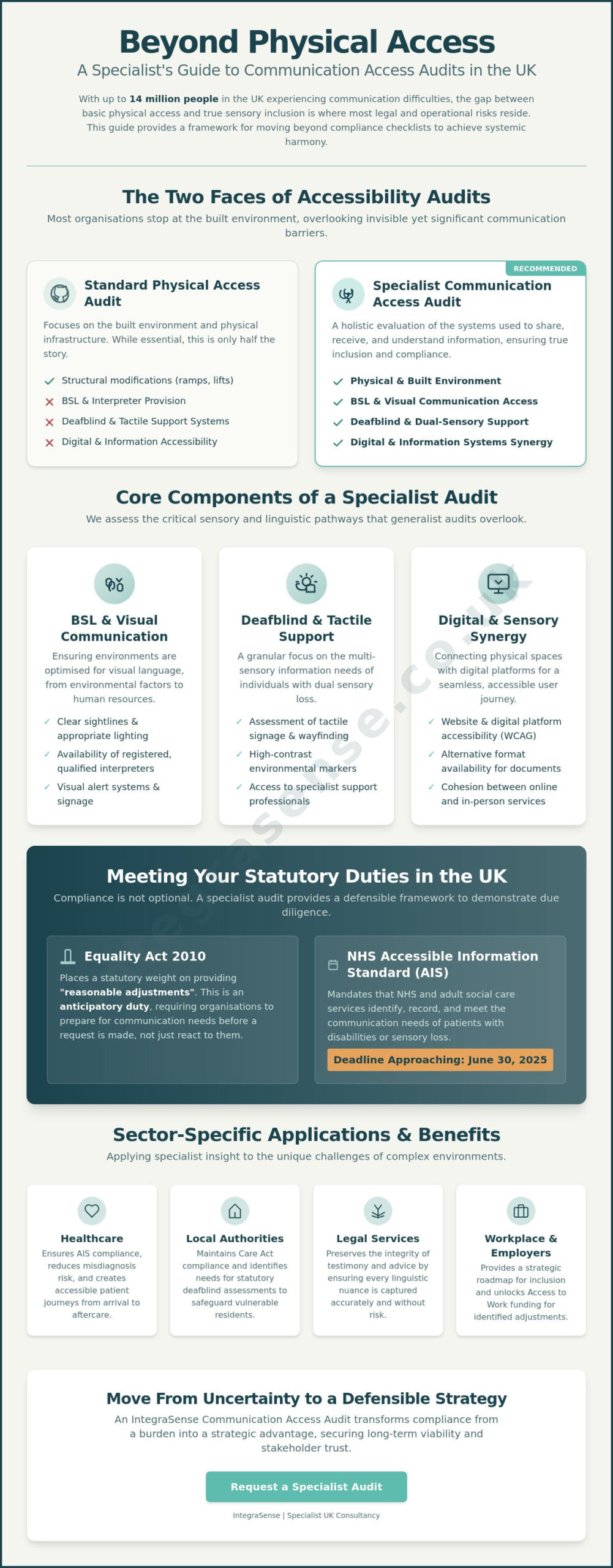
Can a standard disability audit truly protect your organization if it fails to address the nuances of sensory communication? With up to 14 million people in the UK experiencing communication difficulties, the gap between basic physical access and true sensory inclusion is where most legal and operational risks reside. You likely recognize the importance of the Equality Act 2010, yet the fear of litigation often stems from a lingering uncertainty about what constitutes a “reasonable adjustment” for BSL users or deafblind individuals.
We understand that managing these requirements feels complex, especially with the June 30, 2025, deadline for the NHS Accessible Information Standard approaching. This guide shows how a specialist communication access audit UK from IntegraSense provides a defensible decision-making framework. You’ll learn how to move beyond box-ticking exercises toward a model of system harmony that ensures long-term viability and stakeholder trust. We’ll outline the strategic benefits of specialist consultancy and provide actionable recommendations to secure your organization’s compliance and inclusive culture.
Key Takeaways
- Distinguish between physical infrastructure and sensory information exchange to ensure your organization meets holistic inclusion standards.
- Learn how a professional communication access audit UK identifies systemic barriers for BSL users and deafblind individuals, moving beyond simple signage to functional accessibility.
- Explore how specialist communication support and deafblind assessments create seamless transitions in complex environments, from local authority services to healthcare consultations.
- Develop a strategic action plan using priority ratings to transform audit findings into a manageable roadmap for organizational transformation and compliance.
Understanding the Scope of a Communication Access Audit in the UK
A communication access audit UK isn’t a simple inspection of physical barriers. It’s a specialist evaluation of the systems used to share, receive, and understand information within an organisation. While traditional audits focus on the built environment, communication access examines the linguistic and sensory pathways that allow individuals to participate fully. This involves analyzing British Sign Language (BSL) provision, tactile support for deafblind individuals, and digital fluidity. Grounding your strategy in established accessibility principles ensures that information isn’t just available, but truly perceivable and actionable for every user.
Beyond the Wheelchair: Why Communication Access is Often Overlooked
Barriers to communication are frequently invisible. For the 12 million people in the UK living with hearing loss or dual sensory impairment, a lack of clear communication support is as restrictive as a locked door. Relying solely on a physical access audit Kent might ensure a building is reachable, yet it often overlooks the critical linguistic barriers that prevent a person from actually using the services inside. In high-stakes environments like legal proceedings or healthcare, these oversights lead to significant organizational risk and fragmented service delivery.
The Legal Framework: Equality Act 2010 and Accessible Information Standards
The Equality Act 2010 places a statutory weight on “reasonable adjustments” that extends far beyond physical modifications. For NHS and social care organisations, the Accessible Information Standard (AIS) mandates that they identify, record, and meet the communication needs of patients with disabilities or sensory loss. This is a proactive requirement, not a reactive one. Organisations have an anticipatory duty to provide communication support before a specific request is made. Failing to prepare for these needs doesn’t just hinder inclusion; it creates a defensible gap in your compliance framework. IntegraSense provides the specialist insight needed to bridge this gap through methodical, results-oriented auditing.
Specialist Audit Examples: Applying Inclusion in Complex Environments
The application of a communication access audit UK varies significantly across sectors, yet the underlying goal remains the same: ensuring information flows without friction. In the public sector, local authorities utilize these audits to maintain Care Act compliance, often identifying the need for statutory deafblind assessments to safeguard vulnerable residents. Healthcare settings present a different challenge, where an audit might reveal that while a building is physically accessible, the transition from reception to a private consultation is fraught with barriers for BSL users. These gaps in the patient journey often lead to misdiagnosis or inadequate care, highlighting why specialist insight is non-negotiable.
In addition to specialist human support, technology can play a crucial role in maintaining the integrity of clinical records. For healthcare professionals, Doctoria offers an AI Scribe that automates clinical documentation, ensuring that every detail of a consultation is captured accurately, which is especially vital in complex communication environments.
Legal and professional services require a higher level of precision to maintain the integrity of testimony or advice. In these settings, specialist communication support ensures that every nuance is captured and understood, mitigating the risk of procedural error or legal challenge. In workplace environments, audits serve as a strategic roadmap for employers. These organizations can often leverage Access to Work grants to fund the specific adjustments identified during the audit process, turning a compliance requirement into a funded opportunity for organizational growth.
Auditing for British Sign Language (BSL) and Deafblindness
Specialist audits look for markers that generalists often miss. For BSL access, we evaluate lighting levels to prevent eye fatigue and ensure sightlines are clear for visual communication. We also verify the availability of registered interpreters, as using unqualified staff introduces unacceptable risk to both the organization and the individual. Auditing for deafblindness requires an even more granular focus. It involves assessing tactile signage, high-contrast environmental markers, and the presence of specialist support professionals who facilitate dual-sensory interaction in complex spaces.
Digital and Sensory Synergy: A Holistic Approach
Physical spaces don’t exist in isolation from digital platforms. A truly inclusive environment aligns its physical infrastructure with website accessibility to create a seamless user journey. Adhering to UK government accessibility standards ensures that digital touchpoints are as robust as the physical ones. This synergy includes integrating assistive technologies like hearing loops and visual alert systems into the broader organizational architecture. If you’re looking to optimize your environment, our specialist accessibility consultancy can help you bridge these gaps effectively.
Implementing Defensible Decisions: The Audit as a Risk Management Tool
In high-stakes environments, a communication access audit UK functions as a vital risk management tool. It moves beyond identifying barriers to providing a defensible decision-making framework. This documentation is essential when justifying “reasonable adjustments” during legal challenges or complaints. By utilizing the NHS Accessible Information Standard self-assessment framework, health and care providers can benchmark their performance against national expectations. Relying on qualified NRAC or specialist sensory consultants ensures your report holds the necessary validity to withstand scrutiny from regulatory bodies or the courts.
The outcome of a professional audit is a strategic action plan. We categorize findings into High, Medium, and Low risk ratings, allowing your leadership team to allocate resources effectively. This structured approach helps IntegraSense partners transition from chaotic, reactive fixes to an optimized state of proactive compliance. It provides the clarity needed to manage complex environments with precision and long-term viability.
The Audit Process: What to Expect from a Specialist Consultant
A specialist audit follows a logical, three-step sequence to ensure comprehensive coverage:
- Step 1: Desktop Review. We analyze existing policies and previous accessibility audits to identify historical gaps and internal standards.
- Step 2: On-site Sensory Walk-through. This involves physical environmental testing and stakeholder interviews to understand the lived experience of staff and service users.
- Step 3: Technical Reporting. We deliver a detailed report featuring a cost-benefit analysis of suggested adjustments, ensuring recommendations are both impactful and sustainable.
Mitigating Professional Risk through External Quality Assurance
Effective inclusion requires ongoing oversight. Implementing external quality assurance (EQA) for your communication services protects your organisation from service failure and the risk of vicarious trauma among staff. When teams handle complex communication needs, professional supervision becomes a critical pillar of support. It ensures that specialists maintain high standards of delivery while managing the cognitive and emotional demands of their roles, ultimately fostering a more resilient and inclusive workplace environment.
Strategic Inclusion: Securing Your Organizational Future
True inclusion requires a deliberate shift in organizational perspective. It’s about recognizing that communication is both a fundamental human right and a critical operational requirement for modern service delivery. By integrating specialist insight into your core infrastructure, you move beyond mere compliance toward a state of genuine system harmony. This proactive approach ensures that every sensory-impaired individual can interact with your services with dignity and precision.
A professional communication access audit UK provides the clarity needed to navigate complex sensory environments with quiet confidence. You gain a defensible decision-making framework that protects your organisation from risk while ensuring robust BSL and Deafblind statutory compliance. Our NRAC-aligned expertise transforms technical challenges into streamlined, inclusive solutions that empower every individual to manage their interactions effectively. It’s time to replace chaotic, reactive fixes with a methodical strategy that values long-term viability and human empowerment.
Request a specialist communication access audit from IntegraSense to begin your journey toward an optimized and truly accessible environment. Taking these strategic steps today ensures your organization remains resilient, compliant, and welcoming to all.
Frequently Asked Questions
What is the difference between a disability access audit and a communication access audit?
A disability access audit typically evaluates the physical built environment, such as ramps and lifts, while a communication access audit focuses on linguistic and sensory pathways. It assesses how information is exchanged through British Sign Language, tactile markers, and digital platforms. This specialist approach ensures that your infrastructure supports individuals with complex sensory needs rather than just addressing mobility barriers. For those seeking comprehensive property assessments beyond accessibility, South Surveyors offers professional surveying services to ensure your premises are fully compliant with structural standards.
Is a communication access audit a legal requirement for UK businesses?
Conducting a communication access audit UK is a strategic necessity to meet the anticipatory duty of the Equality Act 2010. Public sector bodies and healthcare providers also face specific mandates under the Accessible Information Standard. Failing to audit these systems leaves an organisation vulnerable to litigation and service failure when reasonable adjustments aren’t effectively implemented.
How much does a specialist communication access audit cost in the UK?
The investment for a specialist audit varies significantly based on the scale of your facility, the complexity of your services, and the number of stakeholders involved. Because every organisation has unique sensory requirements, we recommend requesting a tailored proposal to ensure the scope aligns with your specific operational risks. This approach ensures you receive a precise technical roadmap rather than a generic customer service checklist.
What are “reasonable adjustments” for communication support under the Equality Act?
In the context of communication, reasonable adjustments include providing British Sign Language (BSL) interpreters, installing hearing loops, and offering information in tactile or high-contrast formats. The goal is to ensure that sensory-impaired individuals experience the same level of service and clarity as any other user. A professional audit helps define which adjustments are necessary and proportionate for your specific environment.
How often should our organisation review its communication accessibility?
Organisations should ideally review their communication accessibility annually or whenever there’s a significant change in service delivery or physical layout. Regular reviews ensure that your systems remain optimized as technology advances and regulatory standards, such as WCAG updates, evolve. Maintaining this cadence prevents the accumulation of accessibility debt and ensures your inclusion strategy remains robust and defensible.
Can we use Access to Work grants to pay for an accessibility audit?
Access to Work grants are designed to fund specific communication support and equipment for individual disabled employees rather than organizational audits. While these grants can cover the cost of BSL interpreting or specialist software for staff, the audit itself is an organizational responsibility. However, an audit is a vital first step in identifying which adjustments for your staff might be eligible for such funding.