
Many local authorities treat sensory impairment as a secondary concern, yet failing to secure a specialist evaluation is a direct path to legal non-compliance. With the deafblind population in the UK projected to reach 610,000 by 2035, the margin for error is disappearing. Understanding what is a deafblind assessment is the first step in moving from reactive crisis management toward a model of clinical and statutory precision.
You’re likely aware that the definition of “suitably qualified” remains a point of significant friction under the Care Act 2014. It’s a complex environment where the wrong choice in assessor doesn’t just impact the individual; it creates substantial organizational risk. This specialist guide provides the clarity you need to navigate these requirements, ensuring every assessment is legally robust and focused on tangible quality of life improvements. We’ll examine the mandatory RQF Level 3 qualifications for adult specialists and the specific requirements for children’s services. At IntegraSense, we transform these technical obligations into person-centered success, providing the expert oversight necessary for defensible, high-quality care planning.
Key Takeaways
- Identify the legal triggers under the Care Act 2014 that mandate a specialist evaluation for any individual experiencing combined sight and hearing loss.
- Define what is a deafblind assessment by examining the specific training and RQF Level 3 requirements necessary for an assessor to be considered “suitably qualified.”
- Review the essential specialist domains covered during the process, including tactile communication methods, bespoke mobility strategies, and assistive technology solutions.
- Master the reporting standards required to provide local authority commissioners with a transparent, defensible basis for long-term care and support planning.
- Map the transition from initial statutory referral to the implementation of a robust, person-centred support framework that optimizes individual independence.
What is a Deafblind Assessment? Understanding Statutory Duties under the Care Act 2014
A statutory deafblind assessment is a specialized diagnostic evaluation mandated for individuals living with combined sight and hearing loss. Understanding what is a deafblind assessment requires a shift in perspective; it isn’t a mere administrative checkbox but a technical requirement under Section 78 of the Care Act 2014. In reality, Deafblindness encompasses any degree of dual impairment where the combination of losses creates significant barriers to daily life. Local authorities have a non-delegable duty to identify and record anyone in their region who meets this criteria. For younger individuals, the Children Act 1989 provides the equivalent legal framework, ensuring that support begins at the earliest possible stage.
Who Qualifies for a Specialist Sensory Assessment?
Eligibility isn’t determined by clinical thresholds alone. It’s defined by the functional impact on an individual’s autonomy. While a person with a single sensory loss might use their other senses to compensate, those with dual loss experience a multiplier effect that compromises communication, mobility, and information access. If a person’s combined impairment hinders their ability to interact with their environment or process data effectively, they qualify for a specialist evaluation. This process moves beyond basic needs to map out a holistic journey toward independence and system harmony.
The Legal Mandate: Why Generalist Assessments Fail Compliance
Standard social care assessments often lack the technical depth required to capture the nuances of dual sensory loss. Relying on generalist staff creates a significant risk of legal non-compliance and defensibility issues for commissioners. A Care Act Compliant Deafblind Assessment is the only way to ensure that the individual’s rights are upheld and the local authority’s statutory obligations are met. At IntegraSense, we provide the specialist expertise necessary to bridge this gap, ensuring that every assessment is a robust, expert-led document that stands up to scrutiny while delivering person-centred outcomes.
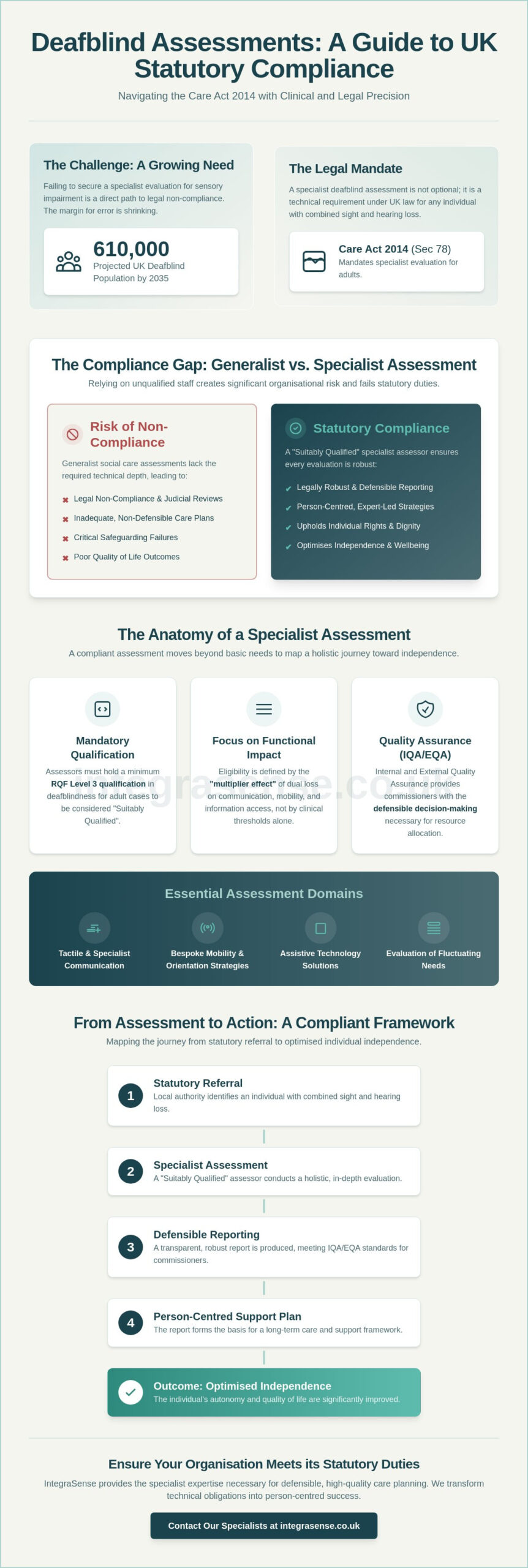
The Critical Importance of Specialist Expertise: Who is “Suitably Qualified”?
Legitimacy in sensory social care is defined by technical proficiency. The Care Act 2014 mandates that assessors must be “suitably qualified,” a term that translates to a minimum of RQF Level 3 training in deafblindness for adult cases. When organisations ask what is a deafblind assessment, they must recognize it as a high-stakes diagnostic process. Relying on unqualified staff doesn’t just lead to poor outcomes; it invites judicial reviews and safeguarding failures that can destabilize a local authority’s legal standing.
A specialist assessor brings a sophisticated toolkit to the evaluation. They possess the expertise to analyze diverse communication methods, from tactile signing to British Sign Language (BSL), while simultaneously mapping mobility requirements and assistive technology needs. Crucially, they identify fluctuating needs. Sensory capacity often shifts based on environmental factors or emotional wellbeing, requiring an assessor who can interpret these variables into a cohesive, long-term support strategy.
The Role of the Specialist Assessor in Complex Environments
Specialists navigate the often-conflicting silos of health, education, and social care to provide a unified perspective. In high-pressure settings like hospitals or legal chambers, the nuances of communication become even more critical. A specialist ensures that the individual’s sensory access remains fluid and functional, preventing the isolation that frequently occurs in complex institutional environments.
Ensuring Quality through External Quality Assurance (EQA)
Precision requires oversight. Implementing Internal Quality Assurance (IQA) and External Quality Assurance (EQA) ensures that every assessment report meets the rigorous statutory standards expected by commissioners. This layer of scrutiny provides the defensible decision-making necessary for resource allocation. For organisations seeking to broaden their compliance framework, our Accessibility Audits provide a strategic starting point. To ensure your statutory duties are met by experts who value precision, consider how our specialist services can optimize your current assessment workflows.
From Assessment to Action: Defensible Decision-Making and Outcomes
The transition from diagnostic data to tangible support requires a structured, intentional methodology. Understanding what is a deafblind assessment involves recognizing it as the catalyst for a 5-step journey that moves an individual from isolation toward integrated care. This process begins with the initial referral and moves through the specialist evaluation, technical reporting, strategic planning, and finally, the implementation of a person-centred care plan. By following this sequence, organisations ensure that every decision is rooted in clinical evidence and statutory requirements.
For local authority commissioners, the assessment report serves as a critical strategic document. It provides the defensible decision-making framework necessary to justify resource allocation in an environment of increasing fiscal scrutiny. A specialist report doesn’t just list needs; it provides a roadmap for long-term cost-efficiency. By recommending early interventions such as one-to-one communicator-guides or BSL interpreting, authorities can prevent the high costs associated with crisis interventions and residential breakdowns. Precision at the assessment stage acts as a safeguard for both the individual’s wellbeing and the organisation’s budget.
Translating Findings into Specialist Communication Support
Once the evaluation is complete, the focus shifts to environmental application. Assessment data directly informs specialist communication support for complex needs, moving beyond theoretical requirements to practical audits of the individual’s living or working space. This ensures that the communication tools provided, whether tactile or digital, are optimized for the specific context in which they’ll be used.
Partnering with IntegraSense for Expert Assessments
Precision in sensory social care isn’t achieved in isolation. IntegraSense acts as a multidisciplinary partner, providing Specialist Assessment and Reporting that meets the highest professional standards. Our approach integrates professional supervision and expert witness services to ensure that every evaluation is robust, compliant, and transformative. We don’t just identify challenges; we engineer solutions that empower people to manage their environments effectively. Contact our consultancy team today to discuss how we can support your statutory assessment requirements and improve the quality of your sensory service delivery.
Optimising Sensory Outcomes and Statutory Compliance
The complexity of dual sensory loss requires more than a generalist approach; it demands technical precision. We’ve explored how a robust evaluation serves as both a legal safeguard for the local authority and a blueprint for individual autonomy. By understanding what is a deafblind assessment, organisations move away from the risks of statutory non-compliance. You can instead build a system of defensible, evidence-based care planning that prioritises long-term viability and person-centred results.
Since our founding in 2019, IntegraSense has established itself as a leading multidisciplinary consultancy. We specialise in Care Act 2014 compliance throughout Kent and South East England, providing the professional oversight necessary to transform complex communication barriers into actionable support frameworks. Fulfilling your statutory duties shouldn’t be a source of organisational friction when you have a dependable partner to manage the technical depth. Our expertise ensures that every assessment is a durable foundation for future care.
Take the first step toward clinical excellence and request a statutory-compliant Deafblind Assessment from IntegraSense to ensure your services are robust and effective. Providing clarity in a complex landscape is the most effective way to empower those with sensory loss. We look forward to helping you achieve system harmony and superior support outcomes.
Frequently Asked Questions
Who is responsible for paying for a deafblind assessment in the UK?
Local authorities carry the legal responsibility for funding statutory deafblind assessments under the Care Act 2014. This mandate ensures that individuals with dual sensory loss receive an expert evaluation without incurring personal costs. It is a non-delegable duty that remains in place regardless of the individual’s financial status, reflecting the council’s obligation to identify and support residents with complex sensory needs.
Can I request a specialist deafblind assessment if my local council has already done a standard one?
You have the right to request a specialist evaluation if a standard council assessment was conducted by a professional lacking the mandatory RQF Level 3 qualifications. When determining what is a deafblind assessment in a legal context, the statutory guidance is clear that generalist staff are insufficient. If the combined impact of sight and hearing loss was not evaluated by a specialist, the resulting care plan may be legally non-compliant.
How long does a statutory deafblind assessment typically take to complete?
Completion timelines depend on the specific complexity of the individual’s communication and environmental requirements. A specialist assessment usually involves several hours of direct engagement, often spread across multiple sessions, to capture a truly holistic view of the person’s life. This methodical pace allows the assessor to account for fluctuating needs and emotional wellbeing, ensuring the final report is robust and defensible.
What happens if a local authority refuses to provide a specialist assessor?
If a local authority refuses to provide a specialist assessor, the individual or their representative can initiate a formal complaint or seek a judicial review. The Care Act 2014 statutory guidance is binding, so councils must provide a “suitably qualified” professional for anyone meeting the deafblind definition. Engaging a specialist advocate is often an effective step to remind the authority of its mandatory legal responsibilities.