Professional awareness of neurodiversity has reached an all-time high, yet many organisations remain trapped in a cycle of theoretical understanding without practical implementation. You likely recognise that supporting neurodivergent talent is essential for a high-performing team, but the path to meaningful change often feels obscured by technical uncertainty and the fear of failing to meet accessibility standards. This guide provides a clear, expert-led framework for Creating a Neuroinclusive Workplace: Practical Adjustments for ADHD and Autism that move beyond surface-level changes to deliver measurable organisational benefits. By transitioning from generic awareness to specialist implementation, your organisation can improve employee retention and productivity through expert-led decision making. We will examine how specialist communication audits, environmental optimisation, and professional supervision can transform your operational culture into one where every professional has the support to excel.
Key Takeaways
- Understand why proactive environmental design is essential for modern organisations seeking to retain specialist talent and move beyond basic awareness.
- Identify specific strategies for Creating a Neuroinclusive Workplace: Practical Adjustments for ADHD and Autism including flexible scheduling and the implementation of quiet zones.
- Recognise the critical role of professional supervision in helping managers navigate the practical and ethical challenges of sustaining inclusive systems.
- Discover how specialist communication audits and consultancy provide a defensible framework to optimise organisational performance and employee retention.
The Strategic Value of Creating a Neuroinclusive Workplace
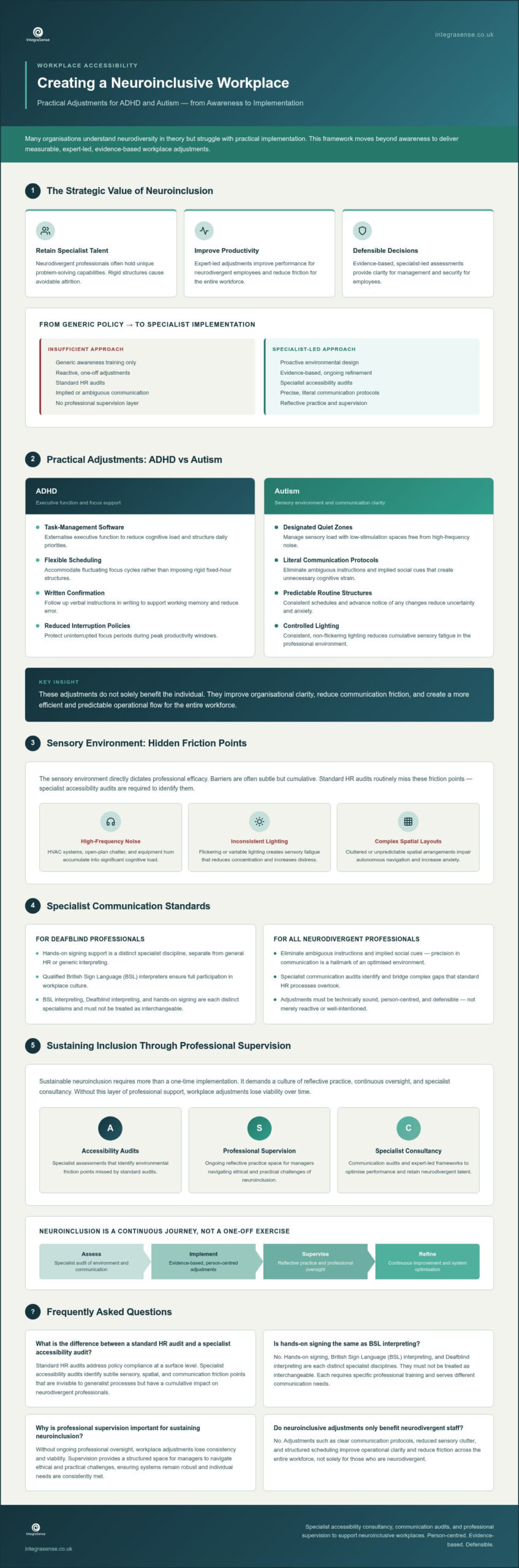
Neuroinclusion represents the proactive design of environments and systems that accommodate diverse cognitive processing styles. It moves beyond simple awareness toward a structural framework where the workplace adapts to the individual. For modern organisations, Creating a Neuroinclusive Workplace: Practical Adjustments for ADHD and Autism is a strategic necessity to retain specialist talent. Relying on generic policies is no longer sufficient; organisations must implement precise, evidence-based systems to remain competitive.
Specialist professionals often possess unique problem-solving capabilities, yet they are frequently hindered by rigid operational structures. Transitioning to a model of defensible decision making ensures that adjustments are not merely reactive but are rooted in expert-led assessments. This approach provides clarity for management and security for the employee, ensuring that technical challenges are handled with precision and long-term viability.
Sensory Processing and the Professional Environment
The sensory environment dictates the efficacy of professionals with Autism or combined sight and hearing loss. For those who are Deafblind, environmental barriers are often subtle but cumulative. High-frequency noise, inconsistent lighting, or complex spatial layouts can create significant cognitive load. Accessibility consultancy identifies these environmental friction points that standard HR audits often overlook. By utilising specialist accessibility audits, organisations can move toward an optimised environment. These assessments ensure that professionals who are Deafblind or have specific sensory profiles can navigate their space with autonomy. This level of technical depth is essential for maintaining a high-performance culture. When an organisation prioritises these adjustments, it demonstrates a commitment to person-centred outcomes and systemic fluidity.
Practical Adjustments for Supporting ADHD and Autistic Professionals
Effective implementation requires moving from abstract concepts to concrete environmental and operational changes. When Creating a Neuroinclusive Workplace: Practical Adjustments for ADHD and Autism, organisations should prioritise both flexibility and structural clarity. For professionals with ADHD, this involves the integration of task-management software to externalise executive function and flexible scheduling to accommodate fluctuating focus cycles. Conversely, supporting autistic professionals often requires establishing designated quiet zones to manage sensory load and implementing rigid, literal communication protocols. These adjustments do not merely benefit the individual. They improve organisational clarity and reduce communication friction for the entire workforce, leading to a more efficient and predictable operational flow.
Optimising Communication and Professional Standards
Precision in communication is a hallmark of an optimised professional environment. Ambiguous instructions or implied social cues often lead to unnecessary cognitive strain and avoidable operational errors. For professionals who are Deafblind or use British Sign Language (BSL), communication requirements are even more specific and technically demanding. Access may involve hands-on signing or the provision of qualified BSL interpreters to ensure full participation in workplace culture. It is essential to recognise that specialist communication support is a distinct discipline from general HR advice. Relying on specialists ensures that adjustments are technically sound, defensible, and person-centred. Organisations seeking to refine their internal systems should consider specialist consultancy services to identify and bridge these complex communication gaps. By adopting these high-level standards, a business ensures that its infrastructure supports the diverse ways in which people process, interpret, and transmit information.
Sustaining Inclusion through Professional Supervision and Consultancy
A visionary organisation understands that professional growth and organisational harmony are intrinsically linked. To support leadership development in these areas, you can learn more about Humanise Solutions. Creating a Neuroinclusive Workplace: Practical Adjustments for ADHD and Autism is a continuous journey of refinement rather than a static goal. Specialist consultancy ensures that these adjustments are not only effective but also defensible and prioritised alongside broader organisational objectives. This methodical approach allows for the interpretation of data and the combination of disparate elements into a cohesive, high-performing whole.
The Role of Specialist Communication Audits
A specialist communication audit serves as a diagnostic tool to identify hidden barriers that standard assessments frequently miss. These audits are particularly vital for neurodivergent and Deafblind staff, where subtle friction in information flow can lead to significant isolation or inefficiency. This high-level technical approach mirrors the professional supervision for BSL interpreters, where specialist insight preserves practice standards and practitioner resilience. By combining audits with ongoing supervision, an organisation creates a cohesive framework for success. We invite you to contact IntegraSense for a bespoke assessment of your organisational needs to ensure your inclusion strategy is both precise and enduring.
Optimising Organisational Performance through Specialist Inclusion
High-level performance depends on structural precision. It is no longer enough to offer generic support; organisations must implement specialist systems that respect diverse cognitive processing. By integrating communication audits and professional supervision, you ensure that your inclusion strategy remains technically sound and sustainable. Creating a Neuroinclusive Workplace: Practical Adjustments for ADHD and Autism represents a transition from simple awareness to an optimised, high-functioning professional culture. IntegraSense brings deep expertise in Deafblind assessments and specialist communication support to help you navigate these requirements with precision and authority. To discuss how our specialist consultancy can help you implement practical adjustments and professional supervision, please contact IntegraSense today. Your commitment to a truly inclusive environment will empower your team and secure the long-term viability of your organisation.
Frequently Asked Questions
What is the difference between neurodiversity and neuroinclusion in a professional context?
Neurodiversity describes the natural variation in human cognitive processing, while neuroinclusion is the proactive design of systems to accommodate these differences. In a professional context, neurodiversity is the presence of diverse cognitive profiles; neuroinclusion is the active practice of Creating a Neuroinclusive Workplace: Practical Adjustments for ADHD and Autism. This approach ensures that technical depth and professional standards are maintained across the entire workforce.
How do sensory processing differences affect workplace performance for Deafblind individuals?
Sensory processing differences can create significant environmental barriers for individuals who are Deafblind. Inconsistent lighting, background noise, or complex spatial layouts increase cognitive load and reduce focus. Specialist assessments identify these friction points, allowing for environmental optimisation. Implementing adjustments such as hands-on signing or British Sign Language (BSL) interpreting ensures that professionals with combined sight and hearing loss maintain autonomy and productivity.
Are workplace adjustments for ADHD and Autism expensive to implement for SMEs?
Many effective workplace adjustments are low-cost or require no financial investment beyond a change in operational protocols. Simple strategies, such as providing literal communication or allowing flexible scheduling, primarily require a shift in management approach. While some specialised software or consultancy fees apply, the resulting improvements in retention and organisational performance often outweigh the initial resource allocation for supporting ADHD and autistic professionals.
How can professional supervision support a neuroinclusive culture?
Professional supervision provides a structured environment for managers and practitioners to reflect on their inclusive practices. It facilitates the resolution of complex ethical dilemmas and ensures that adjustments remain person-centred and defensible. By providing specialists with ongoing mentoring, an organisation maintains its resilience and ensures that its neuroinclusive framework is consistently refined to meet evolving professional and technical standards.