
What should you share before a BSL interpreting assignment? For an assignment involving British Sign Language (BSL), knowing how to brief a BSL interpreter effectively means providing more than an agenda. Share the purpose, people involved, subject matter and communication arrangements so the interpreter can prepare for the context.
It can be difficult to know which details will be useful, particularly when the discussion involves specialist terms or sensitive topics. A concise, organised brief brings the essential information together and helps everyone prepare. This guide covers what to send in advance, how to plan the interpreting environment and what to consider on the day, with the Deaf person’s communication needs at the centre.
Key Takeaways
- To brief a BSL interpreter effectively, share the assignment’s purpose, context and participants before the session.
- Provide relevant agendas, presentation materials, names, specialist vocabulary and documents, and identify any drafts.
- Plan seating, lighting and sightlines so the Deaf person can see the interpreter and the speakers.
- Support clear communication by addressing the Deaf person directly, speaking clearly and avoiding overlapping contributions.
Why an effective BSL interpreter brief starts with the communication task
A useful brief starts with the communication task, not a pile of documents. It is a focused exchange of information about the assignment’s purpose, context, participants and practical arrangements. This gives the interpreter a basis for preparing and helps keep the plan centred on the Deaf person’s communication needs.
The format matters. A presentation with prepared slides has different demands from an interview with questions and responses, or an appointment where the discussion may change as new information emerges. Explain the setting and likely flow, including whether there will be a chair, a presenter or several contributors. This helps the interpreter understand how communication is expected to work without assuming that the conversation will follow a script.
A brief supports preparation; it does not direct the interpreter’s professional decisions or prescribe how to interpret. Share relevant context and materials, then allow the interpreter to use professional judgement during the assignment. Preparation and professional independence work together.
What should the brief help everyone understand?
Set out what the assignment is for, how it is expected to run, who will take part and what each person’s role is. Describe the topic and likely discussion areas, and explain whether people will present, ask questions or contribute to a group discussion. For example, if a meeting includes a formal presentation followed by open discussion, say so. Avoid writing a script: a realistic overview is more useful than wording that may change on the day.
Keep the Deaf person’s preferences and involvement central. Consider how they will participate, what communication arrangements have been discussed with them and whether there is relevant context they want included. Link those details to the practical plan: who is likely to speak, how contributions will be managed and whether anyone will refer to written material. A shared understanding gives everyone a more purposeful starting point.
How to brief a BSL interpreter before the assignment
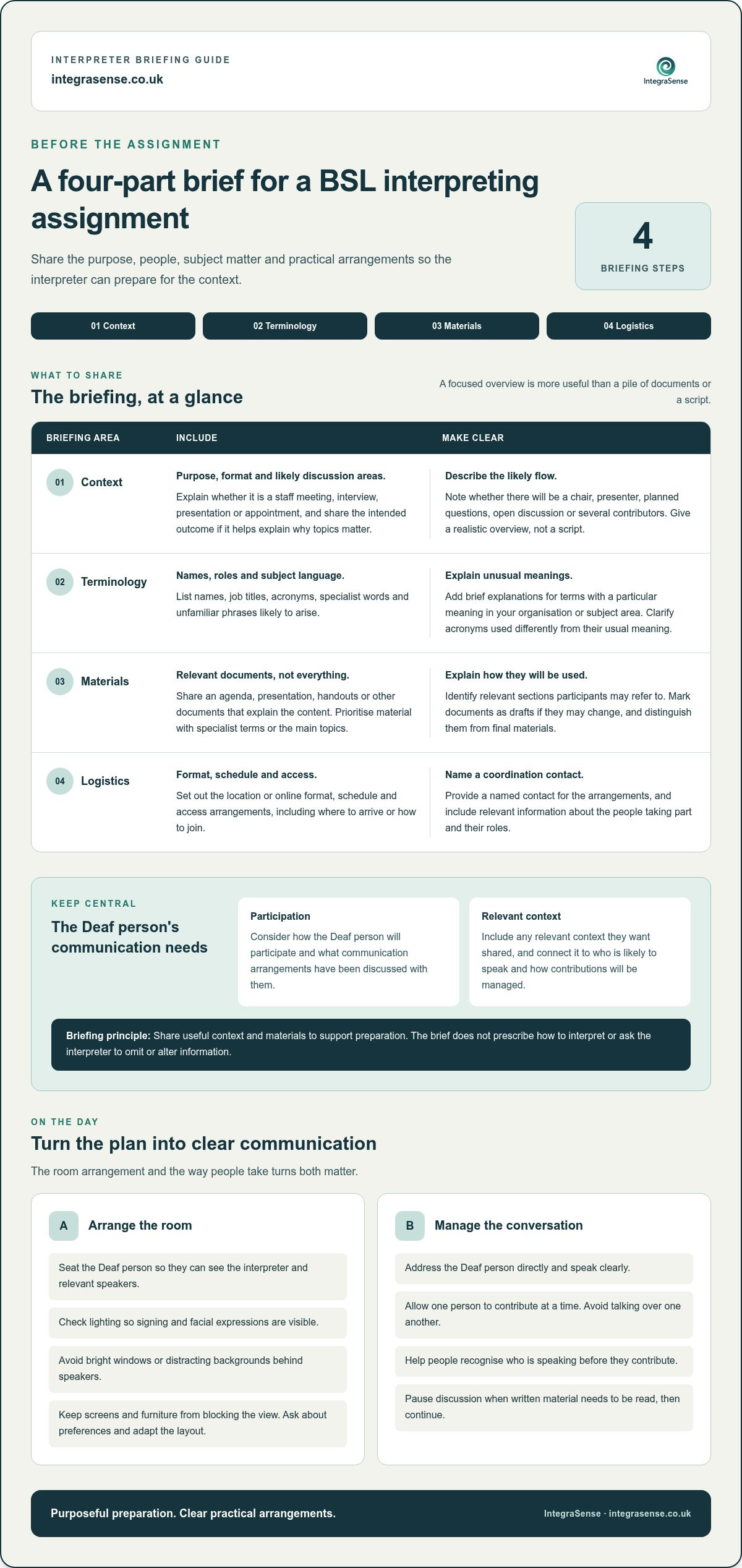
A short, structured briefing makes preparation manageable. Work through these four steps, sharing information that explains the assignment and its communication demands.
- Share the context. Explain the purpose, format and likely discussion areas. A staff meeting, for example, may involve updates and open discussion, while an interview may follow planned questions. Include the intended outcome of the session if it will help explain why particular topics matter.
- Identify terminology. List names, job titles, acronyms and specialist words likely to arise. Add a brief explanation where a term has a particular meaning in your organisation or subject area. If people use an acronym differently from its usual meaning, clarify that too.
- Provide relevant materials. Send an agenda, presentation, handouts or other documents that will help the interpreter understand the content. Explain how each item relates to the session, and identify which materials are final and which may change. Prioritise documents that contain specialist terminology or introduce the main topics.
- Confirm the logistics. Set out the location or online format, schedule, access arrangements and a named coordination contact. Include practical details such as where to arrive or how to join the meeting. This gives everyone a clear point of reference for arrangements.
What information and materials belong in a briefing?
Choose materials for relevance, not volume. An agenda can show how the discussion is expected to progress, while a presentation may introduce subject-specific language. Share the names and roles of people who are likely to speak, along with any abbreviations, technical terms or unfamiliar phrases that may come up. If the discussion includes sensitive or unfamiliar subject matter, flag it factually so the interpreter can prepare. Do not ask the interpreter to omit or alter information. A briefing supports interpretation; it does not predetermine what is communicated.
Think about how the materials will be used during the session, too. If participants will refer to a document, identify the relevant sections and plan how everyone will know what is being discussed. Where information is still being prepared, label it as a draft rather than presenting it as final. Keep the Deaf person’s communication preferences in view as you assemble the information. A focused set of context, terminology and practical details gives the interpreter a useful preparation framework without turning it into a script. IntegraSense provides BSL and English interpreting support tailored to the assignment context.
How to support clear BSL interpreting during the assignment
The advance plan is most useful when it informs the room and the conversation. Arrange seating so the Deaf person can see the interpreter and relevant speakers without repeatedly turning between them. Check that lighting makes signing and facial expressions visible. Avoid placing speakers in front of bright windows or distracting backgrounds, and check that screens or furniture do not block the view.
How should the organiser coordinate the room and conversation?
Make the arrangement practical for the specific session. In a meeting, consider where people will sit and how speakers will be recognised before they contribute. Keep the interpreter within the Deaf person’s line of sight, and leave a clear view of anyone presenting. In a small group, a semi-circle may make it easier to see each contributor than seating everyone in a row. Ask the Deaf person about their preferences and adapt the layout accordingly.
Good conversation management matters as much as the room. Ask speakers to address the Deaf person directly, speak clearly and allow one person to contribute at a time. Avoid talking over one another. If a slide, handout or other written material needs to be read, pause the discussion and allow time for reading before continuing. This helps avoid asking the Deaf person to divide attention between text and interpreted discussion at once.
For presentations, share or display materials in a way that supports participation, and make clear when the speaker is moving to a new topic. If the agenda changes, explain the change and allow a moment for the interpreter and Deaf person to adjust. Plan breaks where appropriate to the format and pace of the session.
IntegraSense provides specialist communication services tailored to the assignment. To discuss interpreting support for your context, contact IntegraSense about specialist interpreting support.
Make your next assignment easier to plan
A considered briefing can inform preparation for future assignments. After each session, note which information, communication preferences and practical arrangements were useful in that particular context. Use those observations to improve your planning, while avoiding a one-size-fits-all template. The aim is to respond to the people and purpose involved in each assignment.
IntegraSense provides BSL / English interpreting and communication support tailored to the situation. If you are planning an assignment, contact IntegraSense to discuss the specialist BSL / English interpreting support you need.
Frequently Asked Questions
What information should I give a BSL interpreter before an assignment?
Share the assignment’s purpose, setting, participants, likely topics, relevant terminology, available materials and practical arrangements. These details provide context rather than prescribe what the interpreter communicates. Centre the Deaf person’s preferences, and share sensitive information thoughtfully through an appropriate channel.
Should I send presentation materials to a BSL interpreter in advance?
Yes. Send relevant agendas, presentation slides, handouts, names and specialist terms when available. A draft slide deck can still indicate the themes, but label it as provisional so its status is clear. Also plan how written information will be used during the session, allowing time to read rather than expecting the Deaf person to read and follow interpreted discussion at once.
How should I arrange seating when a BSL interpreter is present?
Arrange seating so the Deaf person can comfortably see the interpreter and the people contributing to the discussion. In a small meeting, a semi-circle may work better than lining participants up behind a table. Check whether screens, furniture or movement obstruct anyone’s view, then adapt the layout to the person’s preferences and the room.
Should I speak directly to the Deaf person or to the interpreter?
Address the Deaf person directly and speak in the first person. For example, ask, “What would you like to discuss?” The interpreter facilitates communication between participants. In group discussions, take turns and pause between contributions so speakers are not talking over one another.