
Arranging a mental health appointment with a mental health BSL interpreter UK service starts with understanding what the Deaf person needs to take part in the conversation. Before confirming arrangements, consider their communication preferences, the appointment setting and what the discussion will involve.
It can be difficult to know what to ask when coordinating the person, interpreter and service provider. This guide offers a practical checklist for discussing preferences, format and preparation. It also explains what to include in an enquiry so suitability and availability can be considered for the specific appointment.
Key Takeaways
- Ask the Deaf person about their communication preferences and what will help them take part in the appointment.
- When arranging a mental health BSL interpreter UK service, explain the appointment’s purpose and setting so requirements can be discussed in context.
- Confirm the preferred format and discuss preparation, including whether relevant context or terminology can be shared with appropriate consent.
- Make a focused enquiry about the communication and practical requirements, then confirm suitability and availability directly with the provider.
What to consider when arranging a mental health BSL interpreter in the UK
Arranging a mental health BSL interpreter UK service starts with the person and the purpose of the appointment. A British Sign Language (BSL) interpreter supports communication between a BSL user and the other people involved. The interpreter conveys what participants communicate, but does not assess the person, provide therapy or make clinical decisions.
Interpreting support enables communication; clinical mental health care remains the responsibility of the relevant practitioner. Keeping these roles clear helps everyone understand the interpreter’s contribution without confusing it with clinical judgement.
What makes a mental health appointment a distinct communication context?
Mental health conversations may involve sensitive experiences, unfamiliar terminology or emotional nuance. Clear communication depends on more than the words used. Pace, turn-taking and enough time to express a complete thought can all matter. The appointment’s purpose is relevant too: an initial assessment, a review and a therapy conversation may have different communication demands.
Ask the Deaf person what helps them communicate comfortably. They may have preferences about how participants take turns, the pace of discussion or where the interpreter is positioned. Do not assume that one format or approach will suit every person or appointment. Let the person’s preferences guide the arrangements alongside the practical requirements of the setting.
Start with the person’s preferences and appointment purpose
Before making arrangements, clarify what the appointment is about, who will attend and whether the person has known communication preferences. Ask what they would like the provider to know. Share relevant context only with appropriate consent, and avoid passing on more personal information than is needed to discuss the request. This helps the provider consider the requirements without assuming that a particular interpreter or format will be suitable.
IntegraSense provides BSL interpreting and specialist communication support. An enquiry can outline the appointment setting and the person’s requirements so these can be discussed and suitability and availability confirmed directly. Explore IntegraSense communication services or use the contact details provided on the website to discuss the specific request.
How to plan BSL interpreting for a mental health appointment
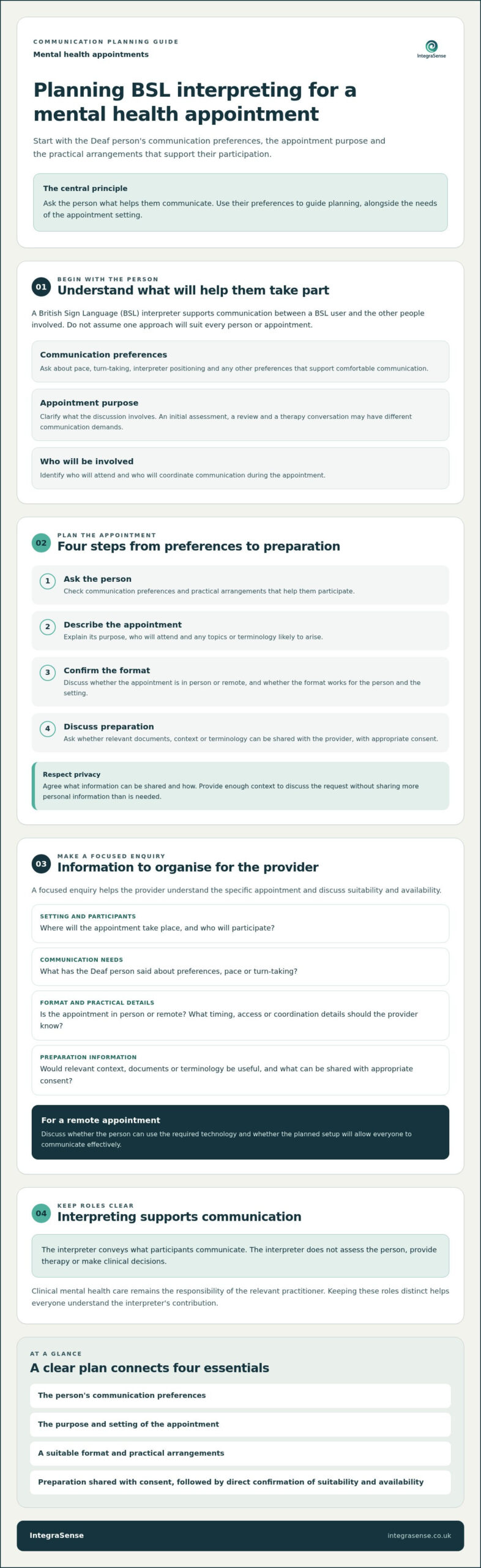
A clear plan connects the person’s preferences with the practical details of the appointment. Work through these steps with the Deaf person and the service provider:
- Ask the person: Check their communication preferences and any practical arrangements that help them take part.
- Describe the appointment: Explain its purpose, who will attend and any topics or terminology likely to arise.
- Confirm the format: Discuss whether the appointment will be in person or remote, and whether that format works for the person and setting.
- Discuss preparation: Ask whether relevant documents or topic information can be shared with the provider, with appropriate consent.
What information should you discuss before the appointment?
Be specific while respecting the person’s privacy. Ask the provider what context or terminology would be useful, and agree what information can be shared and how. Confirm who will coordinate communication on the day, how participants will take turns and whether the person has other preferences that would support their involvement. For a remote appointment, discuss whether the person can use the required technology and whether the planned setup will allow everyone to communicate effectively.
Check suitability and availability directly. IntegraSense provides BSL interpreting and specialist communication support, and an enquiry can set out the appointment context and requirements for discussion. Practitioners seeking reflective support can also explore professional supervision services. Supervision supports practitioners separately; it does not replace interpreting at an appointment.
To discuss a specific request, contact IntegraSense about communication support with the setting, format and requirements to hand.
Finding and enquiring about mental health BSL interpreting support
A focused enquiry helps a provider understand the appointment and consider whether the requested communication support may be suitable. Whether you need a mental health BSL interpreter UK service for an assessment, review or therapy appointment, share enough practical detail to explain the request while respecting the person’s privacy.
What should you ask an interpreting provider?
Use this checklist to organise the enquiry:
- Setting: Where will the appointment take place, and who will participate?
- Communication needs: What has the Deaf person said about their preferences, pace or turn-taking?
- Format: Is the appointment in person or remote, and is that format preferred and practical?
- Practical arrangements: What timing, access or coordination details should the provider know?
- Preparation: Would background information or terminology help? Ask what can be shared and how, with appropriate consent.
Then ask whether the provider can accommodate the setting, format and requirements you have described. Confirm suitability and availability rather than assuming a provider has relevant experience or can meet a particular request. If the arrangement is outside the provider’s confirmed scope, ask what options or next steps may be available.
IntegraSense lists British Sign Language interpreting and specialist communication support among its services. Review IntegraSense interpreting and communication services, then contact IntegraSense about your requirements. Include the appointment context and communication preferences so the specific request can be discussed. Suitability and availability need to be confirmed directly.
Plan communication support with the person at the centre
Effective arrangements begin with the Deaf person’s communication preferences and the purpose of the appointment. Clarify the setting, format and practical requirements, then share relevant context with the provider only with appropriate consent. This gives the provider a clear basis to discuss suitability and availability without assuming a particular arrangement will fit.
IntegraSense lists BSL interpreting and specialist communication support among its services. If you are arranging a mental health BSL interpreter UK service, a focused enquiry can help establish whether the requested support may be suitable for the appointment.
Contact IntegraSense to discuss your communication support requirements. Share the appointment context and the person’s preferences to take a considered next step towards clear communication.
Frequently Asked Questions
Is a BSL interpreter appropriate for every mental health appointment?
Not necessarily. Communication needs and preferences differ, so the Deaf person and the service should discuss arrangements for the specific appointment. Consider its purpose, participants and setting, and ask what approach the person prefers. An interpreter supports communication between participants, but does not provide mental health care or replace the clinical judgement of the practitioner.
Can a mental health appointment use remote BSL interpreting?
Remote interpreting may be suitable for some appointments, but the right format depends on the person, the conversation and the practical arrangements. Discuss the person’s preferences, whether they can access and use the required technology, and how participants will communicate through it. The service and interpreting provider can consider these requirements together before confirming whether remote support is appropriate.
What information should I provide when booking a BSL interpreter for mental health support?
Share the appointment setting and purpose, who will participate, the preferred format and any relevant communication needs. Ask whether documents or topic information would help with preparation, and agree how to share them appropriately, with the person’s consent where relevant. Confirm directly with the provider what information is useful and whether it can meet the request.
How do I find out whether an interpreter can support a mental health setting?
For a mental health BSL interpreter UK enquiry, describe the setting, appointment format and communication requirements, then ask the provider about relevant experience, availability and preparation. Do not assume suitability from a general service description alone. IntegraSense lists BSL interpreting and specialist communication support, and can be contacted to discuss the specific requirements and confirm whether they can be met.