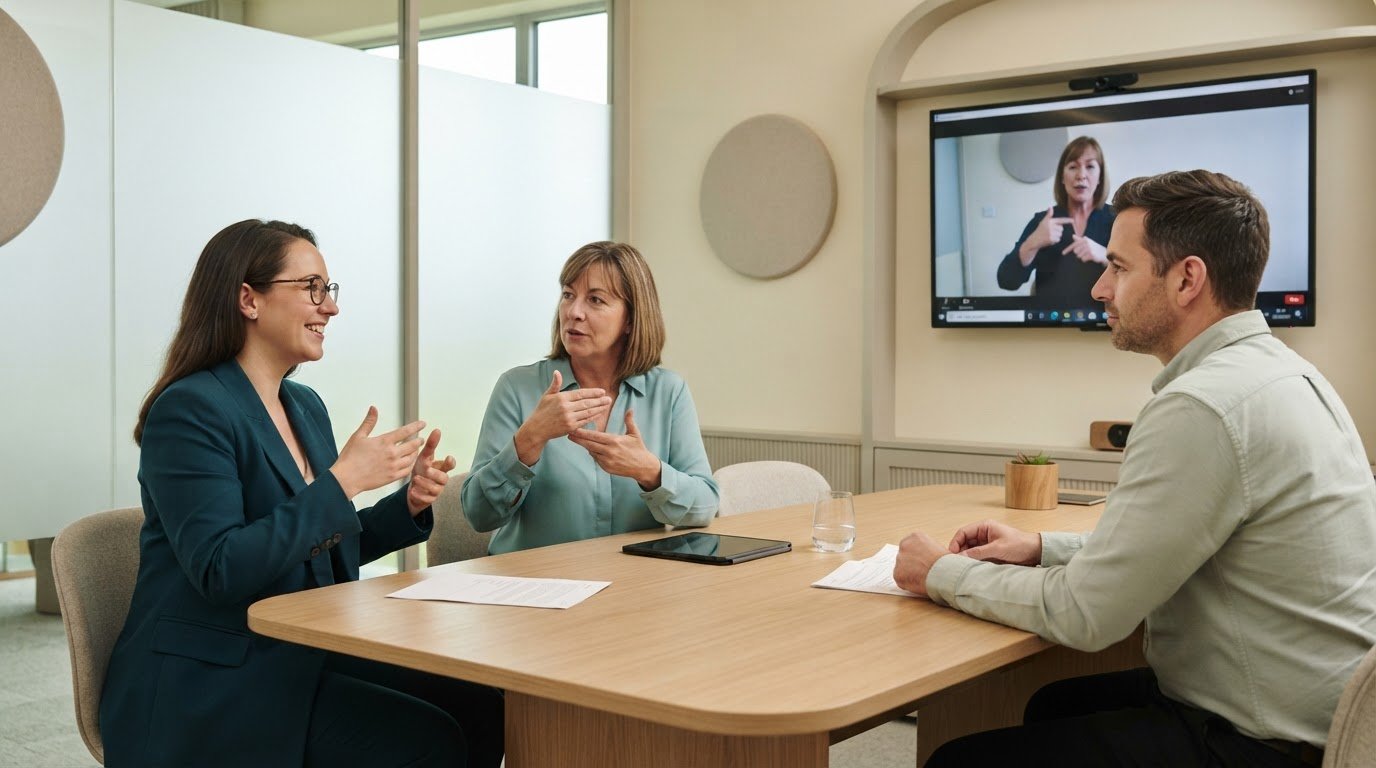
Selecting the delivery model for British Sign Language (BSL) communication support is never merely an administrative convenience. When evaluating in-person vs remote BSL interpreting, treating delivery format as an operational shortcut rather than a structured professional judgment introduces genuine risk into complex environments. You likely recognise the recurring tension between immediate digital availability and the necessity of safeguarding message fidelity in high-stakes settings where spatial language cannot be compromised.
This guide provides a defensible, person-centred framework to help your organisation establish exactly when on-site presence is mandatory and when remote technology provides equitable access. We examine the technical thresholds, cognitive demands, and professional standards required to make consistent, justifiable decisions that prioritise quality and individual communication needs.
Key Takeaways
- Establish a structured screening process to evaluate in-person vs remote BSL interpreting based on situational risk, environmental suitability, and individual communication preferences.
- Identify the essential technical thresholds, including dedicated bandwidth and appropriate screen dimensions, required to sustain visual-spatial clarity during remote assignments.
- Recognise the operational scenarios that necessitate on-site presence, particularly complex diagnostic settings and extended meetings where cognitive fatigue impacts comprehension.
- Formulate an auditable, person-centred policy supported by accessibility consultancy and professional supervision to maintain high standards across all service provisions.
Evaluating the Landscape of Modern BSL Interpreting Delivery
The rapid adoption of Video Remote Interpreting (VRI) has transformed accessibility across public institutions and private enterprises. Even so, effective provision requires recognising that BSL is an intricate visual-spatial language. Meaning is conveyed not merely through hand formations, but through depth, eye gaze, facial expressions, and spatial referencing around the upper body. A standard two-dimensional screen fundamentally alters how these visual markers are projected and perceived.
Consequently, delivery methods must function as distinct operational mechanisms within a wider accessibility strategy. Evaluating in-person vs remote BSL interpreting is never an administrative default. It demands a rigorous professional assessment of the environment to determine whether remote channels maintain linguistic fidelity and organisational governance.
The Evolution of Video Remote Interpreting
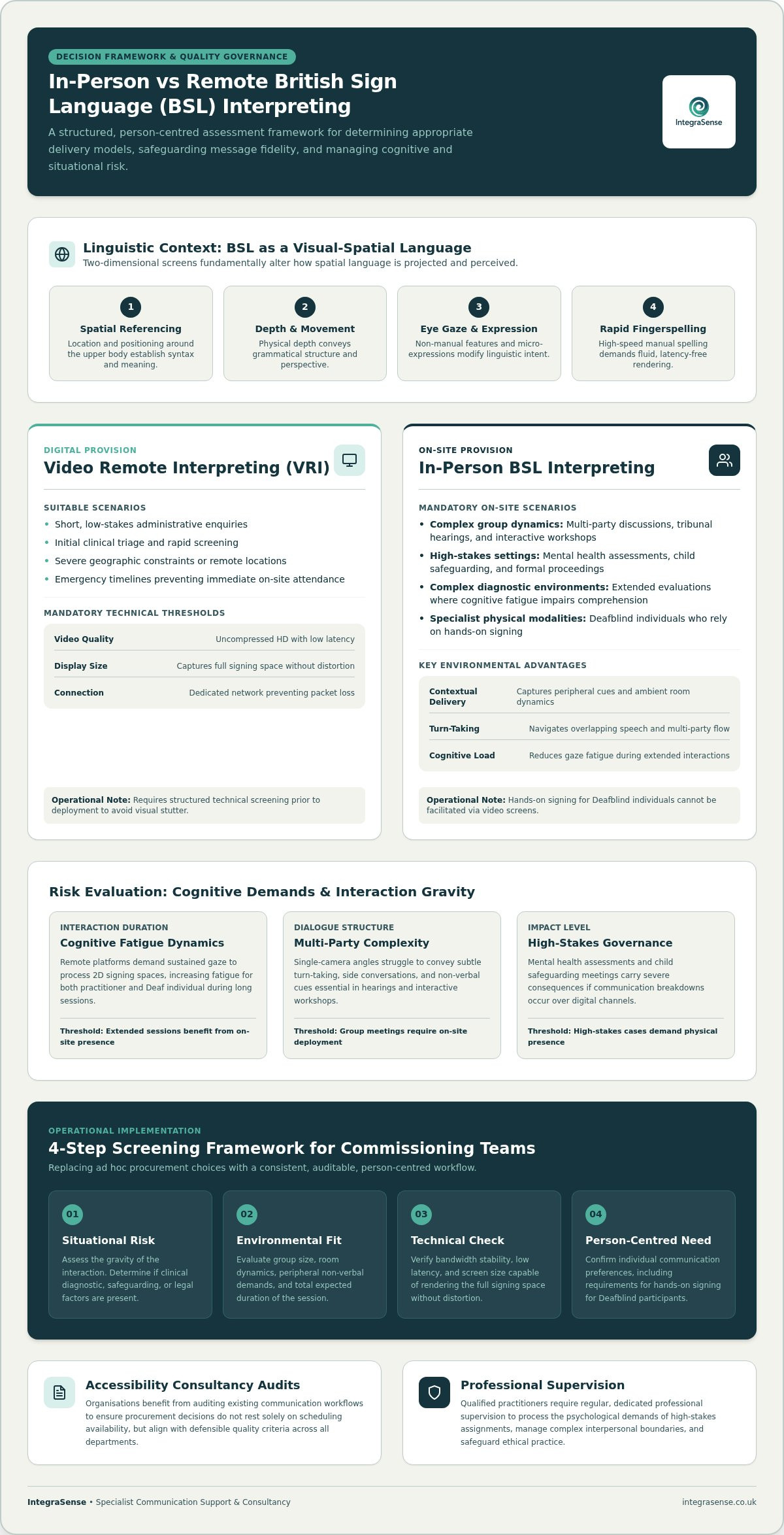
Remote platforms offer flexible, on-demand engagement for short, low-stakes appointments, administrative enquiries, or initial clinical triage. When severe geographic constraints or emergency timelines prevent physical attendance, remote technology delivers vital access. However, successful execution depends upon strict technical parameters:
- Uncompressed, high-definition video feeds with low latency to preserve the fluidity of rapid finger-spelling.
- Sufficient display dimensions that capture the complete signing space without spatial distortion.
- Dedicated network connections that prevent packet loss and visual stutter during live dialogue.
Applying these standards ensures that remote solutions are deployed responsibly, supporting defensible decisions across diverse organisational settings through structured specialist communication support.
Clinical and Organisational Risk Factors in Interpreting Delivery
Treating the choice between in-person vs remote BSL interpreting as an operational risk assessment safeguards institutional governance. In sensitive environments, such as mental health assessments, child safeguarding meetings, or formal proceedings, communication breakdown carries profound operational consequences. Remote video platforms often introduce heightened cognitive fatigue for both the practitioner and the Deaf individual during extended interactions, largely due to the sustained gaze required to process two-dimensional signing spaces.
When In-Person British Sign Language Interpreting is Essential
Physical deployment remains irreplaceable across complex settings where physical presence directly influences message clarity. Key factors that dictate on-site provision include:
- Complex group dynamics: Multi-party discussions, tribunal hearings, and interactive workshops involve subtle turn-taking and overlapping speech that single-camera angles cannot adequately capture.
- Visual and physical context: On-site practitioners observe peripheral non-verbal cues, environmental developments, and ambient room dynamics that inform accurate contextual delivery.
- Specialist physical modalities: Deafblind individuals with combined sight and hearing loss who rely on hands-on signing require on-site specialists, as this mode cannot be facilitated through a screen.
Developing defensible protocols ensures that delivery models match the gravity of the interaction. Establishing this framework is supported by structured professional supervision, which assists teams in evaluating situational risk objectively.
Implementing a Defensible Strategy for Communication Support
Commissioning teams require a structured policy that links the complexity of an interaction directly to the delivery format. Rather than allowing procurement decisions to rest solely on scheduling availability, organisations benefit from partnering with an accessibility consultancy to audit existing workflows. A robust framework evaluates language nuance, environmental demands, and individual preferences before confirming whether an assignment proceeds on site or online.
This systematic alignment guarantees that communication support remains resilient across every department. Objective criteria replace ad hoc choices, ensuring full transparency in professional governance.
Professional Supervision and Quality Assurance in Interpreting
Interpreting involves intense cognitive processing and complex interpersonal dynamics. To maintain delivery standards across both in-person and remote settings, structured governance mechanisms must be integrated into service contracts:
- Professional supervision: Qualified practitioners require regular, dedicated supervision to process the psychological demands of high-stakes assignments, evaluate boundary challenges, and safeguard ethical practice.
- External quality assurance: Embedding independent external oversight verifies that language professionals hold appropriate voluntary registrations and maintain linguistic accuracy across diverse clinical or statutory settings.
- Reflective practice: Structured debriefing sessions enable practitioners to examine critical incidents, identify communication friction points, and continually refine their situational judgment.
IntegraSense delivers professional supervision and external quality assurance that uphold high practice standards across all modalities, reinforcing defensible decision-making across complex organisational environments.
Advancing Defensible Standards in Communication Delivery
Navigating the balance of in-person vs remote BSL interpreting requires moving beyond operational convenience toward structured, defensible governance. Matching the delivery modality to situational complexity ensures message fidelity, respects individual preferences, and prevents communication breakdown across critical environments.
Organisations achieve consistent, high-quality outcomes when their policies are grounded in specialist insight and continuous oversight. IntegraSense combines specialist BSL and Deafblind interpreting expertise with dedicated professional supervision for practitioners, offering the clarity required to guide defensible decision-making across complex public and private sector settings.
Contact IntegraSense to discuss your specialist communication and interpreting requirements and establish a robust, person-centred delivery framework for your teams.
Frequently Asked Questions
Is remote BSL interpreting legally compliant for all healthcare appointments?
Remote delivery is not appropriate for every clinical environment. Ensuring compliance depends upon whether the format satisfies individual communication requirements and safeguards message fidelity. When evaluating in-person vs remote BSL interpreting for sensitive diagnostics, complex care planning, or mental health consultations, on-site provision is generally necessary to maintain robust professional standards and patient safety.
How do I determine if a Deafblind individual requires hands-on signing or remote support?
A specialist Deafblind assessment determines the appropriate communication method based on visual field, hearing loss, and individual preference. Individuals who have combined sight and hearing loss and communicate via hands-on signing require on-site specialists. Two-dimensional video screens cannot transmit physical touch or spatial positioning, making physical attendance mandatory whenever tactile communication methods are needed.
What are the technical requirements for a successful Video Remote Interpreting session?
Successful delivery requires a reliable internet connection with dedicated bandwidth of at least 2 to 4 Mbps. Display hardware must support high-definition video at 30 to 60 frames per second, viewed on screens measuring at least 10 to 12 inches for personal devices. Low latency and clear lighting are essential to capture fine finger-spelling and facial expressions accurately.
Can I use a mix of in-person and remote interpreting for the same project?
Organisations frequently adopt blended communication strategies across multi-stage projects. Administrative catch-ups or preliminary briefings can proceed through remote video platforms, while complex assessments, multidisciplinary case reviews, and formal proceedings transition to on-site delivery. Each touchpoint requires an independent assessment to establish whether remote or physical attendance delivers the necessary standard of communication support.