
The Core Functions of an Internal Quality Assurer
For training providers, further education colleges, and organisations delivering accredited qualifications, robust internal quality assurance (IQA) is the cornerstone of a credible assessment system. The role of an IQA assessor is not merely administrative; it is a dynamic function dedicated to upholding the integrity and consistency of assessment judgements. An effective IQA process provides confidence that all learners are assessed fairly and that an organisation’s qualifications will withstand the scrutiny of external quality assurance.
The primary activities of an IQA assessor include:
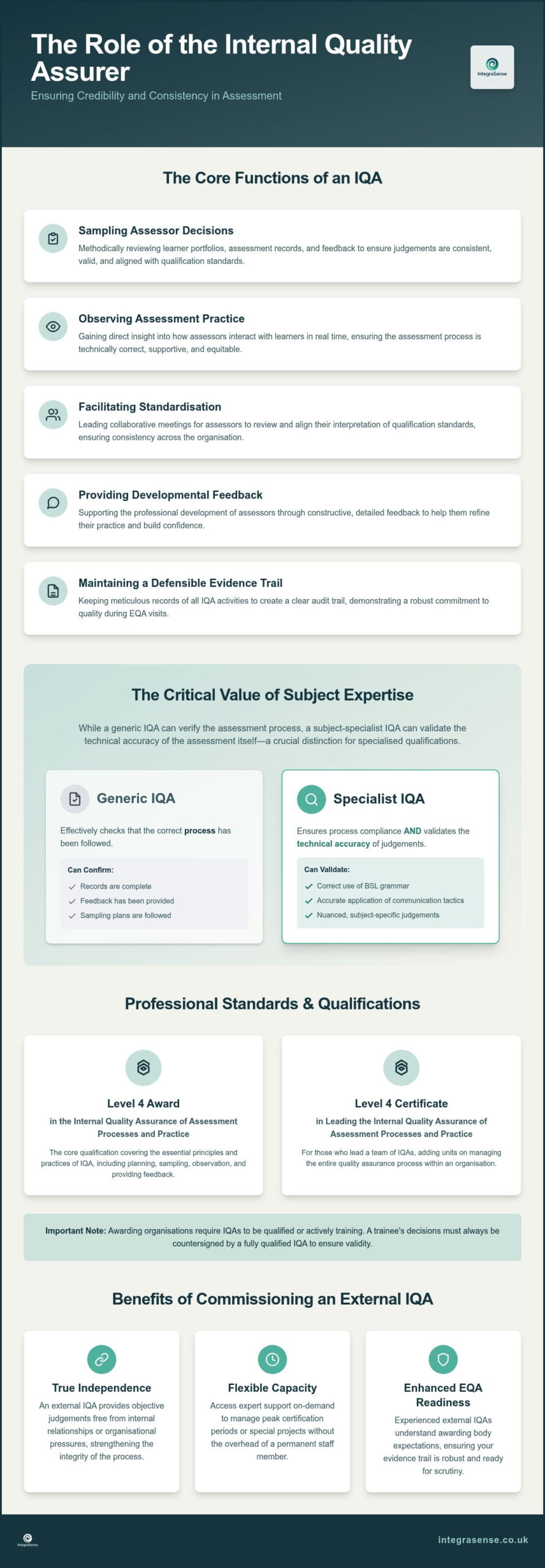
- Sampling Assessor Decisions: The IQA methodically samples the work of each assessor. This involves reviewing portfolios of learner evidence, assessment records, and feedback to confirm that judgements are consistent, valid, and aligned with the qualification standards.
- Observing Assessment Practice: Direct observation provides valuable insight into how an assessor interacts with learners and conducts assessments in real time. It helps ensure that the process is not only technically correct but also supportive and equitable for all learners.
- Facilitating Standardisation: IQAs lead standardisation meetings where assessors convene to review and discuss assessment materials and judgements. This collaborative process is vital for ensuring every assessor interprets the qualification standards in the same way, leading to greater consistency across the organisation.
- Providing Developmental Feedback: A key function of the IQA is to support the professional development of assessors. Through constructive, detailed feedback, the IQA helps assessors refine their practice, address inconsistencies, and build confidence in their roles.
- Maintaining a Defensible Evidence Trail: Meticulous record-keeping is essential. The IQA maintains a clear and comprehensive audit trail of all quality assurance activities. This documentation serves as crucial evidence during an External Quality Assurance (EQA) visit, demonstrating the organisation’s commitment to quality.
The Importance of Specialist Subject Expertise in IQA
While the principles of IQA are universal, their application in specialist fields requires more than just procedural knowledge. For providers delivering training in highly technical or nuanced subjects, such as British Sign Language (BSL) or Deafblind communication, the value of a subject matter expert IQA cannot be overstated.
An IQA without a background in the specific subject can effectively check the assessment process. They can confirm that records are complete, that feedback has been given, and that sampling plans are being followed. However, they cannot validate the technical soundness of the assessment decisions themselves. This creates a significant gap in the quality assurance cycle.
Beyond the Process: Ensuring Technical Accuracy in Assessment
In a BSL course, for example, is an assessor correctly evaluating a learner’s use of grammar, spatial awareness, and non-manual features? In a Deafblind awareness qualification, has the assessor accurately judged the learner’s ability to apply complex communication tactics? Without specialist knowledge, an IQA can only assume the assessor’s judgement is correct.
Similarly, in the security industry, ensuring that an assessor correctly evaluates practical defense or patrol techniques—such as those found in a QQI Level 4 Guarding Skills course Ireland—requires an IQA with specific sector experience.
A specialist IQA brings a dual competency. They understand the mechanics of robust quality assurance and possess the deep subject expertise needed to challenge and confirm the accuracy of assessment decisions. This strengthens the entire assessment framework, reduces the risk of incorrect judgements, and provides a more meaningful development pathway for specialist assessors. It ensures that the quality assurance process is not just a box-ticking exercise but a genuine measure of technical and professional excellence.
Professional Standards: Qualifications and Competence for an IQA
The credibility of an IQA assessor is underpinned by recognised qualifications and demonstrable professional competence. For organisations in Kent and across the South East, understanding these standards is key to selecting the right quality assurance partner.
The nationally recognised qualifications for this role are:
- The Level 4 Award in the Internal Quality Assurance of Assessment Processes and Practice: This is the core qualification for anyone practising as an IQA. It covers the principles and practices of IQA, including planning, sampling, observation, and providing feedback.
- The Level 4 Certificate in Leading the Internal Quality Assurance of Assessment Processes and Practice: This qualification is designed for those who manage a team of IQAs. It builds on the Award, adding units on leading the IQA process and managing the quality of assessment within an organisation.
Awarding organisations typically require IQA staff at their approved centres to either hold the relevant qualification or be actively working towards it. In cases where an IQA is in training, their decisions must be countersigned by a fully qualified IQA. This ensures that all quality assurance judgements remain valid and reliable throughout the training period.
While specific IQA qualifications are essential, many professionals first establish their expertise through academic degrees; for example, you can discover Sardar Patel Educational Institute and their offerings in B.Ed and M.Ed studies.
Commissioning IQA Services: The Benefits of an External Assessor
While many larger organisations maintain an in-house IQA team, an increasing number of providers are choosing to commission external IQA support. This strategic decision offers several distinct advantages, particularly for those delivering specialist training or managing fluctuating assessment schedules.
Key benefits include:
- True Independence: An external IQA is entirely independent of the assessment team. This objectivity strengthens the integrity of the quality assurance process, as their judgements are not influenced by internal relationships or organisational pressures.
- Flexible Capacity: Commissioning an IQA provides access to expert support when you need it most. This is particularly useful for managing peak certification periods or preparing for an upcoming EQA visit without the overhead of a permanent staff member.
- Enhanced EQA Readiness: An experienced external IQA will be highly familiar with the expectations of various awarding organisations.
Partnering with a Kent-Based IQA Specialist
IntegraSense provides professional, independent IQA services for assessment centres and training providers across Kent and the South East. We specialise in the quality assurance of qualifications related to specialist communication and accessibility, including BSL and Deafblind studies. Our approach combines a rigorous adherence to IQA best practices with the deep subject matter expertise needed to validate technical assessment judgements.
By partnering with us, you gain access to a flexible and credible resource that strengthens your assessment systems and supports the continuous development of your assessors. We work with you to establish a quality assurance framework that is proportionate, effective, and ready for external scrutiny.
Frequently Asked Questions about IQA
What is the difference between internal and external quality assurance?
Internal quality assurance (IQA) is the process conducted within the assessment centre or training provider to monitor and improve its own assessment practices. It is carried out by the organisation’s own staff or a commissioned specialist. External quality assurance (EQA) is the next layer of review, performed by an external body. This is typically the awarding organisation, but it can also be an independent specialist commissioned to review the centre’s overall quality framework.
What qualification should an IQA hold?
An IQA should hold, or be working towards, the Level 4 Award in the Internal Quality Assurance of Assessment Processes and Practice. If they are leading a team of IQAs, the appropriate qualification is the Level 4 Certificate in Leading the Internal Quality Assurance of Assessment Processes and Practice.
Can an IQA quality assure a subject they are not experienced in?
An IQA can check the quality of the assessment process without being a subject matter expert. They can ensure paperwork is complete, sampling plans are followed, and feedback is recorded. However, they cannot validate the technical accuracy of the assessor’s judgement. For specialist subjects, it is highly recommended that the IQA also has relevant sector expertise to ensure the quality of the assessment decision itself.
How often should internal quality assurance sampling take place?
There is no single rule for sampling frequency. It should be determined by a risk-based approach. Factors to consider include the experience of the assessor (new assessors should be sampled more frequently), the complexity of the qualification, and any issues identified from previous IQA or EQA activities. The sampling strategy should be clearly documented in an IQA plan.
To enhance your organisation’s assessment integrity with expert internal quality assurance in Kent, contact IntegraSense to discuss your requirements. We offer tailored support to help you achieve and maintain the highest standards of professional practice.