
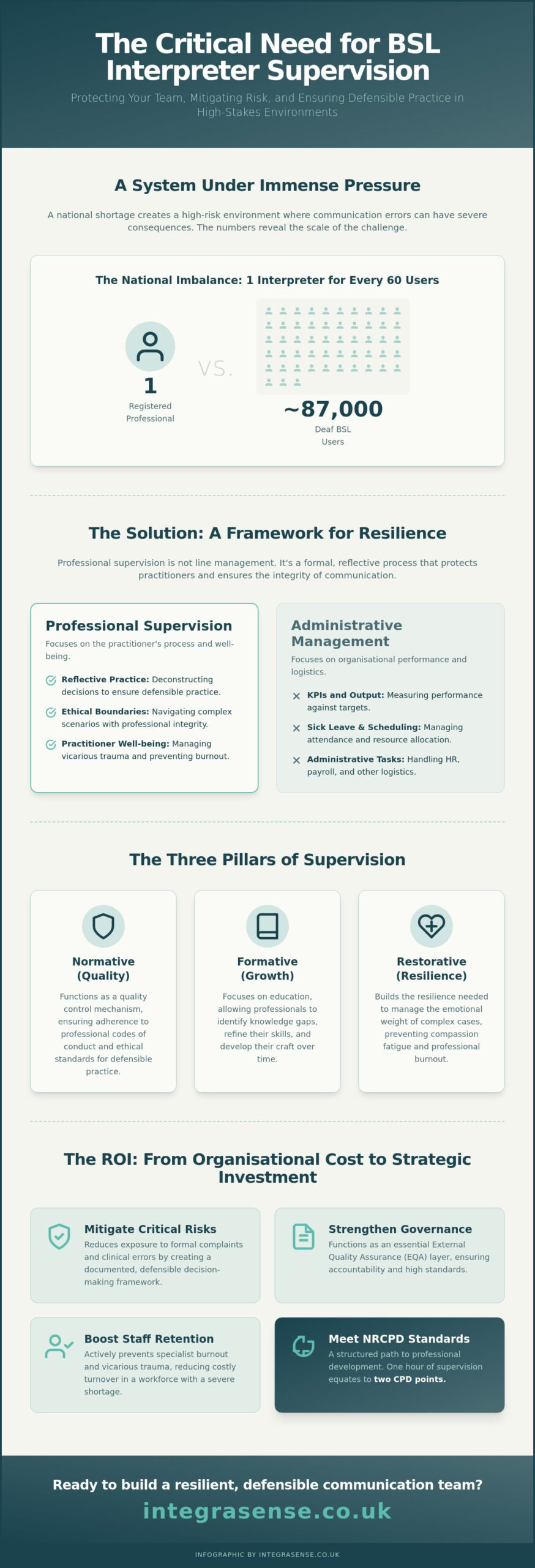
A single communication error in a clinical or legal setting can trigger a formal complaint that costs your organisation far more than any service fee. With a national shortage leaving only 2,000 registered professionals to support 87,000 Deaf BSL users, the current ratio of one interpreter to every 60 users places immense pressure on your specialist staff. You likely recognise that meeting the requirements of the BSL Act 2022 is about more than just booking a slot; it’s about maintaining the integrity of the message. This is why professional supervision for BSL interpreters has moved from a discretionary benefit to a critical governance tool for defensible practice.
Discover how IntegraSense provides a framework that protects your team from vicarious trauma while ensuring high-quality, clinical-grade communication. We’ll examine the ROI of resilience, the NRCPD requirement where one hour of supervision equates to two CPD points, and the practical steps to reduce clinical risk in 2026. This guide offers the clarity you need to move from reactive crisis management to an optimised, sustainable model of accessibility.
Key Takeaways
- Define the critical distinction between administrative line management and reflective practice to ensure specialist staff are supported beyond simple KPIs.
- Mitigate the operational risks of vicarious trauma and burnout by implementing structured professional supervision for BSL interpreters in high-pressure environments.
- Strengthen your organisation’s governance through defensible decision-making frameworks that protect against formal complaints and clinical communication errors.
- Establish a clear three-way contract between the supervisor, practitioner, and organisation to maintain confidentiality while ensuring quality assurance and professional accountability.
- Leverage supervision as a strategic retention tool that meets NRCPD standards and provides a measurable return on investment for your communication support budget.
Understanding Professional Supervision for BSL Interpreters
Professional supervision is a formal, contractual arrangement where practitioners review their work with a qualified supervisor. It’s a structured space for critical reflection that sits entirely apart from administrative line management. While a manager focuses on sick leave and output, a supervisor focuses on the practitioner’s internal processes and ethical boundaries. This distinction is vital for maintaining the integrity of Language interpretation in sensitive environments.
We categorise the impact of this support into three core pillars:
- Normative: This serves as a quality control mechanism, ensuring the interpreter adheres to professional codes of conduct.
- Formative: This focuses on the educational aspect, allowing the professional to identify knowledge gaps and refine their craft.
- Restorative: This builds the resilience needed to manage the emotional weight of complex cases, preventing burnout.
BSL interpreting requires this specific focus because of the unique linguistic and emotional labor involved. Interpreters aren’t just conduits; they’re active participants in high-stakes communication. Without supervision for BSL interpreters, the risk of vicarious trauma remains high, threatening the stability of the UK’s limited workforce of 2,000 registered professionals.
The Mechanism of Reflective Practice
Reflective practice allows an interpreter to deconstruct their decision-making after a session. In high-pressure settings, professionals often work on instinct. Supervision provides the tools to analyse these micro-decisions. This transition from reactive interpreting to intentional, defensible practice ensures that every action is ethically sound and professionally justified.
Supervision vs. Mentoring: Key Differences
Confusion often exists between these two disciplines. Mentoring is primarily about skill acquisition and learning from a senior peer’s experience. Supervision, however, focuses on the psychological and ethical dynamic between the practitioner and the service user. Even the most seasoned professionals require supervision for BSL interpreters to identify blind spots and maintain their emotional health over a long career.
Strategic Benefits: Why Organisations Must Prioritise Supervision
Organisations often view professional support as a secondary concern. This perspective overlooks the significant liability risks associated with communication failure. In high-stakes environments such as police interviews or mental health assessments, the emotional and cognitive load is extreme. Implementing structured supervision for BSL interpreters acts as a strategic buffer against these risks.
By integrating this practice, your organisation adopts a model of defensible decision making. When a professional can justify their linguistic choices through a documented reflective process, the likelihood of successful formal complaints or legal challenges diminishes. It’s about precision. It’s about accountability. This level of oversight ensures that your communication remains high-quality and legally sound.
The economic argument is equally compelling. With a workforce that’s overstretched, such as in Wales where only 54 registered interpreters remained as of December 2025, the cost of losing a specialist to burnout is prohibitive. Supervision reduces long-term sick leave by identifying signs of exhaustion before they lead to resignation. If you’re looking to fortify your team’s resilience, our professional supervision services provide the necessary framework for sustainability.
Mitigating Vicarious Trauma and Compassion Fatigue
Vicarious trauma occurs when an interpreter absorbs the distressing experiences of the service users they assist. This is particularly prevalent in social care and criminal justice settings. Without intervention, this leads to compassion fatigue and a decline in interpreting accuracy. For a deeper analysis of these risks, see our guide on Tackling Vicarious Trauma in BSL Interpreting.
Governance and Quality Assurance
Supervision functions as an essential External Quality Assurance (EQA) layer. It ensures that practitioners meet the National Registers of Communication Professionals (NRCPD) requirements, where one hour of supervision provides two CPD points toward their annual 24-point quota. This alignment with professional standards highlights the benefits of supervision for interpreters, transforming individual practice into a robust organisational asset.
Implementing a Robust Supervision Framework in Your Organisation
Transitioning from strategic intent to operational reality requires a structured approach to delivery. Organisations should establish a regular cadence for sessions to ensure consistency. Monthly 1:1 meetings are the gold standard for high-risk settings like mental health or legal services, while group supervision offers a cost-effective alternative for larger interpreting teams. This collaborative format fosters a shared sense of professional identity and collective problem-solving.
A critical component of this framework is the “three-way contract” between the supervisor, the interpreter, and the organisation. This document defines the boundaries of confidentiality and specifies what information must be reported back to the employer, such as safeguarding concerns or significant clinical errors. Clear boundaries protect all parties and ensure that supervision for BSL interpreters remains a safe space for reflection without compromising organisational oversight.
Funding these sessions shouldn’t be a barrier to implementation. Access to Work (AtW) grants frequently cover the costs of professional support for both d/Deaf and hearing interpreters. Organisations should proactively assist their staff in navigating these applications to offset the financial burden. Alternatively, integrating these costs directly into BSL procurement budgets or salary packages ensures that professional resilience is treated as a core operational expense rather than a discretionary extra.
Selecting the Right Professional Supervisor
Effective oversight depends on the supervisor’s specific expertise. You should verify that they hold a recognised qualification, such as a Diploma in Supervision, and possess deep experience within the BSL/English linguistic landscape. A supervisor who understands the unique cultural nuances of the Deaf community will provide far more relevant guidance than a generalist practitioner. This industry-specific insight is vital for identifying subtle risks in communication. Practitioners seeking accessible, specialist-led support can book professional supervision online to ensure they are matched with a supervisor who holds the precise expertise their caseload demands.
Measuring the Impact of Supervision
To justify the investment, organisations must track specific performance indicators. Monitor metrics such as a reduction in formal incident reports, lower staff turnover rates, and improved practitioner confidence scores during annual reviews. If your organisation requires a tailored framework to manage these complexities, contact IntegraSense for bespoke consultancy that aligns with your specific operational requirements and compliance duties.
For organisations operating in highly regulated sectors, maintaining this level of compliance often extends to cybersecurity and data privacy. Expert consultancies like SeComPass provide the necessary advisory and assurance services to ensure that sensitive information remains protected across all operational levels.
Securing the Future of Professional Communication
Transitioning from reactive support to a structured governance model is no longer optional for organisations prioritising safety. By distinguishing between administrative oversight and reflective practice, you provide your team with the tools to manage the 1:60 interpreter-to-user ratio currently facing the UK. Implementing supervision for BSL interpreters ensures that every micro-decision made in a clinical or legal setting is ethically sound and professionally defensible. This proactive approach mitigates the risk of formal complaints while safeguarding the mental health of your specialist workforce.
IntegraSense has been at the forefront of this shift since our founding in 2019. Our team provides specialist supervisors for the health, education, and legal sectors; we focus on building resilience through robust, defensible decision-making frameworks. We help you navigate the complexities of Access to Work funding and quality assurance to create a seamless, sustainable service. Contact IntegraSense for professional supervision and consultancy to optimise your communication support strategy. Investing in your team’s resilience today ensures the long-term integrity of your organisation’s accessibility commitments.
Frequently Asked Questions
Is professional supervision for BSL interpreters mandatory in the UK?
No, professional supervision is currently a voluntary standard rather than a legal mandate for registration with the NRCPD. However, the regulatory body identifies it as a high-value activity within its 2026 CPD handbook, awarding two points for every hour of structured sessions. Many public sector frameworks and healthcare trusts now require evidence of ongoing supervision as a condition of contract to mitigate clinical risk and ensure compliance with the BSL Act 2022.
Can Access to Work (AtW) be used to pay for professional supervision?
Yes, Access to Work (AtW) grants frequently cover the costs of supervision for BSL interpreters as a legitimate workplace adjustment. Both d/Deaf and hearing professionals can apply for these funds to maintain their practice standards and mental health. It’s essential to include supervision in the initial application or during a claim review, specifically highlighting its role in preventing burnout and ensuring the sustainability of the interpreter’s role in high-pressure settings.
What is the difference between clinical supervision and professional supervision for interpreters?
Clinical supervision focuses on the patient-practitioner relationship within medical or therapeutic settings, whereas professional supervision for interpreters focuses on the linguistic and ethical process of communication. While a clinical supervisor manages medical outcomes, an interpreting supervisor helps the professional navigate the emotional labor of the assignment. This distinction ensures the interpreter remains an effective conduit without absorbing the trauma of the environment, a service IntegraSense provides across diverse specialist sectors.
How often should a BSL interpreter attend supervision sessions?
Frequency depends on the practitioner’s caseload and the intensity of their work environment. Most professionals working in high-stakes domains like social care or mental health attend sessions once every four to six weeks to maintain safe practice. For those in lower-risk settings, quarterly sessions might suffice. The goal is to establish a consistent cycle of reflection that prevents compassion fatigue from accumulating, ensuring long-term professional resilience. For practitioners managing demanding caseloads with limited time, the ability to book professional supervision online offers a flexible, strategically sound solution for maintaining this essential reflective practice.