
Can you truly defend a legal decision if the underlying assessment failed to account for the unique communication needs of a person with dual sensory loss? A generic mental capacity evaluation often falls short of the Care and Support (Assessment) Regulations 2014, creating significant risks for practitioners. We recognize the pressure you’re under to meet Kent County Council standards while managing the complexities of the Mental Capacity Act 2005. It’s a delicate balance where the cost of error is high, especially with residential care fees in Kent now reaching up to £1,918.42 per week for specialist placements as of April 2025.
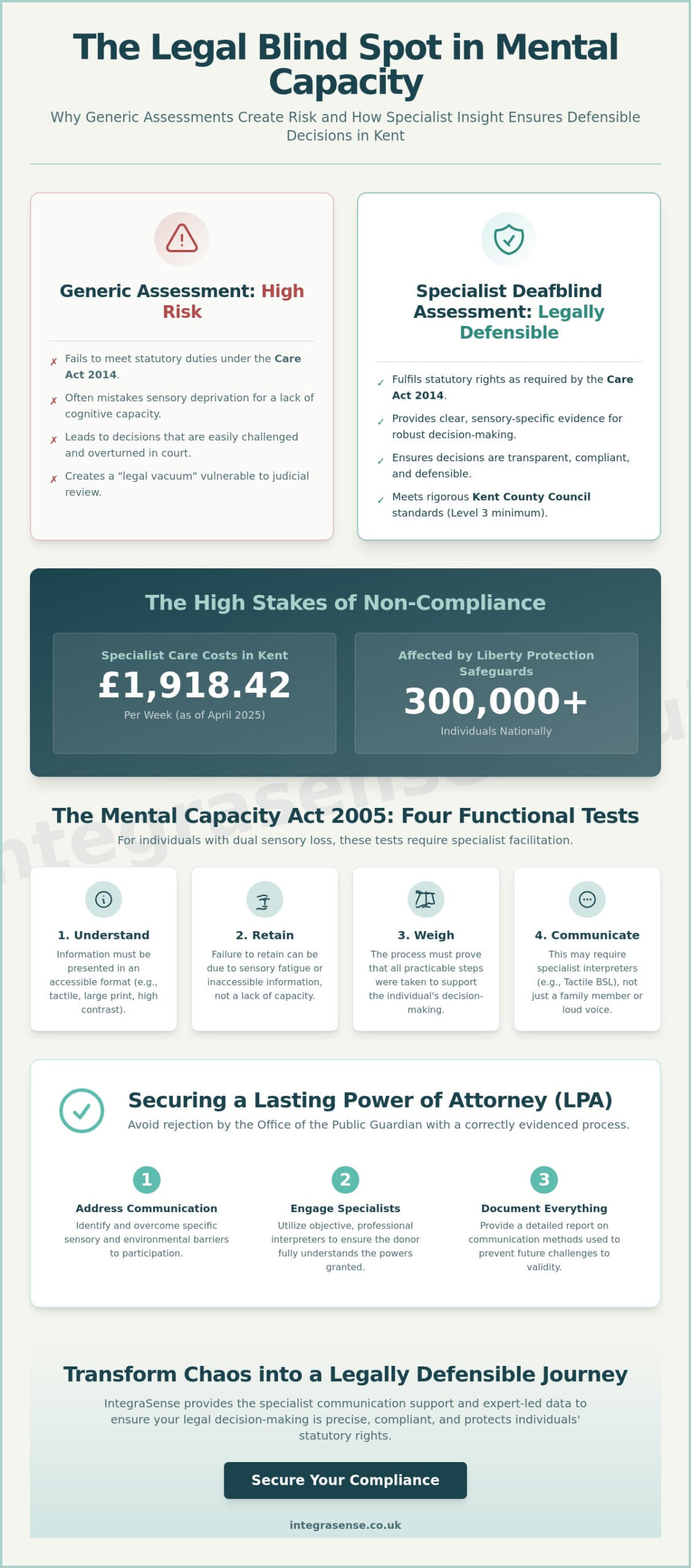
This article explains how a specialist deafblind assessment and legal decision making Kent strategy ensures your decisions are robust, transparent, and fully compliant. You’ll learn how specialist sensory evidence clarifies mental capacity, simplifies the path for Lasting Power of Attorney, and prepares your practice for the transition to Liberty Protection Safeguards (LPS) which affects over 300,000 people. By integrating IntegraSense’s expert insights, you can transform a chaotic assessment process into a seamless, legally defensible journey that prioritizes the individual’s statutory rights.
Key Takeaways
- Identify why a specialist deafblind assessment and legal decision making Kent framework is a statutory necessity under the Care Act 2014 for defensible outcomes.
- Learn how to accurately apply the four functional tests of the Mental Capacity Act 2005 for individuals with complex dual sensory loss.
- Establish a clear, compliant path for executing Lasting Power of Attorney by addressing significant communication barriers with specialist expertise.
- Discover how documented, evidence-based reasoning from IntegraSense mitigates legal risks and meets rigorous Kent County Council standards.
The Role of Specialist Deafblind Assessment in Legal Decision Making
Under the Care Act 2014, a specialist assessment isn’t a luxury; it’s a statutory right for any Kent resident whose dual sensory impairment impacts their daily life. When we discuss the framework for deafblind assessment and legal decision making Kent practitioners must follow, we’re talking about a rigorous evidentiary process. Generic social care evaluations frequently fail the ‘defensible’ test in legal settings. They lack the technical depth to differentiate between cognitive decline and sensory deprivation, leading to decisions that are easily challenged in court. By May 2026, Kent County Council standards have evolved to require sensory-specific evidence that accounts for the unique way Deafblindness affects information processing and executive function.
Capturing legal testimony from an individual with combined sight and hearing loss requires more than just a loud voice or large print. It demands an understanding of tactile communication, environmental sensing, and the specific fatigue associated with sensory effort. Specialist assessors utilize intelligence-led methods to ensure the individual’s voice is heard clearly. Without this specialist insight, legal decisions regarding mental capacity or high-cost care placements remain vulnerable. Precision in the initial assessment phase creates a seamless transition to long-term legal sustainability.
Statutory Duties and the Kent Local Context
Kent County Council maintains strict requirements for specialist involvement, aligning with Department of Health guidance that assessors must be ‘appropriately trained’ to a minimum of Level 3 in deafblindness. Bypassing these experts creates a significant legal vacuum. If a decision is made without a qualified specialist, the resulting care plan or capacity ruling is often deemed indefensible during a judicial review. IntegraSense provides the specialist communication support necessary to bridge this gap. This ensures that every deafblind assessment and legal decision making Kent process is grounded in precise, expert-led data that meets 2026 compliance standards.
Navigating Lasting Power of Attorney and the Mental Capacity Act
The Mental Capacity Act 2005 hinges on four functional tests: the ability to understand, retain, weigh, and communicate information. For individuals with dual sensory impairment, these tests aren’t simple hurdles. They represent complex interactions between sensory input and cognitive output. If a person cannot see the evidence or hear the explanation, their failure to ‘retain’ information is a failure of the process, not their capacity. Achieving a robust deafblind assessment and legal decision making Kent outcome requires practitioners to document exactly how they facilitated these tests. It’s about proving that every practicable step was taken to support the individual before making a final determination.
Executing a lasting power of attorney involves high-stakes communication. In Kent, legal practitioners often face challenges when donors use tactile BSL or have specific environmental needs that affect their ability to participate. Without specialist evidence, an LPA is vulnerable to future litigation or rejection by the Office of the Public Guardian. Professionals should consult a Mental Capacity Act 2005 guide tailored for sensory loss to avoid these pitfalls. Precision here ensures that the donor’s wishes are protected and the legal framework remains resilient against scrutiny.
Communication Adjustments for LPA Execution
Specialist interpreters are essential during the signing process to ensure the donor fully grasps the scope of the powers they are granting. It isn’t enough to have a family member translate; you need an objective professional who can provide a detailed report on the communication methods used. This documentation prevents later challenges to the document’s validity. By prioritizing these adjustments, Kent organisations can move from a state of legal anxiety toward one of optimized compliance. If you require expert oversight, our team can provide specialist communication support to secure your legal proceedings and ensure every decision is evidence-based.
Securing Defensible Outcomes: Specialist Consultancy in Kent
Defensible decision making is the gold standard for statutory social care in Kent. It involves a documented, evidence-based reasoning process that can withstand high-level legal scrutiny. When a local authority or legal team relies on generic data, they risk significant failure during a judicial review. Robust deafblind assessment and legal decision making Kent processes rely on granular detail that accounts for every sensory nuance. IntegraSense acts as a visionary partner, providing the specialist communication support required to translate complex sensory needs into clear, actionable legal evidence.
External Quality Assurance (EQA) offers an additional layer of resilience in high-stakes disputes. In 2026, the complexity of sensory-legal cases has increased, making third-party oversight essential for effective risk management. We position ourselves as a trusted leader for Care Act compliant deafblind assessment services. This ensures that every report isn’t just a summary of needs, but a strategic document that supports long-term sustainability for both the provider and the individual. Our methodical approach ensures that technical depth never overwhelms the clarity of the decision.
Risk Mitigation for Public Sector Providers
Public sector organisations should audit their current pathways to ensure they meet the statutory requirement for a specialist assessment. Start by identifying cases where communication barriers were noted but no Level 3 qualified specialist was involved. Using expert reports to defend against formal complaints or judicial reviews is a logical, common-sense approach to the complex engineering of care. It’s about moving away from the chaotic and towards the optimized. If your organisation faces a legal challenge, having an intelligence-led assessment on file provides the clarity and control needed to justify your professional standing and protect your resources. Understanding what is safeguarding within the context of the 2026 statutory updates is equally essential for building a proactive, defensible framework around these complex cases.
Strengthening Legal Resilience Through Specialist Insight
Statutory compliance in Kent requires more than just following a checklist. It demands a sophisticated understanding of how sensory deprivation interacts with the legal framework. We’ve explored how specialist assessments satisfy the Care Act 2014 and how precise communication support validates capacity tests under the Mental Capacity Act 2005. By shifting from generic evaluations to intelligence-led reporting, you ensure that every decision is resilient and sustainable. This transition from the chaotic to the optimized is essential for managing high-stakes care placements and complex legal signings.
The path to robust deafblind assessment and legal decision making Kent relies on integrating specialist evidence into your daily practice. As a Kent-based multidisciplinary consultancy, IntegraSense brings expert witness experience and deep knowledge of sensory loss to every engagement. We specialize in Care Act and MCA compliance, helping you navigate complex statutory duties with quiet confidence. Consult with IntegraSense for defensible deafblind assessments in Kent to secure your legal outcomes. You can lead your organisation toward a future of precision and control, ensuring no individual is left without a voice.
Frequently Asked Questions
How does a specialist deafblind assessment impact a Mental Capacity Act assessment?
A specialist assessment provides the essential evidentiary baseline for the ‘practicable steps’ required by the Mental Capacity Act 2005. It ensures that sensory barriers aren’t misidentified as cognitive deficits during the four functional tests of capacity. By clarifying how an individual receives and processes information, the specialist enables a more accurate determination of whether a person can understand or retain details. This precision is vital for a robust deafblind assessment and legal decision making Kent framework.
Can someone with dual sensory impairment legally execute a Lasting Power of Attorney?
Individuals with dual sensory impairment can legally execute a Lasting Power of Attorney if they possess the requisite mental capacity. The process requires tailored communication support, such as tactile BSL or high-contrast documentation, to ensure the donor fully understands the scope of the powers granted. Documenting these adjustments is critical to prevent future challenges regarding the document’s validity. Proper support allows the donor to maintain control over their future while meeting all statutory requirements.
What are the legal risks of using a non-specialist assessor for deafblind residents in Kent?
Using a non-specialist assessor creates significant legal vulnerabilities, including the risk of judicial reviews and successful formal complaints under the Care Act 2014. If an assessment fails to meet the ‘appropriately trained’ standard defined by the Department of Health, any subsequent legal decision is technically indefensible. This is particularly critical in Kent, where residential care costs for learning disabilities can reach £1,918.42 per week. Specialist insight ensures that high-cost placements are justified by precise, sensory-specific evidence, while Winfields Chartered Surveyors & Valuers provides the independent Red Book valuations often necessary when property assets are involved in funding these care decisions.
How do I request a specialist deafblind assessment for legal proceedings in the South East?
You can request a specialist assessment by contacting a multidisciplinary consultancy that provides expert witness services and Care Act compliant evaluations. For legal proceedings in the South East, it’s essential to specify that the assessor must hold a minimum Level 3 qualification in deafblindness to satisfy Kent County Council standards. This ensures the deafblind assessment and legal decision making Kent process is handled by professionals who understand the intersection of sensory loss and statutory compliance.