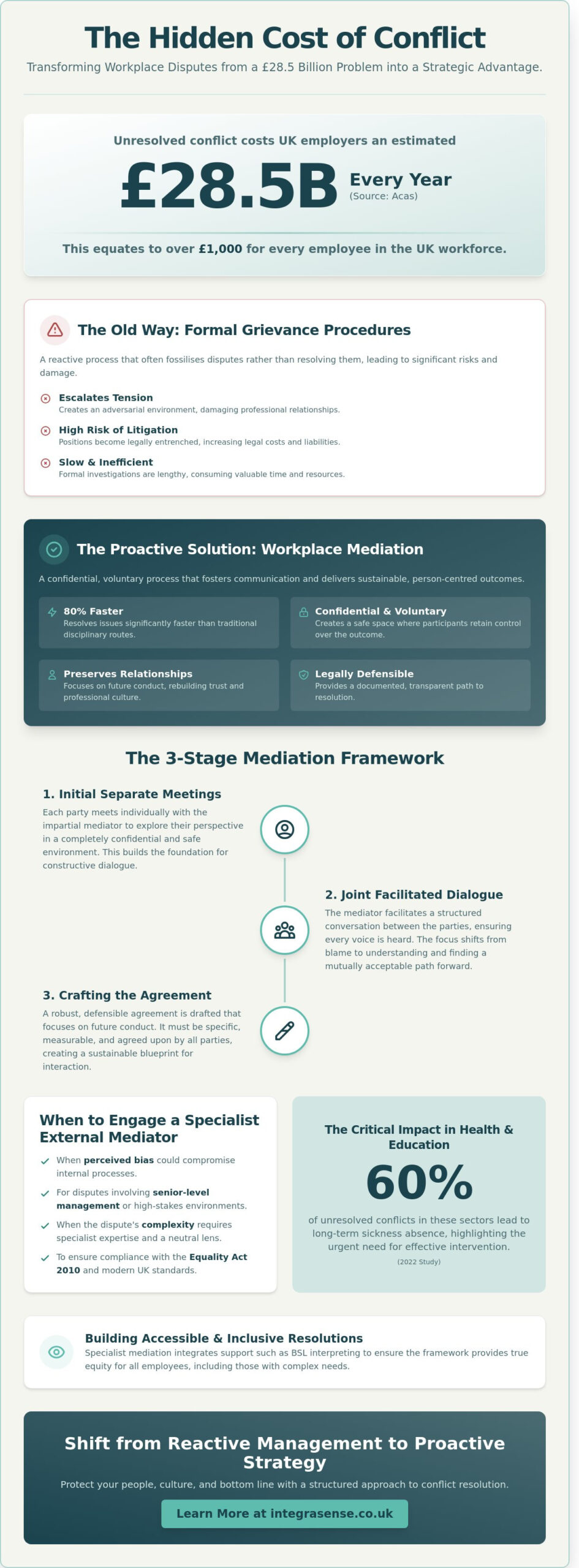
Unresolved conflict costs UK employers an estimated £28.5 billion every year. This staggering figure, reported by Acas, represents more than a simple financial drain; it reflects a systemic failure in how modern organisations manage professional relationships. You likely understand that traditional grievance procedures often escalate tension rather than diffusing it. It’s a process that frequently leads to the litigation and morale damage you’re working to avoid. We believe there’s a more intelligent way to sense and resolve these frictions through workplace mediation before they fracture your professional culture.
By implementing a structured approach to dispute resolution, you can transform volatile conflicts into defensible, person-centred outcomes. This guide provides a strategic framework for 2026, offering clear steps to replace formal risks with communication resilience. We’ll explore how to move away from chaotic disputes toward an optimized environment where every voice is heard and every resolution remains sustainable. It’s time to transition from reactive management to a proactive strategy that protects both your people and your bottom line.
Key Takeaways
- Mitigate the £28.5 billion annual economic impact of conflict by adopting early intervention strategies that prioritise organisational resilience and long-term sustainability.
- Learn to navigate the structured stages of workplace mediation, ensuring every step from initial separate meetings to final agreement remains confidential, voluntary, and defensible.
- Integrate specialist communication support, including BSL interpreting, to ensure your resolution framework provides true equity for employees with dual sensory impairments or complex needs.
- Shift from reactive dispute management to proactive optimization by implementing a person-centred approach that protects your professional culture and enhances trust.
- Identify the critical risks associated with generic mediation processes and discover why specialist-led interventions are essential for meeting modern UK compliance standards.
The Strategic Value of Workplace Mediation in 2026
Workplace conflict isn’t just a cultural friction point; it’s a systemic drain on organisational efficiency. Research from Acas indicates that conflict costs UK employers £28.5 billion annually, which translates to roughly £1,000 for every employee in the workforce. Workplace mediation serves as a sophisticated intervention to stem these losses. It’s a voluntary, confidential process where an impartial specialist facilitates a dialogue to reach mutually acceptable solutions. By prioritising early resolution, organisations shift from reactive grievance handling to a proactive “sense-making” approach. This methodology provides a transparent, agreed-upon path forward, ensuring that every management step remains a defensible decision backed by documented effort.
Mediation vs. Formal Grievance Procedures
Formal investigations often fossilise disputes rather than resolving them. Mediation is typically 80% faster than traditional disciplinary routes, and it preserves professional relationships that formal litigation might destroy. The “tipping point” for this transition occurs when informal dialogue fails to break a deadlock but before positions become legally entrenched. Utilising a framework for understanding the mediation process helps employers fulfil their statutory obligations under the Equality Act 2010. It transforms a potential legal liability into a structured, manageable conversation that respects the dignity of all parties involved.
The Psychology of Resolution
Moving from a “blame-culture” to a “solution-culture” requires a neutral third party to recalibrate the professional environment. This intervention allows individuals to analyse their interactions with the same precision they apply to technical data. There’s a significant overlap between mediation and professional supervision; both practices support practitioner wellbeing and build long-term resilience. At IntegraSense, we view this as the optimization of human capital. It’s about applying intelligence to human systems to ensure that professional environments remain sustainable and focused on core objectives rather than interpersonal friction.
To explore how these frameworks can be integrated into your organisational structure, you can view our full range of specialist services or contact us for a strategic consultation.
Implementing a Robust Mediation Framework: A Practical Guide
Success in workplace mediation relies on a logical progression from initial friction to shared resolution. The process starts with individual sessions where each party explores their perspective in a safe, confidential space. This builds the foundation for the joint facilitated dialogue that follows. By maintaining a voluntary environment, whether in a physical Kent office or through secure digital interfaces, participants retain control over the outcome. Trust is the primary currency in these settings; it’s established through strict confidentiality and the mediator’s visible impartiality.
Integrating these outcomes with person-centred planning ensures resolutions aren’t just superficial fixes. They become sustainable blueprints for future conduct that respect individual needs. While UK organisations typically follow ACAS protocols, global benchmarks like EEOC mediation for workplace disputes demonstrate how structured intervention successfully mitigates high-risk claims. This methodical approach transforms a chaotic environment into one that’s optimised for professional growth.
When to Use a Specialist External Mediator
Internal HR teams often encounter limits when perceived bias or senior-level involvement complicates a dispute. In the health and education sectors, where a 2022 study showed that 60% of unresolved conflicts lead to long-term sickness, external workplace mediation provides necessary distance. IntegraSense offers a neutral lens that aligns with strict corporate governance standards. This professional detachment is essential for high-stakes environments where internal capacity is stretched or when the complexity of the dispute requires a specialist visionary consultant.
Crafting the Mediation Agreement
A robust agreement focuses on future conduct rather than past grievances. It must be specific, measurable, and defensible for all stakeholders involved. Effective frameworks include scheduled reviews at three and six-month intervals to monitor progress and ensure the resolution remains effective. If your organisation requires a methodical approach to conflict, exploring our specialist consultancy services can provide the clarity needed for long-term stability and environmental resilience.
Building Accessible and Inclusive Work Cultures Through Mediation
True equity in the workplace requires more than standard conflict resolution; it demands a sophisticated understanding of specialist communication. Integrating British Sign Language (BSL) interpreting and tactile communication support into the workplace mediation process ensures that every participant engages on a level playing field. Generic mediation often fails individuals with dual sensory impairments because it overlooks the cognitive load of navigating inaccessible environments. By positioning mediation as a vital component of broader accessibility consultancy, organisations can transform potential friction into a catalyst for cultural optimization.
Specialist mediation acts as a bridge for Access to Work implementations, ensuring that sensory-inclusive adjustments are not just provided but effectively integrated into team dynamics. While the EEOC workplace mediation process provides a strong foundational framework for dispute resolution, UK employers must go further to meet statutory obligations. Using mediation as a proactive sensing tool allows leaders to identify where environmental barriers are causing interpersonal strain before productivity is lost. It’s about moving away from the chaotic and towards an environment that’s optimized for all.
Mediation in Complex Sensory Environments
Conflict frequently arises where communication barriers remain unaddressed. In social care settings, mediators must possess deep knowledge of Care Act compliant deafblind assessment standards. This expertise prevents the further marginalisation of staff or service users during the resolution process. Without understanding the nuances of specialist communication, a mediator risks reinforcing the very power imbalances they’re tasked to resolve. For organisations operating in these environments, a dedicated approach to mediation in social care provides the defensible, person-centred framework needed to prevent costly litigation and restore trust between families and service providers. Precision in these high-stakes environments is essential for long-term sustainability and resilience.
Next Steps for Your Organisation
Proactive management is always more efficient than reactive crisis control. Organisations should start with a communication audit to pinpoint conflict flashpoints before they escalate. Establishing a clear protocol for workplace mediation requests empowers employees and demonstrates a commitment to transparency. If you’re ready to optimize your conflict resolution strategy, contact IntegraSense for specialist mediation and conflict resolution support. We help you make sense of complex human environments through intelligent, inclusive solutions that respect the needs of every individual.
Securing Strategic Resilience Through Proactive Conflict Resolution
Effective workplace mediation is no longer a reactive measure; it’s a critical component of organisational sustainability. By 2026, the integration of inclusive communication frameworks will define the most resilient UK workplaces. For global teams, this includes supporting non-native speakers to build confidence and clarity; you can find out more about specialized language and accent training programs. Research from ACAS indicates that workplace conflict costs UK employers approximately £28.5 billion annually, making a robust resolution strategy a financial and operational necessity. Organisations must move beyond surface-level fixes to implement defensible decision-making processes that protect both staff wellbeing and institutional reputation.
At IntegraSense, we specialise in navigating these complexities within the health, education, and public sectors. Our approach combines expert consultancy with essential communication support, including BSL interpreting, to ensure every voice is heard and every resolution is legally sound. In increasingly globalised workforces, this inclusivity also involves empowering non-native speakers to overcome language anxiety; resources such as confidence.me illustrate how targeted support can help individuals speak with greater assurance. We help you transition from chaotic environments to optimised, inclusive cultures where conflict becomes a catalyst for growth rather than a drain on resources.
Explore our Specialist Mediation and Conflict Resolution Services to transform your approach to professional harmony. It’s time to build a workplace that senses challenges early and responds with precision.
Frequently Asked Questions
Is workplace mediation legally binding in the UK?
Workplace mediation isn’t legally binding in the UK until the parties reach a formal, signed settlement agreement. This voluntary process allows participants to maintain control over the outcome rather than having a decision imposed by a court or tribunal. Once both parties sign a written agreement, it functions as a contract. IntegraSense ensures this transition from conflict to resolution remains structured, providing a clear path toward sustainable workplace harmony.
What happens if mediation fails to resolve the dispute?
Parties typically progress to formal grievance procedures or employment tribunal claims if mediation fails. The 2023 ACAS Code of Practice recommends mediation as a preliminary step; therefore, attempting it demonstrates a proactive approach to dispute resolution. IntegraSense helps organisations sense when a more formal intervention is required. This ensures that even an unresolved session provides valuable data for the next stage of the organisational journey.
Can an employee be forced to attend mediation?
Employers can’t force an employee to participate in workplace mediation because the process relies entirely on voluntary engagement. Forcing participation often undermines the resilience of the final agreement and risks breaching trust. Instead, organisations should focus on the benefits of early intervention. Our specialist consultants help leaders articulate how these sessions empower individuals to resolve complex interpersonal challenges through structured, intelligent communication rather than rigid disciplinary action.
How long does the workplace mediation process typically take?
Most cases conclude within one full day of intensive discussion. This timeline includes individual pre-meetings to establish a foundation of trust before the joint session begins. While complex disputes might require two or three sessions spread over 14 days, the goal is always a swift return to operational efficiency. IntegraSense streamlines this journey, ensuring that connectivity between team members is restored with minimal disruption to the wider organisation.