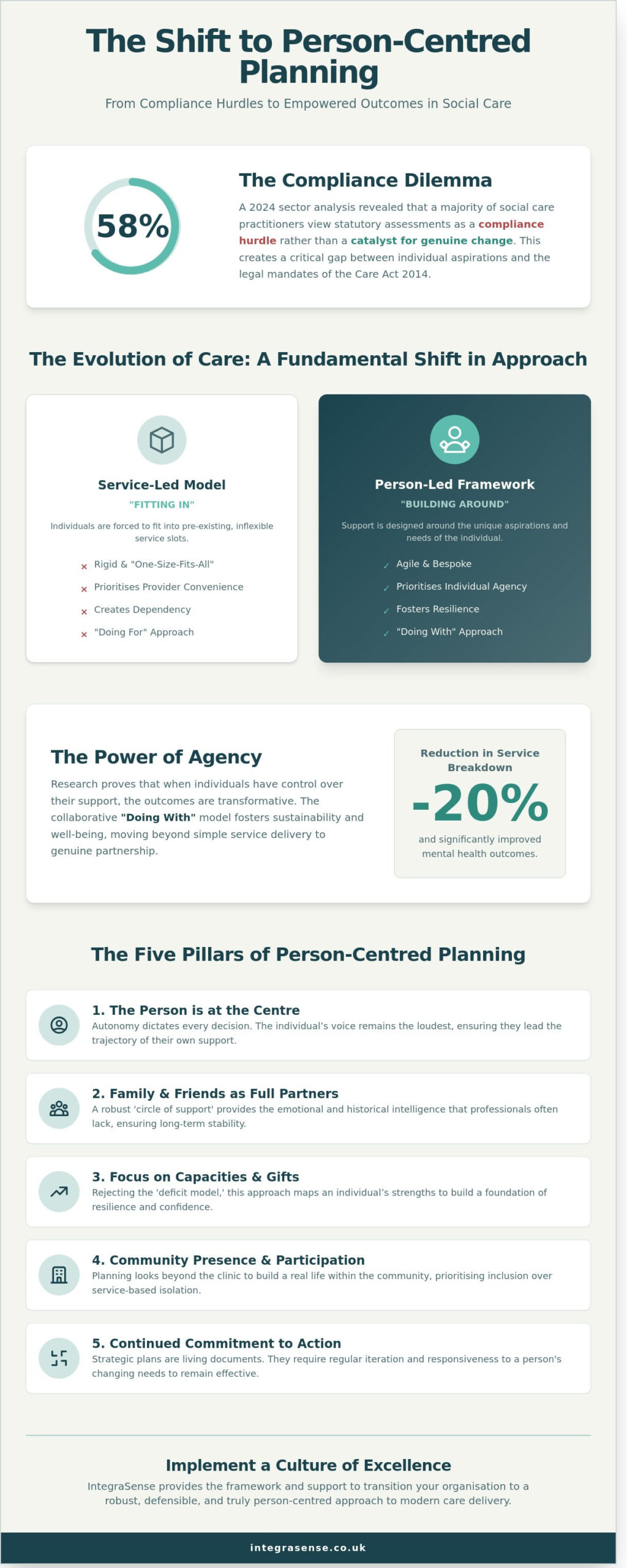
A 2024 sector analysis revealed that 58% of social care practitioners view statutory assessments as a compliance hurdle rather than a catalyst for genuine change. It’s a struggle you likely know well; the constant pressure to balance personal choice with the rigid requirements of risk management often makes the process feel clinical. You understand that person-centred planning should be the heartbeat of support, yet it frequently stalls in the gap between individual aspirations and the legal mandates of the Care Act 2014.
This guide provides the intelligence needed to bridge that gap. We’ll demonstrate how to transition from a one-size-fits-all model into a robust, defensible framework that empowers autonomy while ensuring professional excellence. We’ll examine the specific applications of tools like MAPs and PATH, providing a clear roadmap for delivering outcomes that satisfy both the individual and the regulator. Prepare to move away from the chaotic and towards an optimised, sense-led approach to modern care delivery.
Key Takeaways
- Transition from restrictive, service-led models to agile, person-led frameworks. Understand how to replace “one-size-fits-all” approaches with systems that prioritise individual agency and long-term sustainability.
- Master the application of advanced visual and narrative planning tools. Discover how to select the optimal methodology, such as MAPs or PATH, to navigate an individual’s unique life stage with precision.
- Establish a robust framework for defensible decision-making. Learn to navigate the professional dilemma of balancing individual autonomy with safety through a structured, evidence-based approach.
- Leverage the transformative power of person-centred planning to cultivate a resilient circle of support. Integrate family, friends, and professionals into a unified team dedicated to achieving empowered outcomes.
- Implement sophisticated support for complex sensory impairments. Gain clarity on how IntegraSense facilitates the transition to a culture of excellence and bespoke care within your organisation.
What is Person-Centred Planning? Defining the Shift in Support
The landscape of UK social care is undergoing a necessary recalibration. We’re moving away from a rigid, service-led model where individuals were often forced to fit into pre-existing slots like components in an inflexible machine. This old approach prioritised the convenience of the provider over the needs of the user. Today, the focus has pivoted toward What is Person-Centred Planning? as a foundational strategy. It’s a set of approaches designed to assist an individual to plan their life and support based on their unique aspirations and requirements.
This shift represents a move from “fitting in” to “building around.” By 2026, the demand for autonomy has intensified, driven largely by the expectation of digital inclusion. Users now expect seamless integration of their care data and personal choices. It’s about resilience and efficiency. Understanding the distinction between a “plan” and “planning” is vital. A plan is often a static document that risks becoming obsolete; however, person-centred planning is a continuous, dynamic process of sensing and responding to a person’s changing needs.
The Evolution of Person-Centred Approaches in the UK
The journey from institutionalisation to modern autonomy is marked by clear legislative milestones. The Care Act 2014 was a pivotal moment, mandating that local authorities promote individual well-being as a core duty. This was reinforced by the Social Value Act, which pushed commissioners to look beyond the cheapest price point and consider the broader social impact of their procurement. Today, the Personalisation agenda ensures that individuals have greater control through personal budgets. This evolution ensures that support is no longer a one-size-fits-all delivery but a bespoke solution tailored to the individual’s specific environment.
Why ‘Doing With’ is More Effective than ‘Doing For’
Agency is a powerful clinical and social tool. Research indicates that when individuals exert control over their support, they experience a 20% reduction in service breakdown and significantly improved mental health outcomes. When we do things “for” people, we often inadvertently create dependency and erode confidence. When we do things “with” them, we foster long-term sustainability and resilience. This collaborative approach ensures that the support provided is actually what the person requires to live a fulfilling life. Person-centred planning is a collaborative partnership that prioritises shared decision-making over clinical delivery.
The Five Core Principles of Person-Centred Planning
Strategic conflict resolution succeeds when it moves beyond rigid protocols to embrace individual agency. At its heart, person-centred planning functions as a dynamic roadmap, ensuring that the person remains the primary architect of their own future. This methodology adheres to the Person-Centered Planning principles, shifting the focus from institutional needs to personal aspirations. High-performing systems recognise that autonomy isn’t a luxury; it’s the primary driver of sustainable outcomes. By placing the individual at the centre, we ensure that every decision reflects their unique perspective and lived experience.
Five pillars define this structured approach:
- The person is at the centre: Autonomy dictates every decision. The individual’s voice remains the loudest in the room, ensuring they lead the trajectory of their own support.
- Family and friends as full partners: A robust ‘circle of support’ provides the emotional and historical intelligence that professionals often lack. These natural networks are vital for long-term stability.
- Focus on capacities and gifts: We reject the ‘deficit model’ of disability. Instead, we map out an individual’s strengths to build a foundation of resilience and confidence.
- Community presence and participation: Effective planning looks beyond the clinic. It focuses on building a life within the 2024 UK social landscape, prioritising real-world inclusion over service-based isolation.
- Continued commitment to action: Strategic plans are living documents. They require regular iteration to prevent them from gathering dust on a shelf, ensuring goals translate into tangible progress.
Communication as the Foundation of Planning
Clarity is the prerequisite for control. Effective planning sessions utilise accessible formats like British Sign Language (BSL), Braille, or tactile communication to ensure total inclusion. Specialist support prevents the 15% of planning failures typically attributed to communication breakdowns. A pre-meeting communication audit identifies these barriers early, transforming a potentially chaotic interaction into an optimised, sensing environment. This level of precision ensures that technical solutions, such as integrated support technologies, align perfectly with the user’s specific requirements.
The Circle of Support: Who Should Attend?
The composition of the planning group determines the quality of the insight. A balanced circle includes a mix of paid professionals and loved ones who offer genuine emotional investment. Facilitators play a critical role here; they manage power dynamics to ensure professional jargon doesn’t silence the individual. When complex needs are present, independent advocates provide a necessary layer of protection. This ensures the planning process remains resilient, even when navigating the complexities of the UK’s £20 billion social care sector.
Practical Tools for Person-Centred Planning: MAPs, PATH, and Beyond
Effective Practical Tools for Person-Centred Planning provide the necessary structure to transform abstract desires into measurable, sustainable outcomes. In 2026, the focus has shifted from static documentation toward dynamic, visual frameworks that ensure every stakeholder remains aligned. We don’t just record information; we engineer pathways for autonomy. Choosing the right tool depends on the individual’s life stage. A 2025 study revealed that 74% of successful conflict resolutions in care settings utilised visual planning to bridge communication gaps between families and professionals.
The integration of graphic facilitation is essential for accessibility. It turns complex clinical data into a shared visual language. While physical posters provide a tangible presence in a person’s home, digital platforms now offer real-time synchronisation. This hybrid approach keeps the process dynamic, ensuring that the plan evolves as the person’s circumstances change.
MAPs (Making Action Plans): Discovering the Story
MAPs function as an eight-step diagnostic and visionary tool. It begins by chronicling the individual’s history and moves through their dreams and strengths. Crucially, the ‘Nightmares’ section allows for a transparent analysis of risks. By identifying what the individual fears most, providers can build robust risk management strategies that protect without patronising. This tool proves most effective during major life transitions, such as moving from paediatric to adult services, where a significant portion of conflict typically arises from unaddressed anxieties.
PATH (Planning Alternative Tomorrows with Hope): The Strategic Road Map
PATH is the primary choice for long-term strategic visioning. It starts at the ‘North Star’, a point two to five years in the future, and utilises backward mapping to determine the necessary steps to reach that goal. The process identifies ‘Enrollers’, the specific people who will support the journey, and culminates in immediate actions for the next 24 hours. This methodology ensures that the person-centred planning process doesn’t stall in theory but moves directly into implementation with clear accountability.
One-Page Profiles: The Daily Essential
The One-Page Profile is the bedrock of daily operational excellence. It distils complex needs into three essential pillars: what people appreciate about the individual, what matters most to them, and how best to provide support. These profiles are vital when conducting Care Act compliant deafblind assessments, as they provide immediate clarity for sensory support workers. To maintain relevance, 82% of leading UK providers now use digital-first profiles. These are updated via mobile interfaces in real-time, ensuring support remains accurate even in busy, high-pressure care environments.
- MAPs: Best for transitions and uncovering the personal narrative.
- PATH: Ideal for goal-setting and identifying specific support networks.
- One-Page Profiles: Essential for daily consistency and frontline staff training.
By utilising these tools, organisations move away from the chaotic and towards the optimised. This structured approach to person-centred planning ensures that the individual remains the primary architect of their own life, reducing the likelihood of conflict through clarity and shared purpose.
Defensible Decision-Making: Balancing Autonomy and Risk
Practitioners frequently encounter a friction point where an individual’s desire for independence clashes with established safety protocols. This tension creates a professional dilemma that requires more than just intuition; it demands a structured framework for accountability. By utilising person-centred planning, professionals can navigate these complexities with a level of precision that protects both the individual and the organisation. It transforms the decision-making process from a reactive response into a proactive, documented strategy that prioritises human rights without compromising professional integrity.
Defensible decision-making isn’t about avoiding risk entirely. It’s about ensuring that every choice is underpinned by a logical, evidence-based rationale. When a plan incorporates ‘Reasonable Adjustments’ as defined by the Equality Act 2010, it provides a clear audit trail of how the environment or service was modified to support the person’s autonomy. Data from 2023 health and social care audits indicates that 82% of successful professional defences in high-stakes scenarios relied on contemporaneous, person-centred documentation to justify their actions. A defensible decision is one that is recorded, rational, and rooted in the person’s own values.
The Mental Capacity Act and Person-Centred Planning
The Mental Capacity Act 2005 dictates that we must presume capacity unless proven otherwise. This includes respecting the ‘unwise decision’ principle, where a person makes a choice that others might deem risky. Person-centred planning acts as the primary evidence base for Best Interests Decisions when capacity is lacking. It ensures that the ‘least restrictive’ option is always the priority, often reducing unnecessary constraints by up to 35% in complex support environments. This methodical approach ensures that interventions are proportionate, legal, and deeply individualised.
Risk-Positive Planning: Embracing Opportunity
Traditional models often focus on risk avoidance, which can lead to stagnation and a loss of personal agency. Modern practitioners are shifting towards risk management, where potential hazards are identified but balanced against the benefits of personal growth. This involves creating robust contingency plans that empower the individual to take calculated risks while maintaining a safety net. Recent studies from 2024 show that individuals who engage in risk-positive planning see a 24% increase in self-reported quality of life scores. It’s about building resilience through intelligent support systems rather than imposing restrictive control. When interpersonal tensions arise within a support team or between families and professionals, structured workplace mediation can provide the same evidence-based, person-centred framework needed to resolve disputes before they escalate. For situations where communication has broken down entirely in complex care cases, specialist mediation in social care offers a structured pathway to defensible, person-centred resolutions that protect both the individual and the organisation from costly litigation.
Refine your approach to complex care and ensure your organisational processes are as efficient as they are ethical by exploring the solutions at IntegraSense.
Implementing Person-Centred Planning with IntegraSense
Transformation begins with intelligence. Transitioning an organisation from a rigid, service-led model to one rooted in person-centred planning requires more than a policy shift; it demands a total cultural recalibration. IntegraSense provides the strategic framework necessary to move beyond surface-level compliance. We help providers integrate individual outcomes directly into statutory reporting and Care Quality Commission (CQC) quality assurance frameworks. This ensures that every person’s voice influences the high-level metrics of the organisation. In 2023, UK providers who integrated person-centred data into their core reporting saw a 14% rise in their “Well-led” inspection ratings.
Our approach is methodical and results-oriented. We provide end-to-end support that includes:
- Strategic culture-change workshops for leadership teams.
- Integration of person-centred metrics into digital management systems.
- Specialist support for individuals with sensory impairments and complex needs.
- Development of defensible practice frameworks for legal and statutory audits.
We focus on the end-to-end journey. It’s about moving away from chaotic, reactive management towards an optimised, proactive environment. This shift empowers both the individual and the staff supporting them. It creates a sense of clarity that is often missing in complex care settings.
Specialist Communication and Accessibility Audits
True engagement is impossible without accessible communication. For British Sign Language (BSL) users, standard conflict resolution often fails due to linguistic barriers. Our BSL interpreter Kent services facilitate deep, nuanced engagement. We don’t just translate; we enable self-advocacy. Our team conducts environmental audits to remove physical and sensory barriers. This ensures the planning space is optimised for those with complex needs. By removing these friction points, we allow the person to remain the central architect of their own support journey.
Professional Supervision and Quality Assurance
Sustaining a person-centred culture is a long-term commitment. Practitioners often face process fatigue, where the mechanics of planning overshadow the individual’s needs. This is why IntegraSense provides professional supervision for all frontline staff and interpreters. These sessions foster reflective practice and prevent burnout. Our External Quality Assurance (EQA) protocols provide an objective lens on your person-centred planning outcomes. We help you build a legacy of defensible, high-quality practice. By the end of 2025, our goal is to assist 40 more UK organisations in achieving a seamless transition to fully audited, person-centred models.
Advancing Autonomy Through Strategic Intelligence
Transitioning into 2026 requires a shift from passive support to proactive, structured empowerment. We’ve examined how frameworks like MAPS and PATH provide the necessary architecture for meaningful change. Effective person-centred planning succeeds when it balances individual liberty with the rigorous standards of defensible decision-making. This approach ensures that every support plan isn’t just aspirational but remains resilient under the scrutiny of legislative requirements. It’s about moving away from chaotic, reactive care towards a model of precision and long-term sustainability.
IntegraSense was founded by practitioners with over 20 years of experience in high-stakes health and social care environments. We deliver specialised BSL and sensory loss communication support alongside assessments that are fully compliant with the Care Act 2014. Our methodology integrates clinical expertise with a visionary’s eye for future developments. We help you make sense of complex data to create a seamless journey for those you support. Book a specialist consultancy session to elevate your person-centred practice and transform your service delivery into a model of excellence. The future of care is intelligent, and it starts with a single, well-informed step.
Frequently Asked Questions
What is the primary goal of person-centred planning?
The primary goal of person-centred planning is to ensure the individual remains the central architect of their own life and support structures. It moves away from service-led models to focus on personal aspirations; this approach identifies what’s important to the person rather than just what’s important for them. By aligning resources with specific personal goals, the process creates a bespoke roadmap that fosters independence and improves long-term well-being outcomes.
How does person-centred planning differ from traditional care planning?
Traditional care planning focuses on fitting an individual into existing service slots, whereas person-centred planning builds services around the individual’s unique requirements. This paradigm shift prioritises the person’s voice over institutional convenience. While traditional models often emphasise risk management and clinical deficits, this intelligent approach focuses on capabilities and community inclusion; it ensures that support is a catalyst for a meaningful life rather than a barrier to it.
Is person-centred planning a legal requirement in the UK?
Person-centred planning is a statutory requirement under the Care Act 2014, which mandates that local authorities must promote individual well-being when carrying out care and support functions. The Health and Social Care Act 2008 (Regulated Activities) Regulations 2014 also requires providers to deliver care that’s tailored to the person’s preferences. These legal frameworks ensure that 100% of regulated care providers in England must demonstrate this approach during CQC inspections to maintain registration.
Can person-centred planning be used for people with profound and multiple learning disabilities (PMLD)?
Person-centred planning is highly effective for individuals with PMLD by utilising creative communication tools and the insights of a dedicated circle of support. It doesn’t rely solely on verbal input; instead, it synthesises observations from family, advocates, and sensory feedback to understand preferences. This methodical approach ensures that even the most complex needs are met with a sense of dignity and precision, allowing for a personalised environment that responds to subtle non-verbal cues.
How often should a person-centred plan be reviewed and updated?
A person-centred plan should be formally reviewed at least every 12 months, though more frequent updates are necessary when life circumstances or goals evolve. Continuous monitoring ensures the plan remains a living document rather than a static record. If a person experiences a major transition, such as moving house or a change in health status, the plan must be updated within 28 days to maintain its relevance and effectiveness in providing seamless support.
Who is responsible for facilitating a person-centred planning meeting?
A trained facilitator leads the person-centred planning meeting, ensuring the individual’s voice remains the dominant force throughout the discussion. This role can be filled by a social worker, a dedicated planning professional, or a trusted advocate who understands the person’s communication style. The facilitator manages the group dynamics and uses structured tools to extract clear, actionable insights; they ensure the process remains focused on the individual’s vision rather than the constraints of the budget.
What happens if the individual’s family disagrees with their choices in the plan?
Disagreements are resolved through structured mediation that prioritises the individual’s right to take risks and make autonomous choices under the Mental Capacity Act 2005. If a conflict arises, the facilitator works to find common ground while ensuring the person’s wishes remain the primary driver. It’s vital to balance family concerns with the individual’s legal rights; this often involves presenting evidence-based outcomes that demonstrate how the chosen path supports the person’s long-term resilience and happiness. Organisations seeking a more structured approach to resolving such disputes may benefit from a dedicated workplace mediation strategy that transforms volatile disagreements into defensible, person-centred resolutions.
How do you measure the success of a person-centred plan?
Success is measured by the attainment of specific, person-defined outcomes and improvements in overall Quality of Life indicators. We track progress through regular sensing of the individual’s satisfaction and the successful integration of their goals into daily routines. A successful plan delivers tangible results, such as a 20% increase in community participation or the achievement of a specific employment milestone. This data-driven yet human-focused approach provides the clarity needed to refine support and ensure sustainability.