
A standard non-disclosure agreement is often insufficient to protect sensitive personal data during complex multidisciplinary consultations. Public sector leaders, healthcare directors, and legal professionals face considerable uncertainty when applying UK information governance standards to spoken and signed communication. Commissioning confidential BSL interpreting services requires an operational framework rooted in verifiable professional governance rather than informal trust.
You recognise the absolute necessity of safeguarding client privacy across every consultation, yet assessing the professional accountability, credentials, and regular supervision of external practitioners presents distinct administrative hurdles. In this guide, you will learn how professional governance, ethical practice, and secure communication frameworks protect sensitive organisational information. We examine the essential protocols required to establish defensible decision-making processes and commission vetted British Sign Language (BSL) professionals equipped for high-accountability environments.
Key Takeaways
- Understand how professional ethical standards establish clear boundaries for information integrity during sensitive healthcare, legal, and workplace consultations.
- Identify the core governance benchmarks required when procuring confidential BSL interpreting services, including credential verification and regular professional supervision.
- Discover secure briefing protocols that protect sensitive case material without exposing unnecessary third-party personal data.
- Learn how to embed qualified communication practitioners directly into existing organisational information security workflows.
Understanding Confidentiality Standards in British Sign Language Interpreting
Ethical integrity forms the foundation of professional language mediation. In high-stakes environments such as clinical consultations, disciplinary hearings, and safeguarding conferences, defined ethical boundaries govern how spoken and signed communication is processed. Qualified practitioners adhere to established professional codes of conduct, treating spoken statements, signed dialogue, and contextual nuances as privileged information. This discipline ensures that external practitioners do not become conduits for unauthorised data disclosures.
Maintaining institutional information integrity requires more than passive discretion. Securing confidential communication arrangements ensures that specialists operate within defined operational parameters. These standards establish explicit limits around briefing notes, digital files, and post-session disclosures. Practitioners must actively neutralise personal bias, uphold strict neutrality, and prevent sensitive organisational records from circulating beyond authorised personnel.
The Role of Professional Supervision in Maintaining Ethical Boundaries
Complex multidisciplinary casework often generates emotional and procedural friction. Structured professional supervision offers an essential governance mechanism, enabling practitioners to evaluate complex assignments without breaching individual privacy. Within these sessions, practitioners review decision-making processes through anonymised case analysis, ensuring that personal identifying information remains completely protected. Engaging dedicated communication support and professional supervision services provides public and private organisations with assurance that external practitioners maintain ethical discipline, clinical detachment, and institutional confidentiality.
Key Criteria for Procuring Confidential BSL Interpreting Services
Procuring communication support for sensitive proceedings demands systematic due diligence. Relying solely on basic availability risks operational misalignments during complex case reviews, child protection conferences, or human resource investigations. Commissioners require a clear framework to evaluate external practitioners before sharing sensitive case files.
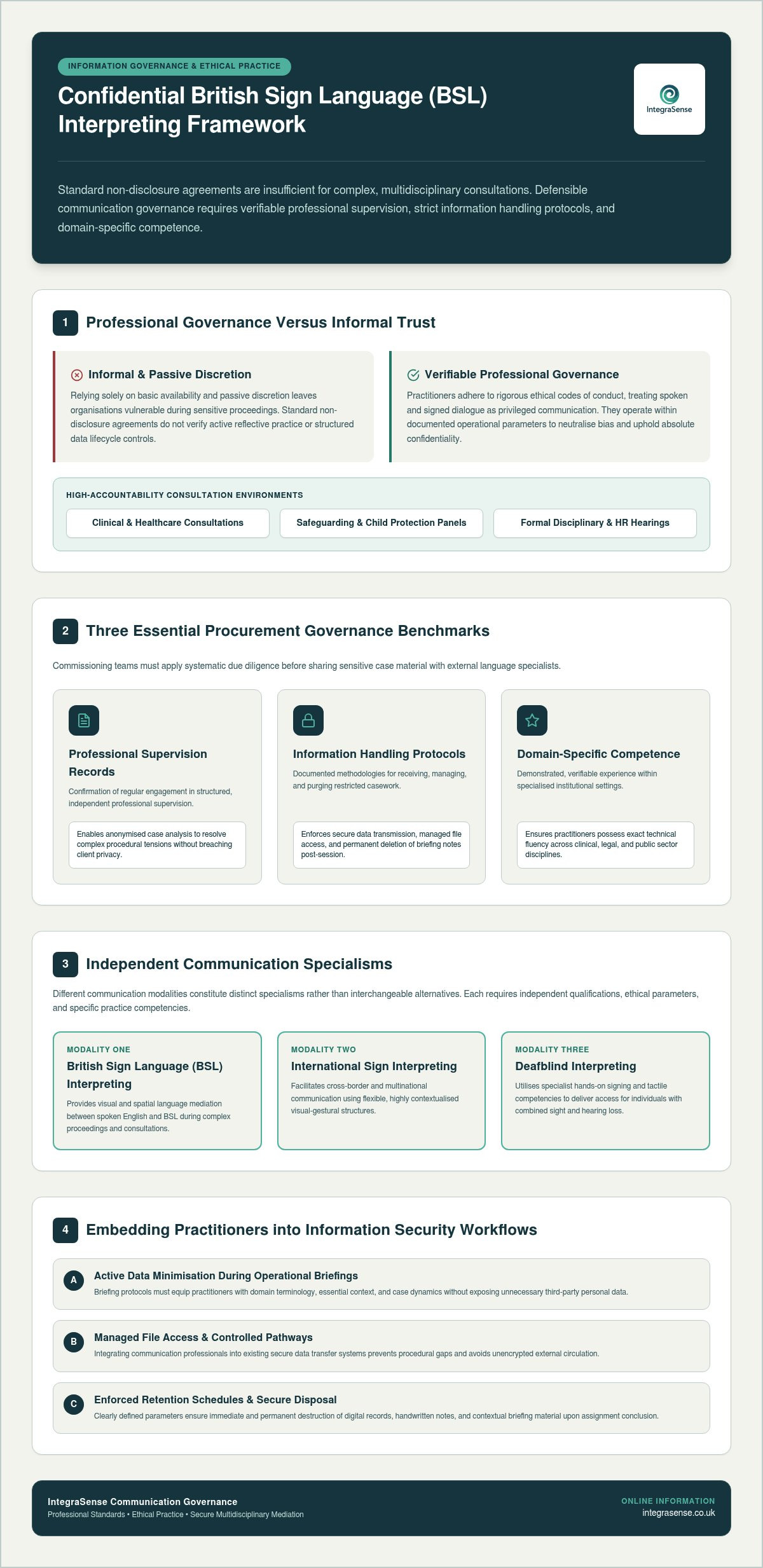
Organisations should assess three critical governance areas when engaging confidential BSL interpreting services:
- Professional supervision records: Confirmation that the practitioner regularly engages in structured, independent supervision to maintain ethical standards and manage reflective practice.
- Information handling protocols: Documented methods for receiving, storing, and permanently deleting preparatory briefing notes and restricted documentation.
- Domain-specific competence: Demonstrated experience within formal administrative, clinical, or public sector environments.
Distinguishing Specialist Communication Practice from General Support
Commissioning teams must align practitioner competence with the specific communication modality required. Deafblind individuals often utilise hands-on signing, requiring specialist practitioners who possess distinct tactile competencies alongside advanced ethical awareness. Similarly, BSL interpreting, International Sign interpreting, and Deafblind interpreting constitute distinct specialisms rather than interchangeable alternatives. Each discipline requires independent professional qualifications and dedicated experience. Commissioners seeking verified expertise across these disciplines can review the complete range of provision via the IntegraSense services directory to ensure their arrangements remain defensible, secure, and fully aligned with organisational requirements.
Implementing Robust Communication Governance in Public and Private Organisations
Embedding external language specialists directly into internal information security workflows eliminates procedural gaps. Organisations often handle sensitive records securely within their core teams, yet inadvertently bypass security protocols when circulating casework to external communication professionals. Integrating practitioners into managed file access environments, secure data transfer pathways, and defined retention schedules ensures institutional data controls remain intact throughout the assignment lifecycle.
Information governance demands active data minimisation during operational preparation. Standard briefing protocols should equip professionals with essential context, domain terminology, and case dynamics without exposing unnecessary third-party personal data. When multidisciplinary panels review complex safeguarding matters or health consultations, establishing structured preparation procedures protects individual privacy while enabling precise linguistic execution. Applying these systematic controls ensures that confidential BSL interpreting services reinforce institutional compliance across every departmental touchpoint.
Collaborating with IntegraSense for Strategic Communication Support
Managing complex communication governance requires proven, multidisciplinary expertise. IntegraSense collaborates with public and private sector organisations to review communication workflows, evaluate accessibility frameworks, and provide defensible decision-making support across high-accountability settings. Whether your department requires specialist communication reviews, external quality assurance, or professional supervision structures, our experienced advisors provide targeted strategic assistance. Public sector leads and procurement teams can connect directly with our specialists through the IntegraSense contact team to discuss tailored organisational solutions.
Securing Defensible Communication Standards for Your Organisation
Protecting sensitive personal data requires verifiable governance frameworks across every interaction. Selecting qualified, confidential BSL interpreting services ensures your department upholds strict data boundaries during critical casework, clinical consultations, and disciplinary proceedings. Integrating communication professionals directly into internal information security workflows safeguards organisational privacy from initial briefing through to post-session review.
Established in 2019, IntegraSense provides multidisciplinary consultancy that underpins defensible decision-making across the public and private sectors. Our comprehensive practice is supported by independent professional supervision and external quality assurance, equipping professionals to handle high-accountability environments with precision and ethical discipline. Contact IntegraSense to discuss your specialist interpreting requirements and establish clear communication protocols for your teams today.
Frequently Asked Questions
How do professional BSL interpreters protect sensitive organisational data during formal meetings?
Professional British Sign Language (BSL) interpreters protect sensitive organisational data by adhering to strict professional codes of conduct that mandate complete confidentiality. Practitioners process live dialogue without recording or retaining personal disclosures, maintain strict neutrality, and permanently delete preparatory notes or digital briefing papers immediately following the conclusion of the assignment. This disciplined process prevents unauthorised secondary disclosure of sensitive institutional information.
Can professional supervision breach client confidentiality in complex safeguarding cases?
Professional supervision does not breach client confidentiality because casework is reviewed through rigorous anonymisation protocols. Identifying personal details, specific dates, and organisational markers are removed prior to reflective discussion. This structured governance model enables practitioners to evaluate ethical dilemmas, linguistic decisions, and procedural challenges while keeping confidential BSL interpreting services fully compliant with institutional data protection standards.
What is the distinction between BSL interpreting and communication support for Deafblind individuals?
BSL interpreting and Deafblind interpreting represent distinct professional specialisms requiring separate technical competencies. While BSL interpreting focuses on visual signed communication, communication support for Deafblind individuals often involves hands-on signing, specific physical positioning, and adapted environmental awareness for people with combined sight and hearing loss. Neither specialism replaces or substitutes the other, and each requires distinct qualifications and experience.
How should an organisation prepare sensitive briefing materials before an interpreted session?
Organisations should apply data minimisation principles by providing contextual briefings that redact unnecessary third-party personal details. Sharing agendas, domain-specific terminology, and participant roles equips the interpreter to deliver accurate translations without exposing confidential case history. Documents should be transmitted through secure organisational channels with clear instructions regarding the permanent deletion of preparatory materials following the consultation.