
Recording every detail of a home visit won’t protect your professional registration if your underlying logic remains invisible. Many practitioners in the UK currently operate under a cloud of anxiety, fearing that a single complex case could lead to a daunting conduct hearing or litigation. This pressure often results in defensive practice, where the primary goal is avoiding blame rather than achieving the best outcome. True defensible decision making social care isn’t about building a paper fortress; it’s about making sense of risk through a transparent, evidence-based process.
We understand that your caseload doesn’t allow for endless deliberation. You need a methodical way to document your professional judgement that feels both efficient and legally robust. This guide provides the clarity you’ve been seeking, moving away from chaotic notes towards optimised, structured documentation. We’ll explore the essential principles of defensibility, offering clear templates that ensure your decisions are resilient under the most intense scrutiny. By the end of this article, you’ll have the tools to manage complex environments with a renewed sense of confidence and control.
Key Takeaways
- Distinguish between transparent, defensible practice and risk-averse defensive practice to ensure professional actions are both ethical and robust.
- Master a structured framework for defensible decision making social care practitioners can utilise to navigate complex risks and maintain rigorous legal compliance.
- Implement a precise documentation process that captures the rationale behind every significant decision, including the specific reasons for rejecting alternative options.
- Identify high-stakes scenarios where specialist consultation is essential to validate internal judgements and uphold professional standards.
- Leverage external quality assurance to provide an objective layer of scrutiny, transforming technical challenges into optimised, sustainable outcomes.
Establishing a Robust Framework for Defensible Decision Making
Effective defensible decision making social care isn’t just about reaching a specific conclusion. It centres on the integrity of the process itself. Practitioners must demonstrate that the “why” behind a choice carries as much weight as the final outcome. A decision remains defensible when it’s logical, rooted in evidence, and fully compliant with current UK legislation. It requires a transparent narrative that accounts for professional ethics, especially when interventions might restrict an individual’s liberty or impact their fundamental rights. By focusing on the rationale, organisations can ensure that their practice stands up to the highest levels of scrutiny.
Defensible vs Defensive Practice: Understanding the Distinction
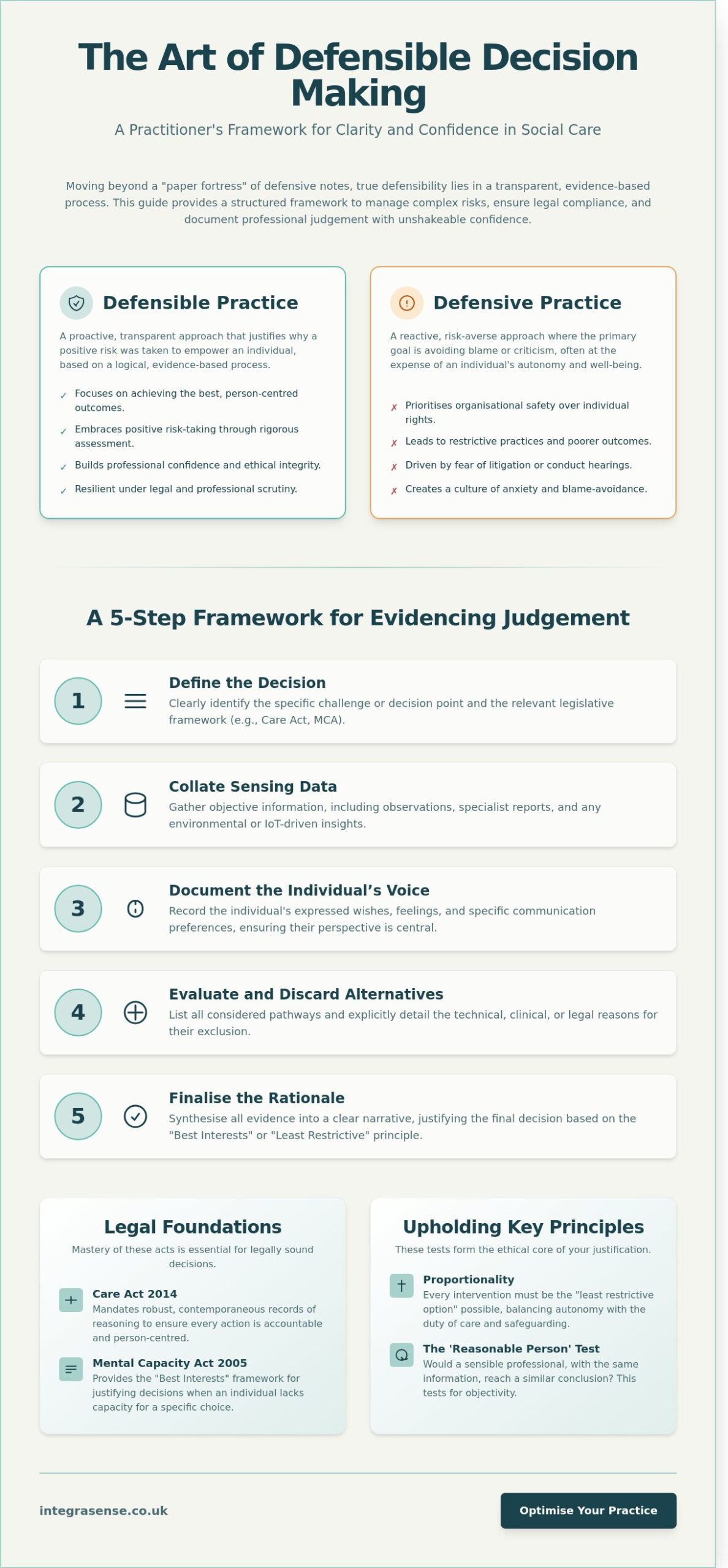
Practitioners often feel pressured into defensive decision making to shield themselves or their organisations from criticism. This risk-averse approach frequently results in poorer outcomes because it prioritises organisational safety over personal autonomy. In contrast, defensible practice embraces positive risk-taking. It acknowledges that risk is inherent in care but manages it through rigorous assessment and clear justification. Defensible practice justifies why a risk was taken to empower an individual, while defensive practice merely explains why a risk was avoided to protect the professional.
The Legal Foundations: The Care Act 2014 and MCA 2005
Statutory duties under the Care Act 2014 mandate that practitioners maintain robust, contemporaneous records of their reasoning. This ensures every action is accountable and person-centred. The Mental Capacity Act 2005 serves as the primary tool for ensuring decisions are legally sound. When a person lacks the capacity to make a specific choice, the “Best Interests” principle provides the necessary framework for justification. This isn’t a subjective guess; it’s a formalised path that balances human rights with the duty of care, ensuring every restriction is proportionate and necessary. Mastering these legal foundations is essential for achieving defensible decision making social care providers can stand behind during audits or legal challenges.
A Practitioner’s Guide to Evidencing Professional Judgement
Effective defensible decision making social care relies on a clear, auditable trail that moves beyond subjective opinion. Evidence isn’t just a record of what happened; it’s a map of why it happened. Practitioners must demonstrate that they’ve considered all variables before reaching a conclusion. A robust documentation process starts with a structured checklist: define the specific challenge, gather objective sensing data, record the individual’s expressed wishes, and explicitly detail why alternative options were discarded. This process ensures that if a decision is challenged, the logic remains resilient.
- Define the decision point and the legislative framework involved.
- Collate sensing data, including observations, specialist reports, and IoT-driven environmental insights.
- Document the individual’s voice and their specific communication preferences.
- List alternative pathways and the technical or clinical reasons for their exclusion.
- Finalise the rationale based on the “Least Restrictive” principle.
Transparent Documentation: The Who, What, and Why
High-quality case notes distinguish between observed facts and professional analysis. Avoid emotive adjectives like “uncooperative” or “difficult”; instead, record specific behaviours and their frequency. This precision is the cornerstone of defensible decision making social care within complex legislative frameworks. Practitioners should refer to Oldham’s 7-Minute Briefing on Defensible Decision Making for a concise framework on evidencing these judgements. To ensure communication barriers don’t compromise the individual’s voice, organisations can access specialist communication audits and reporting to verify that every person’s preferences are accurately captured and respected.
Proportionality and Risk: Balancing Autonomy with Safeguarding
The principle of the “least restrictive option” is central to UK social care. When weighing risks against human rights, practitioners must apply the “Reasonable Person” test: would a sensible professional, equipped with the same information, reach the same conclusion? Documenting this balance involves showing how a specific intervention is proportionate to the risk identified. It’s not about eliminating risk, but managing it while prioritising autonomy. This methodical approach transforms decision making from a reactive process into a strategic, sustainable practice. Understanding what is safeguarding within the latest statutory frameworks is essential for ensuring that proportionality assessments remain compliant with current legal obligations. If your team requires support with complex reporting or compliance, contact our consultants for expert guidance on building robust professional frameworks.
Navigating Complex Cases through Specialist Consultation
High-stakes scenarios in social care demand a level of precision that generalist knowledge cannot always provide. When practitioners encounter complex cases involving dual sensory impairment or profound communication barriers, the margin for error narrows significantly. Achieving defensible decision making social care requires an evidence base that remains robust under legal scrutiny. External Quality Assurance (EQA) serves as a vital validation tool for these processes. It ensures that internal decisions aren’t merely compliant with local policy, but are aligned with national best practices and statutory requirements. IntegraSense acts as a strategic partner in these instances, helping organisations manage the intricate environmental and communication risks that often precede costly litigation or safeguarding failures.
When Generalist Assessments Fall Short: The Case for Specialist Input
A standard social work assessment often lacks the technical depth required for complex sensory cases. The Care Act 2014 is explicit about the need for specialised knowledge in certain areas. Specifically, local authorities must ensure a Care Act compliant deafblind assessment is carried out by a professional with appropriate training. Specialist reports act as expert evidence, providing the clarity needed to justify resource allocation or service design. Without this specialist input, organisations face high risks of non-compliance. Expert witnesses in judicial reviews frequently highlight the absence of specialist assessments as a primary failure in defensible decision making social care, often leading to overturned decisions and reputational damage. Practitioners working within specific local authority boundaries should also consider how a deafblind assessment and legal decision making Kent strategy can ensure that dual sensory loss is properly accounted for within the mental capacity framework, reducing the risk of non-compliant decisions.
Professional Supervision: Protecting the Practitioner and the Organisation
Reflective supervision is more than a management oversight tool; it’s a mechanism for stress-testing professional logic. It creates a space where practitioners can deconstruct their reasoning and identify potential biases before a final decision is recorded. This collaborative approach shifts professional liability from an isolated individual to an informed, collective organisation. It provides a documented audit trail of professional challenge and intellectual rigour. A proactive approach to what is safeguarding as a culture of informed, defensible conduct — rather than a reactive compliance exercise — is what distinguishes organisations that thrive under scrutiny from those that struggle. We encourage local authority leads and private providers to contact us to arrange professional supervision for their teams. By integrating specialist oversight into your workflow, you build organizational resilience and ensure that every decision is backed by expert insight and logical clarity.
Advancing Professional Standards through Rigorous Practice
Securing robust outcomes in the UK social care sector requires a shift from intuitive practice to a structured, evidence-led methodology. It’s not enough to reach the right conclusion; practitioners must demonstrate the logical path taken to get there. By implementing a consistent framework for defensible decision making social care, organisations can mitigate legal risks and ensure that professional judgements stand up to the highest levels of statutory scrutiny. This process relies on two core pillars: the meticulous documentation of every reasoning step and the timely integration of specialist insights for high-stakes cases.
Navigating the complexities of deafblind assessments or sensory communication barriers requires precision that standard protocols often miss. IntegraSense was founded by experts with deep statutory knowledge to bridge this gap, offering specialist assessments and nationwide expert witness services. Our professional supervision ensures your team remains resilient while meeting its legal obligations under the Care Act 2014 and other relevant frameworks. You don’t have to manage these technical challenges alone. Explore our Specialist Consultancy and Defensible Frameworks to refine your practice. We’re here to help you achieve clarity and control in every professional environment.
Frequently Asked Questions
What makes a decision ‘defensible’ in a social care context?
A defensible decision is one that remains robust under legal and professional scrutiny because it follows a transparent, evidence-based process. It requires practitioners to document the rationale behind their choices, ensuring they align with the Care Act 2014 and local authority protocols. By integrating systematic risk assessment with professional judgment, you create a clear audit trail. This transparency allows others to understand why a specific path was chosen, even if the situation was complex.
How does the Mental Capacity Act 2005 support defensible decision making?
The Mental Capacity Act 2005 provides a statutory framework that ensures defensible decision making social care remains person-centred and legally compliant. It establishes five core principles, including the presumption of capacity and the requirement to act in a person’s best interests. Following these 2005 guidelines provides a structured methodology for assessing capacity. This legal clarity protects both the individual’s autonomy and the practitioner’s professional standing by ensuring every intervention is necessary and proportionate.
What is the difference between defensible and defensive practice?
Defensible practice focuses on achieving the best outcomes through rigorous reasoning, while defensive practice is driven by a fear of litigation. Defensive approaches often lead to over-regulation or risk-aversion, which can stifle an individual’s independence. In contrast, a defensible approach embraces positive risk-taking within a structured environment. It prioritises the person’s needs while maintaining a logical, recorded justification for the chosen course of action, ensuring that professional integrity remains intact.
Why is professional supervision critical for defensible decision making?
Professional supervision acts as a critical quality control mechanism that provides an external perspective on complex cases. It allows practitioners to test their logic and identify potential cognitive biases before a final decision is reached. Regular supervision sessions, ideally conducted every 4 to 6 weeks, ensure that practice remains reflective rather than reactive. IntegraSense advocates for this structured oversight to maintain high standards of professional accountability and to foster a culture of continuous operational improvement.
Can a decision be defensible if the outcome is negative?
A decision is considered defensible based on the quality of the process, not the finality of the outcome. Even if a negative event occurs, the practitioner is protected if they followed a logical, evidence-led path and documented their reasoning at the time. Research by the Social Care Institute for Excellence (SCIE) confirms that robust defensible decision making social care acknowledges that risk can’t be eliminated entirely. It focuses on whether the decision was reasonable given the information available.