
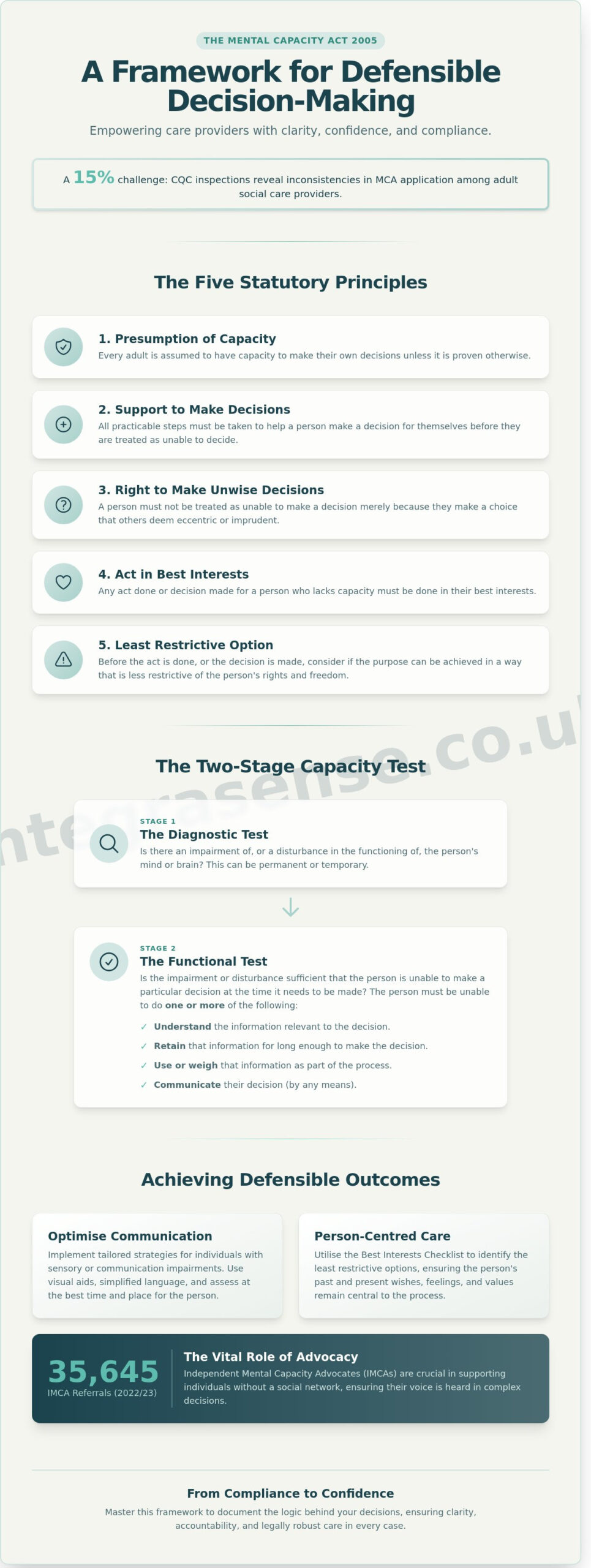
What if the most legally robust decision you make today isn’t the one that keeps a person “safe,” but the one that allows them the freedom to make a mistake? In 2023, Care Quality Commission inspections revealed that inconsistent application of the mental capacity act 2005 remains a significant challenge for 15% of adult social care providers. You likely feel the weight of this responsibility every time you face a complex communication barrier or a resident’s choice that seems inherently risky. It’s a high-stakes environment where the fear of legal repercussions often clouds professional judgement.
We’re here to replace that uncertainty with a framework of precision and quiet confidence. This guide empowers you to master the core principles of the Act, ensuring your care remains person-centred while your documentation stands up to the most rigorous scrutiny. You’ll gain a clear understanding of the five statutory principles, a repeatable method for the two-stage capacity test, and a structured approach to recording defensible decisions. We’ll show you how to make sense of complex individual needs and integrate them into a seamless, legally robust care strategy that protects both your residents and your professional standing.
Key Takeaways
- Master the core principles. Establish a robust foundation by applying the five statutory pillars of the mental capacity act 2005, beginning with the essential presumption of capacity.
- Conduct precise assessments. Navigate the two-stage diagnostic test to ensure your clinical findings are both accurate and legally defensible in complex scenarios.
- Optimise communication. Implement tailored strategies for individuals with sensory impairments, fulfilling the requirement to take all practicable steps before concluding a lack of capacity.
- Prioritise person-centred care. Utilise the Best Interests Checklist to identify the least restrictive options while maintaining full statutory compliance.
- Achieve defensible outcomes. Transition from mere compliance to a framework that documents the logic behind your decisions, ensuring clarity and accountability in every case.
The Five Core Principles of the Mental Capacity Act 2005
The Mental Capacity Act 2005 serves as the definitive statutory framework for England and Wales. It provides a structured methodology for balancing individual autonomy with the necessity of protection. Every professional engagement begins with the absolute presumption of capacity. This isn’t a mere guideline; it’s a legal requirement that protects the person’s right to lead their own life. We don’t assume a lack of ability based on age, appearance, or a specific medical condition. Instead, we seek to find the intelligence within every individual’s decision-making process.
Clarity in this field requires a commitment to five core principles:
- Presumption of capacity: Every adult has the right to make their own decisions unless proven otherwise.
- Support to make decisions: All practicable steps must be taken to help someone decide for themselves.
- Unwise decisions: A person isn’t treated as lacking capacity simply because their choice seems imprudent.
- Best interests: Any act or decision made for someone lacking capacity must be in their best interest.
- Least restrictive option: We must choose the path that interferes least with the person’s rights and freedoms.
Presumption of Capacity and the Right to Make Unwise Decisions
A clinical diagnosis isn’t a proxy for incapacity. Whether someone lives with dementia or a learning disability, the mental capacity act 2005 demands a functional assessment rather than a diagnostic one. In 2023, UK health regulators reiterated that labels shouldn’t dictate a person’s level of control over their life. We must distinguish between an eccentric or risky choice and a decision made without understanding. You might find a client’s plan to give away their life savings to a niche charity unconventional, but if they comprehend the consequences, the law protects that choice. Under the MCA 2005, capacity is decision-specific and time-specific, meaning it must be reassessed for every new choice.
The Duty to Support and Maximise Participation
The framework places a proactive duty on professionals to provide all practicable help. This isn’t a passive requirement; it’s an active process of optimisation. Timing and environment are critical. Assessing someone at 10:00 AM in their own living room often produces more reliable results than an assessment at 6:00 PM in a clinical ward. Using simplified language, visual aids, or involving familiar family members ensures the individual has the best chance to process information. Statistics from 2022/23 show that 35,645 IMCA referrals were made in England, highlighting the vital role of the Independent Mental Capacity Advocate. These advocates provide the necessary sensing and support when an individual lacks a social network to help them navigate complex life changes. This ensures the person’s voice remains the central intelligence of the entire process.
Conducting a Robust Mental Capacity Assessment
Precision is the cornerstone of any assessment. It starts by identifying a specific decision, such as a change in residence or a complex medical procedure. You must pinpoint why capacity is in doubt. The Mental Capacity Act 2005 full text requires a diagnostic test to confirm an impairment or disturbance in the brain’s functioning. This could be a permanent condition like dementia or a temporary state like acute delirium. Establishing a causative link is vital; the impairment must be the direct reason the individual cannot make that specific choice at that specific time.
Assessment goes beyond diagnosis. It focuses on the individual’s ability to process information. We call this the functional test. Practitioners must evaluate four distinct criteria to determine if the person can navigate the decision-making journey. The framework of the mental capacity act 2005 ensures that we don’t judge a person by their appearance or a single medical label, but by their actual cognitive performance in the moment.
The Two-Stage Functional Test in Detail
The functional test focuses on the mechanics of logic. It breaks down the cognitive process into four pillars. First, the individual must understand the information relevant to the decision. Second, they need to retain it. This retention doesn’t require long-term memory; it only needs to last through the decision-making window. Third, they must weigh the information as part of the process. Finally, they must communicate their choice. This includes non-verbal methods like blinking, British Sign Language, or the use of sophisticated communication software.
Documentation transforms a subjective opinion into a defensible decision. You should record the specific questions asked and the exact responses given. This level of detail ensures the assessment stands up to legal scrutiny in the Court of Protection. It’s about creating a transparent audit trail that demonstrates a diligent, person-centred approach. Every assessment should be a snapshot of a specific point in time, acknowledging that capacity can fluctuate.
When to Seek Specialist Professional Consultancy
High-stakes environments often present challenges that exceed standard protocols. When a decision involves assets over £100,000 or complex medical ethics, external validation becomes a necessity. Seeking IntegraSense professional consultancy services provides the governance required to mitigate risk. This external oversight ensures your processes remain resilient and compliant with evolving legal standards. Expert consultants offer a layer of quality assurance that protects both the individual and the organisation from the repercussions of a challenged assessment.
This methodical approach provides clarity in complex environments. By following these structured steps, you move away from uncertainty and towards an optimized, legally sound conclusion. A robust assessment is not just a form to be filled; it’s a vital tool for honouring individual autonomy while ensuring safety.
Supporting Decision-Making for Individuals with Sensory Impairments
Precision is the hallmark of a defensible assessment. When professionals overlook the specific communication needs of the Deafblind community, they risk a fundamental breach of the mental capacity act 2005. Standard verbal assessments frequently fail to meet the “practicable steps” threshold because they ignore the sensory barriers that prevent an individual from receiving and weighing information. It’s not enough to simply ask questions; the assessor must ensure the individual has the specialized tools required to process the data.
Failure to provide tailored support doesn’t just skew the results. It creates significant legal vulnerability for the local authority or healthcare provider. If an assessment is challenged in the Court of Protection, the first question a judge will ask is whether every possible step was taken to facilitate communication. Without documented evidence of specialist intervention, the assessment is likely to be deemed invalid, potentially leading to thousands of pounds in legal costs and a total loss of trust with the individual’s family.
Adapting Information for Complex Communication Needs
Visual aids and syntax-appropriate explanations are vital for the 151,000 BSL users in the UK. For those with dual sensory loss, haptic signals or tactile signing provide the necessary connectivity to the decision-making process. Establishing a robust baseline through a Care Act compliant deafblind assessment ensures that the individual’s environment is fully optimized. This proactive approach eliminates the noise of sensory deprivation, allowing the assessor to focus purely on the individual’s cognitive ability. By utilizing Braille or clear, high-contrast text, we remove the physical obstacles that often mask an individual’s true capacity.
The Role of Specialist Interpreters and Assessors
A standard interpreter might facilitate a basic conversation, but they often lack the specialized knowledge to navigate the nuances of a capacity test. Expert assessors who understand both sensory loss and the NHS guidance on the Mental Capacity Act act as a bridge to person-centred outcomes. This level of specialization is essential to avoid the legal pitfalls of a flawed assessment. Specialist support ensures the assessment is both resilient and legally robust, moving the process away from guesswork and towards verified intelligence. Using an expert who understands the mental capacity act 2005 ensures that the individual’s rights are protected while providing the assessor with a defensible, evidence-based conclusion. For practitioners working with individuals who have dual sensory loss, understanding how to integrate deafblind assessment and legal decision making in Kent into a compliant statutory framework provides essential guidance on meeting the specific evidentiary standards required by local authorities.
- Visual Aids: Essential for BSL users to bridge the gap between English syntax and sign language structure.
- Tactile Communication: Haptic signals provide real-time environmental context for Deafblind individuals during complex discussions.
- Documented Steps: Every adaptation must be recorded to prove compliance with the statutory duty to support decision-making.
Determining Best Interests and the Least Restrictive Option
Precision is paramount. When an assessment confirms a lack of capacity, the mental capacity act 2005 demands a rigorous adherence to the Best Interests Checklist to ensure every decision remains person-centred. This framework prevents clinicians and carers from making decisions based on what they would want for themselves. It forces a shift toward what the individual would choose if they could.
Practitioners must systematically evaluate all relevant circumstances. This includes the person’s past and present wishes, their core beliefs, and the values that shaped their life before capacity was lost. Consultation is a statutory requirement, not an optional courtesy. You must engage with family members, carers, and anyone holding a Lasting Power of Attorney (LPA) to build a complete profile of the individual’s identity.
Applying the Best Interests Framework
Decision-making requires a holistic view. Professionals must consider whether the individual might regain capacity in the future, perhaps through a change in medication or the resolution of a temporary infection. If the decision can wait, it should. Where disagreements arise, such as a conflict between a GP and a family member, formal mediation or an Independent Mental Capacity Advocate (IMCA) should be utilised to find a consensus. Statistics from the Office of the Public Guardian suggest that early intervention in disputes can reduce the need for costly legal proceedings by up to 40%.
Understanding the Least Restrictive Option
The law mandates that we choose the path that interferes least with a person’s basic rights and freedoms. If two options provide the same benefit, you must select the one that is less restrictive. For example, installing a £200 smart sensor to alert carers of a fall is often a superior, less restrictive alternative to placing a resident in a high-dependency unit with locked doors. This principle ensures that care remains proportionate to the risk identified.
This concept is intrinsically linked to the Deprivation of Liberty Safeguards (DoLS). Following the 2014 “acid test” ruling by the Supreme Court, any person who is under continuous supervision and is not free to leave is considered deprived of their liberty. If the proposed care plan meets these criteria, you must apply for a formal authorisation within 21 days to remain compliant with the mental capacity act 2005. For highly complex or disputed cases, such as those involving life-sustaining treatment or serious medical interventions, the Court of Protection remains the final arbiter to ensure legal and ethical integrity.
Optimise your compliance and care workflows by exploring our intelligent monitoring solutions designed for high-stakes environments.
Achieving Defensible Decision-Making in Complex Care Environments
Defensible decision-making transcends the binary of right or wrong. It requires a robust, chronological record of the reasoning process. Practitioners must demonstrate that they applied the principles of the mental capacity act 2005 with absolute precision. This involves balancing the Care Act 2014 mandate for personal wellbeing with the Human Rights Act’s protection of individual liberty. Compliance isn’t a static goal; it’s a continuous state of operational excellence. A decision is defensible when a third party can follow the logic from the initial assessment to the final outcome without finding gaps in the evidence or the application of the law.
Documentation and Evidence for Legal Scrutiny
A defensible report serves as a narrative of logic. It must detail the specific support provided to help the individual decide, the exact nature of the impairment, and the causal link between the two. Common pitfalls include using conclusory statements like “lacks capacity” without evidence or failing to consult relevant family members. In 2022/23, the Court of Protection saw a rise in challenges where documentation failed to prove that “all practicable steps” were taken. When internal records face scrutiny, an expert witness provides an objective lens to validate or challenge past capacity decisions based on statutory standards and clinical insight. This external validation ensures that decisions stand up to the highest levels of judicial review.
Strategic Risk Management for Local Authorities and Providers
Local authorities manage thousands of complex cases annually, with over 300,000 Deprivation of Liberty Safeguards applications recorded in England during the 2022/23 period. Implementing a governance framework ensures that every assessment meets a high threshold of quality. Professional supervision acts as a critical safety net for staff; it allows for the deconstruction of ethical dilemmas in a controlled environment. IntegraSense assists organisations in refining these processes. We move beyond basic compliance by integrating intelligent systems that track decision-making trends and highlight potential risks before they escalate into legal liabilities. This proactive approach fosters resilience and ensures that practitioners feel supported in high-stakes environments.
- Did you apply the five statutory principles of the mental capacity act 2005?
- Is there clear evidence of the “practicable steps” taken to support the individual in making their own decision?
- Have you identified both the “diagnostic” and “functional” elements of the capacity test?
- Does the “best interests” record include a balance sheet of risks and benefits, including the person’s past and present wishes?
- Have all relevant stakeholders, including family and independent advocates, been consulted and their views recorded?
- Is the chosen path the least restrictive option available to achieve the necessary outcome?
By prioritising transparency and logical consistency, care providers can move away from the chaotic and towards the optimised. This level of clarity protects the individual’s rights while safeguarding the organisation from the reputational and financial costs of legal failure. True intelligence in care management lies in the ability to make sense of complex data and transform it into a cohesive, defensible strategy. For practitioners seeking to strengthen their professional practice beyond mental capacity assessments, exploring defensible decision making social care methodologies provides essential frameworks for transparent, evidence-based documentation across all areas of social work practice.
Mastering the Path to Defensible Compliance
Upholding the 5 core principles of the mental capacity act 2005 isn’t just a statutory obligation; it’s a commitment to precision and human-centric care. Achieving a defensible decision requires a seamless blend of legal intelligence and clinical insight. You’ve seen how robust assessments must account for the least restrictive options and the nuanced needs of those with sensory impairments. When communication is complex, the margin for error disappears. Relying on a structured, methodical approach ensures that every determination stands up to the highest level of scrutiny in any UK court or tribunal.
IntegraSense provides the clarity needed to navigate these high-stakes environments. Our team was founded by practitioners with over 15 years of deep statutory experience, ensuring our guidance is rooted in real-world application. We offer specialist expertise in BSL and Deafblind communication alongside expert witness services that bring resilience to your professional practice. Our approach helps you make sense of complex evidence to integrate disparate clinical findings into a cohesive whole. Ensure your assessments are legally robust with IntegraSense Professional Consultancy. Let’s work together to transform chaotic compliance into an optimised, sustainable framework for your organisation. Your journey toward expert-led, defensible decision-making starts here.
Frequently Asked Questions
What are the 5 principles of the Mental Capacity Act 2005?
The five principles of the Mental Capacity Act 2005 provide a robust framework for ethical decision-making. These include the presumption of capacity, the requirement to provide all practicable support, and the right to make unwise decisions. Professionals must also act in the person’s best interests and select the least restrictive option possible. These statutory pillars ensure that 100% of assessments remain person-centred and legally compliant.
Who can carry out a mental capacity assessment?
Any person who proposes a specific action or decision can carry out a mental capacity assessment. For complex medical treatments, this is usually a doctor; for legal matters, a solicitor; and for daily care, a support worker or relative. The assessor must demonstrate they’ve followed the two-stage functional test to ensure the result is defensible. This decentralised approach ensures that decisions are made by those closest to the specific challenge.
Can someone have capacity for some things but not others?
Capacity is decision-specific, meaning an individual might have the intelligence to decide what to wear but lack the capacity to manage a £50,000 investment. The Mental Capacity Act 2005 requires assessors to evaluate each decision in isolation rather than applying a blanket status. This granular approach respects individual autonomy while providing a safety net where it’s truly required. It ensures that 100% of an individual’s remaining abilities are utilised and respected.
What happens if a person’s capacity fluctuates over time?
If a person’s capacity fluctuates, you should delay the decision until they regain the ability to choose, provided the matter isn’t urgent. Conditions like urinary tract infections can cause temporary cognitive decline in 30% of elderly patients, requiring a flexible assessment schedule. When a decision is time-sensitive, the assessment must reflect the person’s state at that exact moment. This ensures the process remains responsive to the fluid nature of human health.
What is the difference between a Lasting Power of Attorney and an IMCA?
A Lasting Power of Attorney (LPA) is a legal document where an individual proactively appoints a trusted person to make decisions on their behalf. In contrast, an Independent Mental Capacity Advocate (IMCA) is a statutory safeguard appointed when a person lacks capacity and has no family or friends to consult. While 6 million people in the UK have registered an LPA, the IMCA service provides a vital voice for those who are otherwise unrepresented.
How do you assess capacity if the person cannot speak or use BSL?
You must use all available communication methods, such as flashcards, digital aids, or blinking, to facilitate an assessment for someone who doesn’t use speech or BSL. The law mandates that you take all practicable steps to help the person communicate their choice before concluding they lack capacity. Specialists often use tailored toolkits to ensure that 100% of communication potential is explored. This commitment to connectivity ensures no individual is silenced by their physical limitations.
Can I be sued for making a decision in someone’s best interests?
Section 5 of the Act provides legal protection against liability, provided you reasonably believe the person lacks capacity and the action is in their best interests. You won’t be successfully sued if your decision-making process is documented, transparent, and adheres to the five core principles. This safe harbour provision allows professionals to act with confidence. It replaces uncertainty with a structured, defensible protocol that stands up to legal scrutiny.
What is the Court of Protection and when should it be used?
The Court of Protection is a specialist legal body that makes decisions for people who lack mental capacity. It should be used for complex disputes, such as disagreements over life-sustaining treatment or the sale of a £300,000 property. While most decisions are made locally, the Court provides a final resolution for the most challenging 5% of cases. It acts as the ultimate arbiter, ensuring that the most sensitive environments remain governed by law and logic.