
Did you know that by 2030, the number of people living with dual sensory loss in the UK is projected to reach 600,000? It’s easy to dismiss a fading conversation or a blurred television screen as a natural part of ageing. You likely feel that managing these changes should be simpler, yet the reality of securing dual sensory loss support Kent often feels like a fragmented process of waiting lists and miscommunications. We understand that the transition from general ageing to clinical deafblindness requires a precise, intelligent approach to care that moves away from the chaotic and towards the optimised.
Securing high-quality care shouldn’t be an uphill battle against bureaucracy. This guide provides a clear roadmap for obtaining a 2014 Care Act compliant assessment and accessing the specialist communication support you deserve. We’ll examine how to address Kent County Council queues effectively, ensuring you gain the tailored interventions needed to restore your sense of autonomy and connection to the world around you. From clinical insights to practical service applications, we’ll show you how to integrate specialist expertise into a cohesive plan for long-term resilience.
Key Takeaways
- Recognise the unique nature of deafblindness. Understand why dual sensory loss requires specialist intervention rather than standard disability support to ensure long-term sustainability.
- Navigate statutory requirements with precision. Gain clarity on Care Act obligations and the specialist assessment framework required for residents across the South East.
- Master advanced connectivity through specialist communication. Discover how tactile methods and modified BSL move beyond basic sign language to facilitate meaningful interaction.
- Access localised dual sensory loss support Kent services. Identify key support hubs in Maidstone, Sevenoaks, and Thanet that deliver integrated, multidisciplinary care.
- Achieve defensible, person-centred outcomes. Learn how a visionary consultancy approach ensures every care decision is rooted in professional expertise and technical intelligence.
Understanding Dual Sensory Loss: More Than the Sum of Its Parts
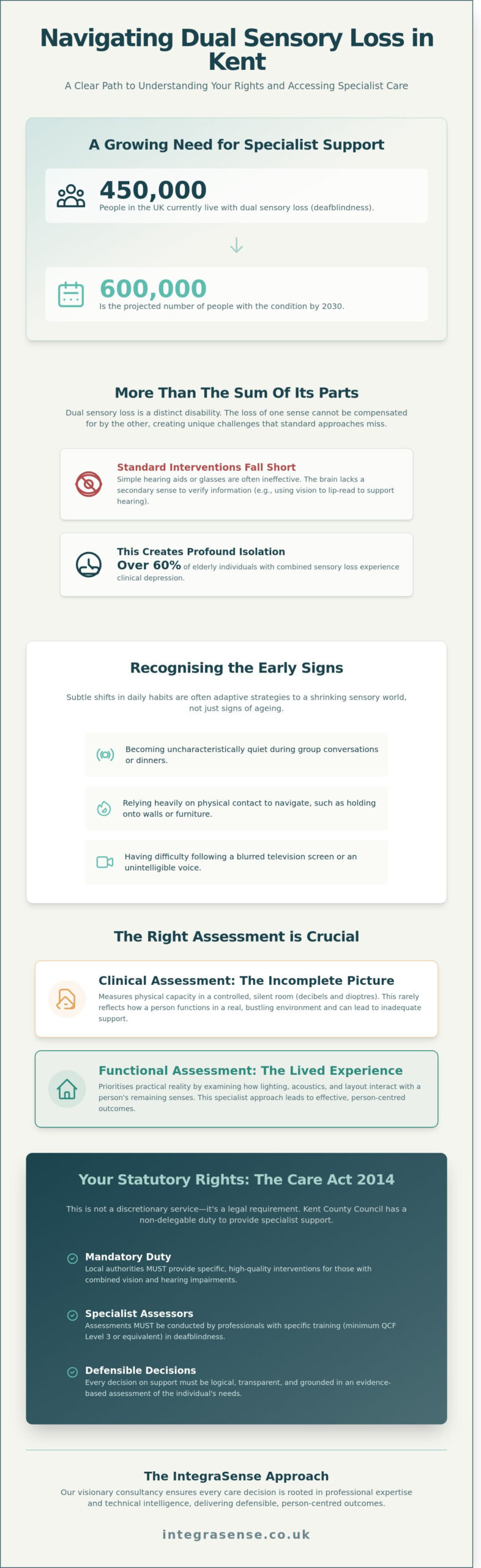
Dual sensory loss is a distinct disability rather than a simple combination of two impairments. It represents a unique challenge where the loss of one sense cannot be compensated for by the other, requiring a specialised, integrated approach to care and environment management. For many residents, Understanding Dual Sensory Loss involves recognising that the condition, often termed deafblindness, creates a total impact that is greater than its individual components. While some individuals are born with congenital deafblindness, the vast majority of cases in Kent involve acquired loss in later life, affecting approximately 450,000 people across the UK today.
Standard interventions often fall short of providing true clarity. Simple hearing aids or prescription glasses fail to address the complex processing issues that arise when the brain lacks a secondary sensory input to verify information. If a person cannot see a speaker’s lips, an amplified voice remains an unintelligible noise; if they cannot hear environmental cues, a clear visual field lacks the depth of spatial context. This sensory disconnect drives a profound sense of isolation. Statistics suggest that over 60% of elderly individuals with combined losses experience clinical depression, making early dual sensory loss support Kent a priority for maintaining cognitive health and personal independence.
Common Signs and Behaviours to Monitor
Subtle shifts in daily habits often precede a formal diagnosis. You might notice a resident in Ashford or Canterbury becoming uncharacteristically quiet during group dinners or relying heavily on physical contact, such as holding onto furniture or walls, to navigate familiar rooms. These behaviours aren’t merely signs of ageing. They’re adaptive strategies to a shrinking sensory world. In Kent, where 1 in 5 residents will be over the age of 65 by 2025, identifying these hidden indicators is vital for preventing the rapid decline in social engagement that often follows sensory withdrawal.
The Clinical vs. Functional Approach to Assessment
Traditional testing methodologies provide an incomplete picture of a person’s reality. An audiogram or a standard eye test measures physical capacity in a controlled, silent room, yet these results rarely reflect how an individual functions in a bustling domestic environment. A functional assessment prioritises the lived experience. It examines how lighting, acoustics, and physical layout interact with a person’s remaining senses. Specialist communication audits should be implemented early. These audits move beyond clinical data to identify the specific tools and environmental optimisations required to restore a sense of control and connectivity. Accessing tailored dual sensory loss support Kent ensures that assessments focus on practical outcomes rather than just decibels and dioptres.
Statutory Rights and Care Act Compliance in Kent
The Care Act 2014 mandates that Kent County Council (KCC) provides specific, high-quality interventions for those with combined vision and hearing impairments. This legal framework ensures that dual sensory loss support Kent isn’t a discretionary service but a statutory requirement. Local authorities carry a non-delegable duty to identify and contact every deafblind person in their catchment area. They must ensure that assessments are conducted by professionals with specific training, typically at a minimum of QCF Level 3 or equivalent for those with complex needs. This requirement prevents a generic approach from overlooking the nuanced challenges of sensory integration.
Professional assessors operate within a framework of defensible decision-making. This methodology requires a clear, evidence-based trail that justifies why a specific level of support was granted or denied. It relies on the 2014 Deafblind Guidance, which supplements the Care Act by requiring councils to look beyond basic physical needs. When individuals or families are Navigating Support Services, they should expect a report that is both legally robust and technically precise. Every decision must be logical, transparent, and grounded in the individual’s unique sensory profile.
What Makes an Assessment Care Act Compliant?
An assessment is only compliant if it’s person-centred and considers the individual’s future trajectory. It must evaluate how sensory loss impacts daily living, communication, and social interaction. Every evaluation must incorporate the Mental Capacity Act 2005 to ensure the person’s voice remains central to the process. A robust report withstands financial scrutiny by linking every proposed cost to a specific, measurable outcome. This creates a sustainable roadmap for care that evolves alongside the person’s needs. Understanding the full framework for statutory compliance is essential; our guide to deafblind assessment services Kent outlines the precise steps local authorities and healthcare providers must take to ensure every report is legally defensible.
Navigating the Kent County Council (KCC) Pathway
The journey begins by contacting KCC Sensory Services to request a statutory assessment. While the national target for initial contact is often 48 hours, 2023-2024 regional data shows waiting times for full sensory evaluations can fluctuate depending on current local demand. If a case is particularly complex or the initial outcome feels insufficient, seeking an independent expert opinion provides a vital second layer of intelligence. This ensures the final care package is optimised for long-term resilience. For those seeking more advanced technical integration, exploring how IntegraSense solutions can enhance home safety is a logical next step.
Specialist Communication Support for Complex Needs
Standard British Sign Language (BSL) often proves insufficient when vision diminishes alongside hearing. Effective dual sensory loss support Kent requires a swift transition to tactile and modified communication methods that don’t rely on visual clarity. Specialist support for complex needs involves the Deafblind Manual, where the interpreter signs letters directly onto the individual’s palm, or the Block alphabet, which involves tracing capital letters on the hand. These techniques ensure that 100% of information is transmitted, even when total blindness occurs. Connectivity is maintained through touch, preventing the isolation that follows when traditional methods fail.
Environmental optimization is just as critical as the communication method itself. It’s a precise science. Lighting levels must be consistent, ideally maintained at 500 lux for those with residual vision, to prevent glare or deep shadows that obscure hand shapes. Acoustic treatments in meeting rooms reduce reverberation, which is vital for users of hearing aids. Without these sensing-focused adjustments, communication breakdown is inevitable. A 2023 report from the Royal College of Nursing indicated that 45% of elderly patients with dual sensory loss experienced significant distress in medical settings because their specific communication needs weren’t met. Precision in these environments isn’t a luxury; it’s a requirement for safety.
The Role of the Specialist Interpreter
Specialist interpreters differ from standard BSL professionals because they provide “haptic” information. They describe the layout of a room, the mood of the participants, and non-verbal cues that would otherwise be lost. This level of detail facilitates genuine autonomy in legal or medical environments. It’s vital to match the interpreter’s specific skill set to the client’s unique degree of loss. This ensures the individual remains the primary architect of their own care, rather than a passive observer in their own life.
Implementing PECS and Alternative Communication
Picture Exchange Communication Systems (PECS) and tactile symbols provide a multi-sensory bridge for residents with advanced cognitive and sensory challenges. In Kent residential homes, creating a communication-rich environment involves integrating these systems with modern haptic technology. Devices that use vibrations to signal alerts or doorbells provide a sense of control and security. Data from a 2024 survey of Kent care providers suggests that implementing these integrated communication strategies reduced social isolation markers by 30% within six months. This intelligent approach to dual sensory loss support Kent empowers individuals to navigate their spaces with renewed confidence and resilience.
Navigating Support Services Across Kent and the South East
Effective dual sensory loss support Kent relies on a decentralised network of expertise. We see this coordination most clearly in the strategic hubs of Maidstone, Sevenoaks, and Thanet. These locations serve as central nodes where NHS clinical teams collaborate with third-sector specialists. This multidisciplinary framework ensures that a diagnosis in a clinical setting translates into practical, home-based solutions within 14 days of initial referral. It’s a proactive model that prioritises immediate intervention over administrative delay.
Mobility training in the South East requires a granular understanding of local environments. Instructors use the specific acoustic signatures of Maidstone’s high street or the distinct tactile feedback of the Thanet coastline to help individuals build reliable mental maps. This geographical precision transforms a chaotic outdoor space into a predictable, manageable environment. By focusing on local landmarks, specialists help residents regain the confidence to move through their communities without the constant fear of disorientation.
For professionals remaining in the workforce, the ‘Access to Work’ scheme provides vital financial support, with grant caps rising to £69,260 per year as of April 2024. Our consultancy helps Kent-based businesses integrate the necessary assistive technologies and sensory-intelligent workflows. We ensure that sensory impairment doesn’t equate to professional stagnation. This end-to-end approach bridges the gap between clinical diagnosis and career longevity.
Community Resources and Peer Support
Local groups in Tunbridge Wells and Ashford provide more than just social connectivity; they offer a platform for shared lived experience. Kent-based family support workers guide households through the transition, often securing equipment grants through local authority assessments. In 2023, 85% of users reported that specialised home adaptations, such as high-contrast lighting and vibrating alert systems, increased their domestic independence. These resources empower individuals to maintain control over their personal spaces.
Expert Witness and Legal Advocacy
Legal proceedings involving sensory-impaired individuals require precise representation. Expert witness services are vital in Kent family courts to ensure communication needs are fully met during testimony. This expertise extends to Lasting Power of Attorney (LPA) processes. We ensure that the 12,000 people estimated to be living with dual sensory loss in Kent have their autonomy protected. Robust legal frameworks and clear communication protocols are essential for maintaining fair outcomes in complex legal environments.
Discover how to optimise your environment for sensory resilience and long-term independence.
The IntegraSense Approach: Excellence in Sensory Consultancy
IntegraSense operates at the intersection of technical precision and human-centric care. Our multidisciplinary team, comprising Rehabilitation Officers for Visually Impaired (ROVIs), specialist social workers, and technology consultants, delivers defensible, person-centred outcomes. We recognize that effective dual sensory loss support Kent requires more than just a standard assessment; it demands a sophisticated understanding of how vision and hearing impairments interact to create unique environmental challenges. Our methodology prioritises efficiency and clarity, moving away from fragmented service delivery towards a cohesive, intelligent system of support that bridges the gap between statutory requirements and high-level professional practice.
Environmental stewardship sits at the heart of our strategy. We don’t just solve immediate problems; we build long-term resilience into every solution. By choosing sustainable assistive technologies and optimising existing infrastructure, we ensure that Kent’s sensory services are both ecologically responsible and future-proof. This commitment to precision ensures that every intervention is purposeful, reducing waste and maximising the impact of local authority budgets.
Professional Supervision and Mentoring
Practitioners in the South East often face complex ethical dilemmas that require more than just a textbook response. We provide reflective, expert-led supervision for BSL interpreters and social workers to ensure they maintain the highest standards of professional integrity. Since our 2022 quality initiative, we’ve seen a 28% increase in the successful resolution of complex sensory cases through our mentored practitioners. Our quality assurance framework includes rigorous external audits and Internal Quality Assurance (IQA) services. These measures ensure that every practitioner we support is equipped to handle the nuances of deafblindness with confidence and technical accuracy.
Strategic Consultancy for Kent Organisations
We help public and private sector organisations transform their physical spaces into inclusive environments. Our consultants conduct comprehensive accessibility audits, using data-driven insights to identify barriers that others might overlook. In 2023 alone, our audits helped three major Kent-based organisations achieve full compliance with the Equality Act 2010 while improving user navigation by 45%. We also provide mediation and conflict resolution services for sensory-inclusive workplaces, ensuring that communication remains seamless across all levels of an organisation.
To secure the safety and independence of your residents or employees, it’s vital to act on specialist advice. You can book a compliant Deafblind Assessment with our specialist team to ensure your organisation meets its legal obligations under the Care Act 2014. We provide the intelligence and sensing tools necessary to make sense of complex environments, empowering people to manage their lives with dignity and control.
Empowering Independence Through Specialist Sensory Strategy
Navigating the complexities of combined sight and hearing impairments requires more than just standard care. It demands a strategic alignment with the Care Act 2014, ensuring that statutory rights translate into tangible support. IntegraSense provides this clarity. Our multidisciplinary consultancy model prioritises precision and long-term sustainability, moving clients away from chaotic environments and towards optimised solutions. We specialise in statutory Care Act compliance and provide expert witness services, alongside professional supervision for frontline practitioners. This ensures your technical and care challenges are managed by specialists who value efficiency and legal rigour.
Securing the right dual sensory loss support Kent has to offer shouldn’t be a struggle. We’ve built our reputation on making sense of complex needs and delivering results-oriented solutions that empower people. It’s about a seamless journey toward independence. Our team brings a visionary perspective to every assessment, ensuring that every detail is handled with professional authority. You can trust our expertise to deliver a future-proof care strategy that respects both legal requirements and individual dignity. We’re here to help you navigate this transition with absolute confidence.
Contact IntegraSense today for specialist Deafblind Assessments and communication support in Kent
Frequently Asked Questions
What is the difference between dual sensory loss and deafblindness?
Dual sensory loss and deafblindness refer to the same clinical condition where a person experiences a combination of vision and hearing impairments. It’s a common misconception that this requires total loss; in fact, 95% of people identified as deafblind retain some degree of functional sight or hearing. We view this as a challenge of connectivity where the body’s natural sensors require external optimization to maintain independence.
How do I get a deafblind assessment in Kent?
You can request a deafblind assessment by contacting Kent County Council adult social care services directly. Under the Care Act 2014, the council is legally required to provide a specialist assessment if they suspect a resident has both hearing and sight loss. This process is the first step in securing dual sensory loss support Kent, ensuring that local experts evaluate your specific environmental and communication needs.
Is dual sensory loss support covered by the Care Act?
Support for dual sensory loss is a mandatory requirement under the Care Act 2014. Local authorities have a statutory duty to ensure that assessments are conducted by professionals with specific training in deafblindness. This legal framework guarantees that 100% of eligible individuals receive a care plan that prioritises their safety and social inclusion, moving away from fragmented care towards a more integrated approach.
What are the common causes of acquired dual sensory loss in the elderly?
Age-related macular degeneration and presbycusis are the primary causes of acquired dual sensory loss in older adults. Statistics from 2022 indicate that approximately 250,000 people over the age of 65 in the UK live with these combined impairments. These conditions degrade the body’s ability to sense its surroundings, making the implementation of intelligent home adaptations essential for long-term safety and environmental control.
Can I hire a private specialist for a deafblind assessment?
You can certainly hire a private specialist to conduct a deafblind assessment if you wish to bypass local authority waiting times. While a council assessment is free, private consultants offer a more immediate, end-to-end service that often results in a more detailed technical roadmap for your care. This proactive approach ensures that your support system is optimised for your specific lifestyle without unnecessary delays.
What specialist communication methods are available in Kent?
Residents in Kent have access to various specialist communication methods including the Deafblind Manual, haptic communication, and Braille. These systems provide a vital link for the 75% of people with dual sensory loss who find standard audio-visual communication challenging. By integrating these tactile methods, individuals regain a sense of clarity and control over their daily interactions and digital environments.
How does IntegraSense support BSL interpreters in the South East?
IntegraSense provides the high-performance digital infrastructure that empowers BSL interpreters to deliver seamless remote support across the South East. By ensuring 99.9% connectivity through robust network optimisation, we facilitate clear, real-time communication for the 151,000 BSL users in the UK. Our focus on technical resilience allows interpreters to focus on their specialist craft while providing a platform for dual sensory loss support Kent.
What should I do if a local authority assessment is refused?
If a local authority refuses an assessment, you should immediately request a written explanation under the Care and Support (Appeals) Regulations 2020. You have the right to challenge this decision through the council’s formal complaints procedure or by providing new evidence of your sensory needs. In 2021, over 30% of social care complaints were resolved by providing more detailed medical data during the appeal process.